COVID-19 UPDATE


Important Notice:Beware of scams using ASOWorld's name for part-time recruitment or ASO earning app activities. ASOWorld is not hiring any part-time staff. Trust only official information posted by ASOWorld.

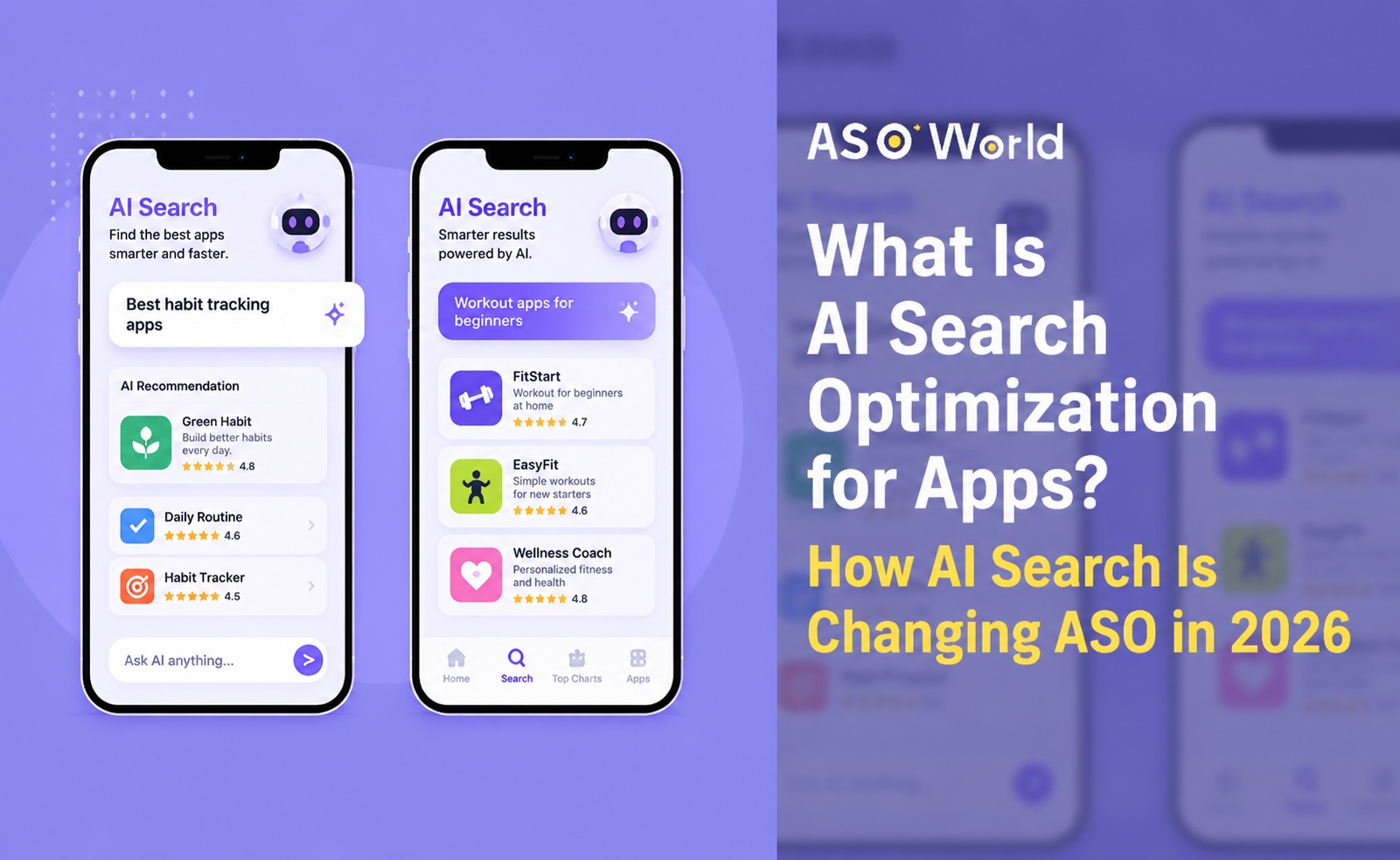
For years, App Store Optimization mainly meant improving keyword rankings inside the App Store and Google Play. Developers optimized titles, subtitles, descriptions, screenshots, ratings, and installs to win more visibility when users searched inside the store.
In 2026, that discovery journey is changing.
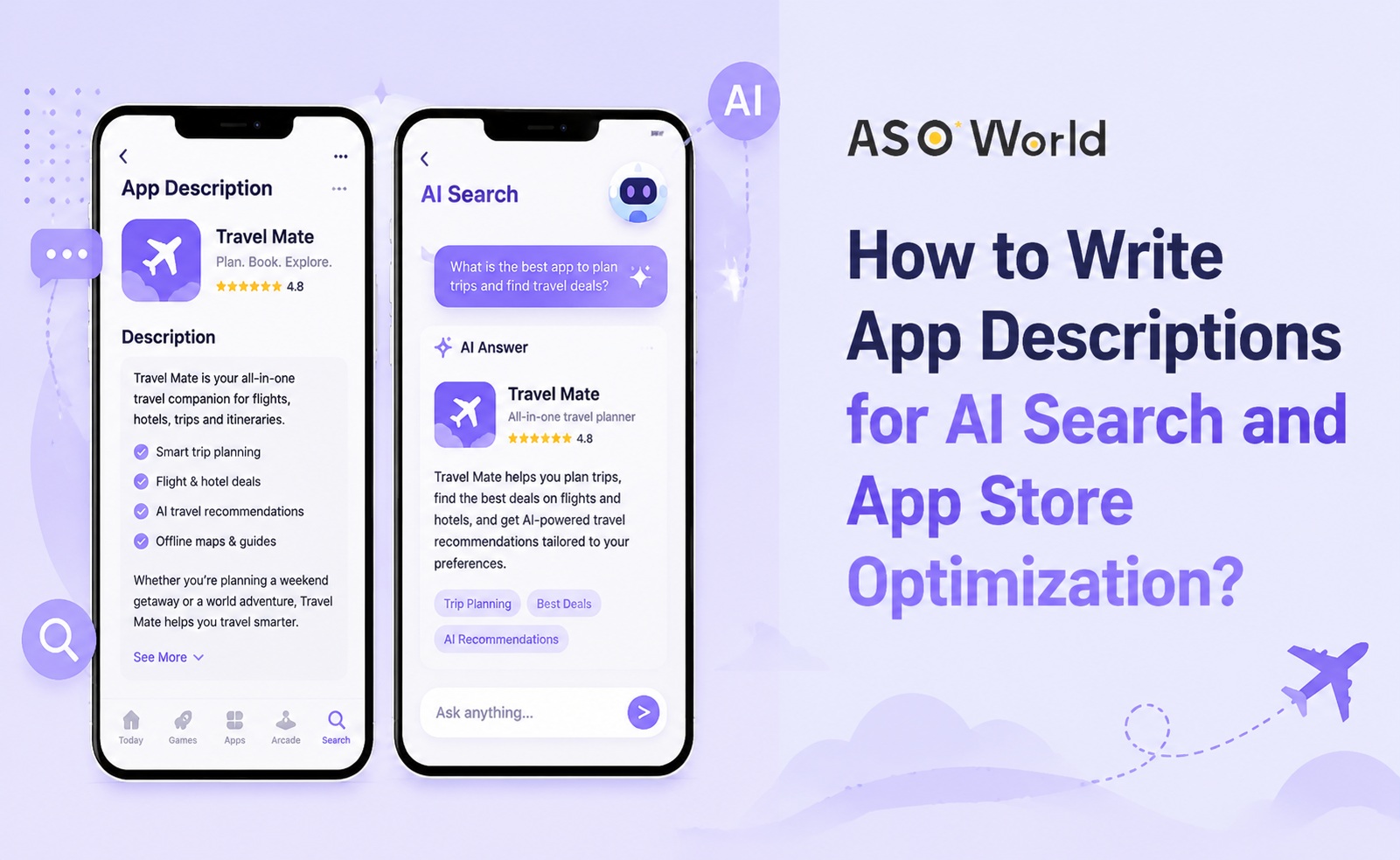
More users now ask AI assistants such as ChatGPT, Gemini, Perplexity, or Google AI-powered search to recommend apps before they ever open an app store. Instead of typing “budget app” or “fitness tracker” directly into the App Store, they may ask:
Key idea: This creates a new discovery layer before traditional app store search. ASO is no longer only about ranking for short keywords inside the store. It is also about making your app understandable, trustworthy, and recommendable across AI-driven discovery environments.
AI Search Optimization for apps is the process of improving your app’s public information so AI systems can better understand what your app does, who it is for, why it is useful, and when it should be recommended.
Traditional ASO focuses on store ranking factors such as:
AI Search Optimization builds on those same foundations, but expands the goal. Your app listing should not only persuade store users. It should also help AI systems classify your app correctly and match it with high-intent user needs.
If your app store listing is vague, outdated, thin, or poorly structured, AI systems may struggle to understand where your app fits. If your app has clear metadata, strong descriptions, consistent reviews, and a wider web presence, it becomes easier for AI-powered search systems to associate your app with the right use cases.
For a deeper view of how AI is expanding app discovery beyond the app stores, read ASOWorld’s related analysis: Beyond ASO: How to Get Your App Recommended by AI.
Recent industry reports indicate that AI apps have grown rapidly in recent years, and app discovery is becoming more competitive. The data also highlights a critical shift: users increasingly describe their needs to AI assistants and receive app recommendations before visiting the App Store or Google Play.
That means app discovery now happens across two connected surfaces:
This does not replace ASO. It makes ASO more important.
Why? Because AI systems still need reliable information to understand and recommend apps. App store listings, descriptions, ratings, reviews, and indexed web content all help shape how an app is interpreted.
ASOWorld has also observed a similar shift in seasonal and long-tail keyword behavior. Users are searching with more specific, intent-rich phrases, and AI search is accelerating that trend. You can learn more from ASOWorld’s 2026 keyword trend breakdown: Summer 2026 App Store Trends & the Long-Tail Keyword Shift.
AI assistants do not simply return a list of keyword-matched results. They interpret user intent, compare possible options, and generate recommendations based on available information.
For app marketers, this changes the optimization mindset.
In traditional ASO, a user may search for “meditation app.” In AI search, the same user may ask, “What meditation app is best for beginners who need short daily sessions?”
This means your app listing should communicate:
If your app description only lists generic features, AI systems may not understand your strongest use cases. For example, “task management app” is broad. “A task planner for remote teams managing recurring workflows” is clearer and easier to match with user intent.
AI-generated answers often try to provide reliable recommendations. Apps with stronger public trust signals, such as positive reviews, high ratings, and consistent user feedback, may be easier to position as credible options.
Your app store listing is still essential, but AI systems may also rely on crawlable web pages, review articles, category pages, comparison guides, and product explainers. A strong ASO strategy should therefore connect store optimization with broader content visibility.
ASOWorld First Order Discount
Get 50% off on your first order to start your app growth!
AI Search Optimization does not require abandoning traditional ASO. Instead, it requires upgrading each ASO element so it is more semantically clear, user-focused, and conversion-oriented.
Your title and subtitle should clearly communicate your app’s main function and positioning. Avoid keyword stuffing. Instead, combine relevance with clarity.
For example:
The second version is easier for both users and AI systems to understand.
Your app description is one of the most important assets for AI Search Optimization. It should explain what the app does, who it helps, and why it is useful.
A strong AI-ready app description should include:
If your Android app depends heavily on Google Play search visibility, ASOWorld’s guide on how to optimize your Google Play description is a useful starting point.
AI search pushes users toward more conversational queries. This makes long-tail keywords more valuable. Instead of only targeting broad keywords like “fitness app,” growth teams should also consider phrases such as:
These phrases are more specific, but they often reveal stronger user intent.
To build a stronger keyword foundation, read ASOWorld’s guide on keyword research and keyword optimization.
Ratings and reviews influence user trust, store conversion, and app visibility. They also provide natural language signals about what users value or complain about.
For AI Search Optimization, reviews can help reinforce:
An app with unclear metadata and weak reviews sends fewer useful signals. An app with clear positioning and consistent positive feedback is easier to understand and recommend.
Market data indicates that screenshots are among the most frequently refreshed metadata elements for top apps. This matters because screenshots directly influence conversion after users land on the product page.
AI may help users decide which app to consider, but your screenshots, icon, and preview video still need to convert that interest into installs.
Use the following framework to update your app listing for both traditional ASO and AI-powered discovery.
Before optimizing keywords, define the app’s core positioning:
“Our app helps [target user] achieve [main outcome] through [key feature or method].”
Example:
“Our app helps busy professionals build consistent workout habits through personalized 15-minute training plans.”
This sentence can guide your title, subtitle, short description, full description, and content strategy.
AI search is problem-driven. Users ask for solutions, not just categories. Build a list of user problems your app solves.
| User Problem | AI Search Query Example | ASO Content Angle |
|---|---|---|
| Hard to stay productive | Best productivity app for remote workers | Remote work planning, task management, focus tools |
| Need better budgeting | Budgeting app for couples | Shared budgets, expense tracking, financial goals |
| Want quick workouts | Workout app for busy beginners | Short workouts, beginner plans, habit building |
Many app descriptions are feature lists. AI-ready descriptions should connect features to outcomes.
Instead of writing:
“Includes calendar, reminders, notes, and task lists.”
Write:
“Plan your week, set reminders, capture notes, and manage tasks in one place so you can stay organized without switching between multiple productivity tools.”
The second version gives both users and AI systems more context.
Use a mix of:
If you need to evaluate keyword opportunities, ASOWorld's ASO keyword ranking tools can help you review keyword coverage, ranking movement, and search visibility opportunities.
If your metadata says your app is built for “busy professionals,” your screenshots should show that use case. If your description emphasizes “AI-powered writing,” your screenshots should clearly show AI writing workflows.
Metadata and creative assets should tell the same story.
AI systems often need richer context than a store listing can provide. Consider building supporting content such as:
This helps your app build a stronger semantic footprint across the web.
Use this checklist to evaluate whether your app listing is ready for AI-powered discovery.
AI Search Optimization is not a single tactic. It requires a connected ASO system that includes metadata, keywords, creative assets, reviews, ratings, and install growth.
ASOWorld can support this process across several stages:
If your app listing has weak metadata, outdated screenshots, or unclear positioning, start with a complete ASO listing update. ASOWorld's App Store Optimization service can help improve titles, subtitles, descriptions, icons, screenshots, promo graphics, and preview videos depending on your selected plan.
If your app already receives some impressions but does not rank for enough high-intent terms, keyword expansion and ranking monitoring should be the next step.
Once your listing is clear and keyword strategy is defined, targeted campaigns can help support ranking improvement. For apps that need search ranking growth around specific terms, ASOWorld's Keyword Installs service can help connect user acquisition with keyword visibility goals.
AI search, app store ranking, and user behavior will continue to evolve. Growth teams should treat ASO as an ongoing system, not a one-time update. Regular keyword audits, metadata refreshes, creative testing, and review management are now essential.
AI search is not replacing App Store Optimization. It is expanding the surface area of app discovery.
In 2026, the apps that win organic visibility will not only rank for keywords. They will also be easier for AI systems to understand, easier for users to trust, and easier for app stores to classify correctly.
That means your ASO strategy should answer three questions:
If the answer to any of these questions is unclear, your app may be missing future discovery opportunities.
Start by auditing your app title, subtitle, description, keywords, screenshots, ratings, and reviews. Then connect those improvements with a clear growth campaign.
Get a good start for your app optimization with practical ASO guideline!
Want to get the latest Guides & Insights from ASOWorld?
Related posts