COVID-19 UPDATE


Important Notice:Beware of scams using ASOWorld's name for part-time recruitment or ASO earning app activities. ASOWorld is not hiring any part-time staff. Trust only official information posted by ASOWorld.


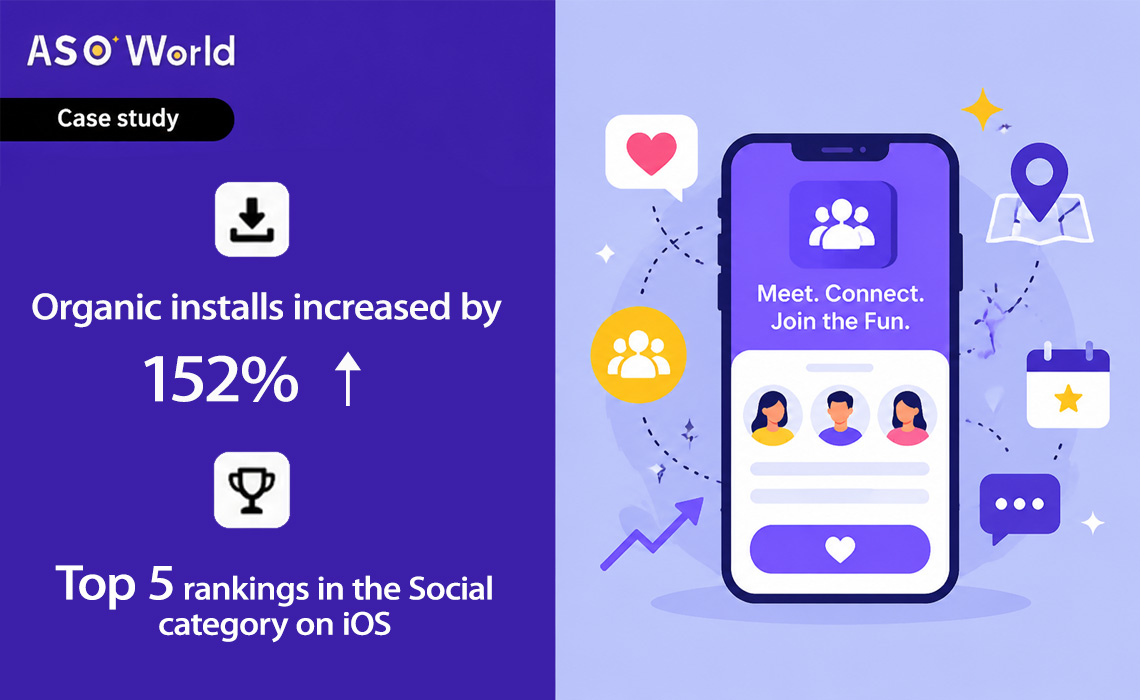
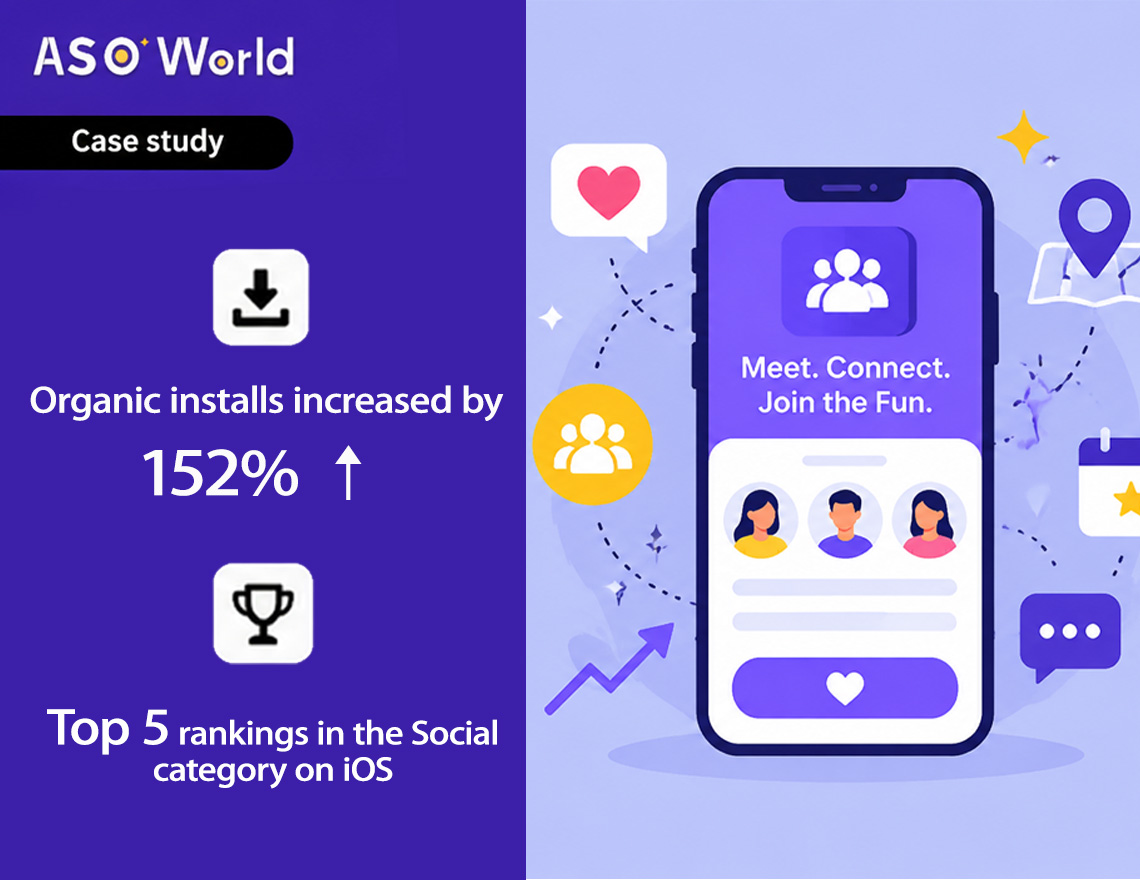
Summer is a make-or-break season for social apps. Demand for travel plans, social events, and meeting new people spikes dramatically. But here's the catch — that traffic won't wait for your app to be ready. As we highlighted in our earlier analysis of how seasonal events create large-scale app install opportunities, timing is everything.
By the time you notice a traffic surge, the window of opportunity may already be closing. Today, we're sharing a case study of how we helped one social app prepare for and capitalise on the summer season ahead of time — turning what could have been a missed opportunity into their strongest growth period yet.
Our client is a mid-stage social networking app designed to help young adults (aged 18–30) connect offline through interest-based groups and local events. The app had gained some traction in its first year, reaching around 50,000 downloads, but growth had since plateaued. Keyword visibility was limited, and the app had virtually no presence on high-value generic terms such as "meet new people," "social events near me," and "group activities."
Social Networking
United States (primary), United Kingdom and Australia (secondary).
The client came to us in early May with a clear but urgent problem. Despite strong retention metrics and positive user feedback, the app was generating almost no organic traffic from App Store search. They had attempted some basic ASO work on their own — adjusting metadata and selecting keywords they assumed were relevant — but after months of waiting, rankings hadn't moved in any meaningful way. This is a common pattern for apps that haven't yet implemented an effective keyword research methodology.
Several factors made the situation particularly pressing:
1. Summer was fast approaching. For social apps, the June–August window represents the single highest-demand cycle of the year. Users actively search for new friends to join events and socialise with throughout the summer. Failing to resolve their visibility problem by late May meant missing the peak season entirely. As we covered in our Summer ASO Strategy Guide, preparation needs to begin at least several weeks before target traffic peaks.
2. Rankings were stuck. The app was sitting outside the top 50 for most of its target keywords. With no ranking signals, there was no organic traffic — and without traffic data to analyse, there was no basis for deciding which keywords to prioritise. It was a classic invisible loop.
3. Fierce industry competition. Social networking is a market where established players have built years of ranking authority. What the client needed wasn't a slow, incremental climb — they needed an aggressive strategy capable of generating rapid ranking signals and shifting the competitive landscape. That required a thorough competitor analysis to identify exploitable gaps.
4. Budget constraints. As an app in its early growth phase, every dollar spent needed to produce measurable results. There was no room for wasted spend on keywords that wouldn't convert — the focus had to be on the high-intent terms most likely to drive genuine installs and meaningful ranking improvements.
Ultimately, the client engaged ASOWorld to plan and execute a seasonally targeted ASO campaign capable of delivering tangible improvements before the summer traffic peak arrived.
ASOWorld's core approach follows a structured four-stage framework: Diagnose → Customise Strategy → Allocate Targets & Resources → Track, Iterate & Refine. The goal was to move the client's app from near-invisible to competitive as efficiently as possible — placing it in front of users actively searching in one of the App Store's most contested categories.
Before placing a single order, we ran a thorough diagnostic using ASOWorld's proprietary competitor monitoring and keyword research tools. Rather than guessing which keywords might work, we used real data to map what competing apps were already ranking for — and, more importantly, where meaningful gaps still existed.
Key findings from the diagnostic:
Based on this data, we proposed a dual-track strategy:
💡 Expert Insight: Many social app developers fixate on high-volume macro keywords like "chat" or "social network" — terms where only apps with years of established authority can realistically compete. The smarter play is to build ranking credibility through more targeted mid-tail and seasonal keywords first, then expand into broader, higher-competition terms once growth momentum is established.
Most apps are distributed across both the iOS App Store and Google Play, but the two platforms rank apps using fundamentally different algorithmic signals. We designed separate optimisation strategies for each. For a detailed breakdown, see our official iOS vs. Google Play Keyword Strategy Guide.
iOS Strategy: Sustained, Consistent Keyword Install Velocity
The Apple App Store is highly responsive to install velocity — rankings can rise quickly when momentum builds, but they can also drop just as fast if that momentum stalls. For the competitive US market, our approach was as follows:
Google Play Strategy: A Longer-Cycle Approach Combined with CPI
Google Play's ranking algorithm operates on a slightly different cadence, weighing not just install velocity but also factors such as active retention and in-app engagement. Our approach for this platform was:
💡 Expert Insight: For social apps on Google Play, combining CPI campaigns with targeted keyword installs is one of the highest-ROI approaches in our toolkit. The CPI volume provides scale signals that reinforce keyword-level precision targeting, creating a compounding ranking effect that would be difficult to replicate using keyword installs alone.
Once the target keyword list was finalised and the platform strategies were set, the next challenge was operational: managing a campaign that spanned 20+ individual keywords across two platforms, each with its own daily volume requirements and scheduling logic.
This is where ASOWorld's Keyword Ordering Module proved its value. Rather than manually entering individual keywords, dates, and volumes one by one, we used the platform's batch planning features to map out the entire 8-week campaign structure in a single session — a process that would otherwise have taken hours.
How we used the platform's tools in practice:
💡 Expert Insight: The batch planning functionality within ASOWorld's ordering system is one of the platform's most underutilised features. For broad-scale campaigns like this one — targeting multiple keywords across multiple platforms simultaneously — it's not just a convenience tool. It's what makes consistent, well-structured campaign execution genuinely achievable, and that consistency is one of the most reliable drivers of sustained ranking improvement.
A keyword install campaign is not a set-and-forget exercise. In a peak seasonal window where the competitive landscape shifts daily, the ability to act on live performance data is just as important as the initial strategy.
ASOWorld's keyword ranking tracking dashboard gave us two particularly valuable capabilities throughout the campaign:
Integrated order and ranking data in a single view: Rather than cross-referencing a separate order history panel against ranking graphs in another tab, the dashboard overlays both data streams in one place. For each target keyword, we could see exactly how much install volume had been delivered on any given day, alongside the corresponding movement in that keyword's ranking — all on the same timeline. This made it immediately clear which keywords were responding strongly to spend and which were not.
Daily volume visualisation: Install volumes are displayed as bar charts alongside ranking curves, making it easy to correlate specific volume injections with ranking responses. On one occasion, a deliberate volume increase on the keyword "summer events" was followed by a sharp ranking jump the very next day — a clear, visible confirmation of the strategy working in real time. This kind of immediate feedback loop was central to how we made budget allocation decisions throughout the campaign.
Key mid-campaign adjustments made:
Categories