COVID-19 UPDATE


Important Notice:Beware of scams using ASOWorld's name for part-time recruitment or ASO earning app activities. ASOWorld is not hiring any part-time staff. Trust only official information posted by ASOWorld.


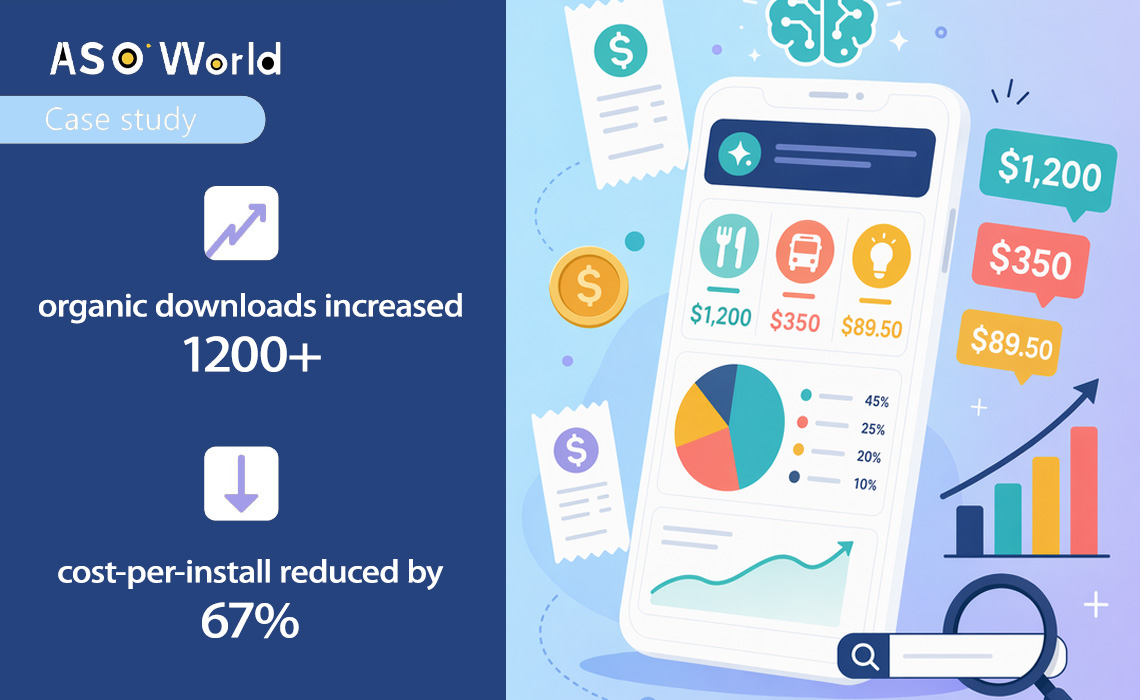
The client is a solo developer who built an AI bookkeeping app designed for freelancers and small business owners. The app uses AI to auto-categorize expenses from bank statements, generate tax-ready reports, and provide spending insights — solving a real pain point for users who find traditional accounting apps overly complex.
After three months of development, the app launched on the iOS App Store with solid fundamentals: clean UI, a 4.7-star rating from beta testers, and a freemium model. But after the first two weeks live, the app had accumulated only 83 total downloads — almost all from the developer's personal network.
United States
iOS App Store
The AI bookkeeping and expense tracking space is increasingly competitive. Established players like Mint, YNAB, QuickBooks Self-Employed, and newer AI-native tools dominate the top search results. For a brand-new app with no download history, breaking into these rankings organically is nearly impossible without a deliberate strategy.
The developer faced three specific problems:
1. The app was invisible in App Store search.
Searching for "AI bookkeeping," "expense tracker AI," or "smart bookkeeping app" returned zero results for the app — it didn't appear anywhere in the top 200. Potential users actively looking for this exact type of tool simply could not find it. This is the most common growth blocker for newly launched bussiness apps that haven't done keyword research.
2. Metadata was underutilized.
The app title contained only the brand name — no descriptive keywords. The subtitle and iOS keyword field were filled with broad, high-competition terms like "bookkeeping" and "finance" that a zero-download app had no chance of ranking for. The developer hadn't followed any metadata optimization best practices.
3. Paid ads burned budget with no organic spillover.
The developer spent $800 on Meta Ads in the first two weeks, generating 74 installs at approximately $10.80 CPI. Worse, these paid installs did nothing to improve App Store search rankings because they came from external deeplinks — not from App Store search queries. The difference between external traffic and search-driven installs is critical for new apps.
Rather than spreading a limited budget across multiple channels, the developer chose to focus entirely on one growth lever: keyword search visibility. The logic was straightforward — over 65% of app downloads originate from a search query. If the app could appear in search results for the right keywords, organic downloads would follow.
The developer partnered with ASOWorld's keyword installs service and followed a three-phase approach over 7 days.
Before launching any install campaigns, the developer completely overhauled the app's metadata based on competitive keyword analysis.
Using ASOWorld's free ASO tools and FoxData's keyword explorer, the developer:
| Keyword Tier | Example Keywords | Search Volume | Competition | Targeting Phase |
|---|---|---|---|---|
| Tier 1 (Long-tail) | "AI bookkeeping app," "smart expense tracker," "auto expense categorizer," "AI receipt scanner free" | Moderate | Low | Days 1–4 |
| Tier 2 (Mid-tail) | "expense tracker AI," "bookkeeping app for freelancers," "AI finance app" | Higher | Moderate | Days 5–7 |
| Tier 3 (Head terms) | "bookkeeping app," "expense tracker," "AI accounting" | Highest | Very High | Future phases |
The metadata rewrite results:
⚡ Expert Tips
With metadata optimized, the developer launched keyword install campaigns through ASOWorld, targeting exclusively Tier 1 long-tail keywords.
The strategy was deliberate: new apps have zero keyword authority in the store algorithm. Competing for head terms like "bookkeeping app" on day one is futile — those positions are occupied by apps with millions of downloads. But long-tail keywords like "AI bookkeeping app" and "smart expense tracker" have meaningful search volume with far fewer competitors, making it possible to crack the top 10 quickly.
Why long-tail first:
Key execution details:
| Metric | Before Campaign (Day 0) | After Phase 2 (Day 4) | Change |
|---|---|---|---|
| Keywords in Top 10 | 0 | 6 | +6 |
| Keywords in Top 5 | 0 | 3 | +3 |
| Daily Organic Impressions | ~20 | ~350 | +1,650% |
| Daily Organic Downloads | ~6 | ~80 | +1,233% |
With ranking authority established on long-tail terms, the developer shifted a portion of the budget to Tier 2 mid-tail keywords while maintaining volume on the best-performing Tier 1 terms.
⚡ Expert Tips
| Metric | Day 0 (Pre-Campaign) | Day 7 (End of Campaign) | Total Change |
|---|---|---|---|
| Total Organic Downloads (7-day) | ~42 | 1,200+ | +2,757% |
| Daily Organic Downloads | ~6/day | 170–200/day | +2,733% |
| Keywords Ranked Top 10 | 0 | 9 | +9 |
| App Store Search Impressions | ~20/day | ~500/day | +4.2x |
| Effective CPI | $10.80 (Meta Ads) | $3.56 (keyword installs) | -67% |
This case study demonstrates a replicable pattern for any newly launched bussiness, finance, or productivity app facing the cold-start problem:
1. Don't waste the launch window on paid ads alone.
External traffic from Meta or Google Ads does not build App Store search authority. The installs arrive via deeplinks, not search queries — so the algorithm doesn't credit them toward keyword rankings. For new apps, keyword-driven installs are the fastest path to organic visibility.
2. Start with long-tail keywords, not head terms.
A new app cannot compete with Mint or YNAB on "expense tracker." But it can rank for "AI bookkeeping app free" within days — and that momentum compounds as the algorithm recognizes the app's growing relevance in the category.
3. Metadata is the foundation — optimize it before spending on acquisition.
No keyword campaign will produce results if the app's title, subtitle, and keyword field don't contain the target terms. Metadata optimization is step zero, not an afterthought.
4. Seven days is enough to validate and break the cold start.
This developer did not need a 3-month engagement to see results. A focused, one-week keyword campaign with disciplined targeting was sufficient to establish organic download momentum and prove the app's market viability.
Ready to get your productivity app found in search? Start with ASOWorld's Keyword Installs or explore the Guaranteed Keyword Ranking Service for top-10 placement on your most important keywords.
ASO World Keyword Optimization
Boost your app visibility in the App Store & Google Play search result!
For long-tail keywords with low competition, a new app can achieve top-10 rankings within 3–5 days using a combination of optimized metadata and targeted keyword install campaigns. Head terms with high competition typically require sustained effort over several weeks.
Keyword installs are driven through App Store search — users search for a specific keyword and download the app from the search results. This sends ranking signals to the algorithm that directly improve keyword positions. Regular paid installs from external ads (Meta, Google) bring users via deeplinks and do not contribute to App Store search rankings.
Budget varies by market and competition level. In this case, the developer's 7-day keyword campaign cost significantly less than the $800 previously spent on Meta Ads — while generating over 16x more organic downloads. A customized ASO plan can help determine the right budget based on your specific category and target keywords.
It depends on where your target users are. This case focused on iOS because the developer's core audience (U.S. freelancers) indexed higher on iPhone. However, the same keyword-first strategy applies to Google Play — Google Play's ranking algorithm also heavily weighs keyword relevance and install velocity.
Metadata optimization (title, subtitle, keyword field) can and should be done by the developer — it's your app and you understand the product best. Where an ASO service like ASOWorld adds value is in the keyword install campaigns that build ranking authority, and in providing competitive data and volume calibration that are difficult to manage independently. Many developers start with free ASO diagnostic tools and scale from there.
Categories