COVID-19 UPDATE


Important Notice:Beware of scams using ASOWorld's name for part-time recruitment or ASO earning app activities. ASOWorld is not hiring any part-time staff. Trust only official information posted by ASOWorld.

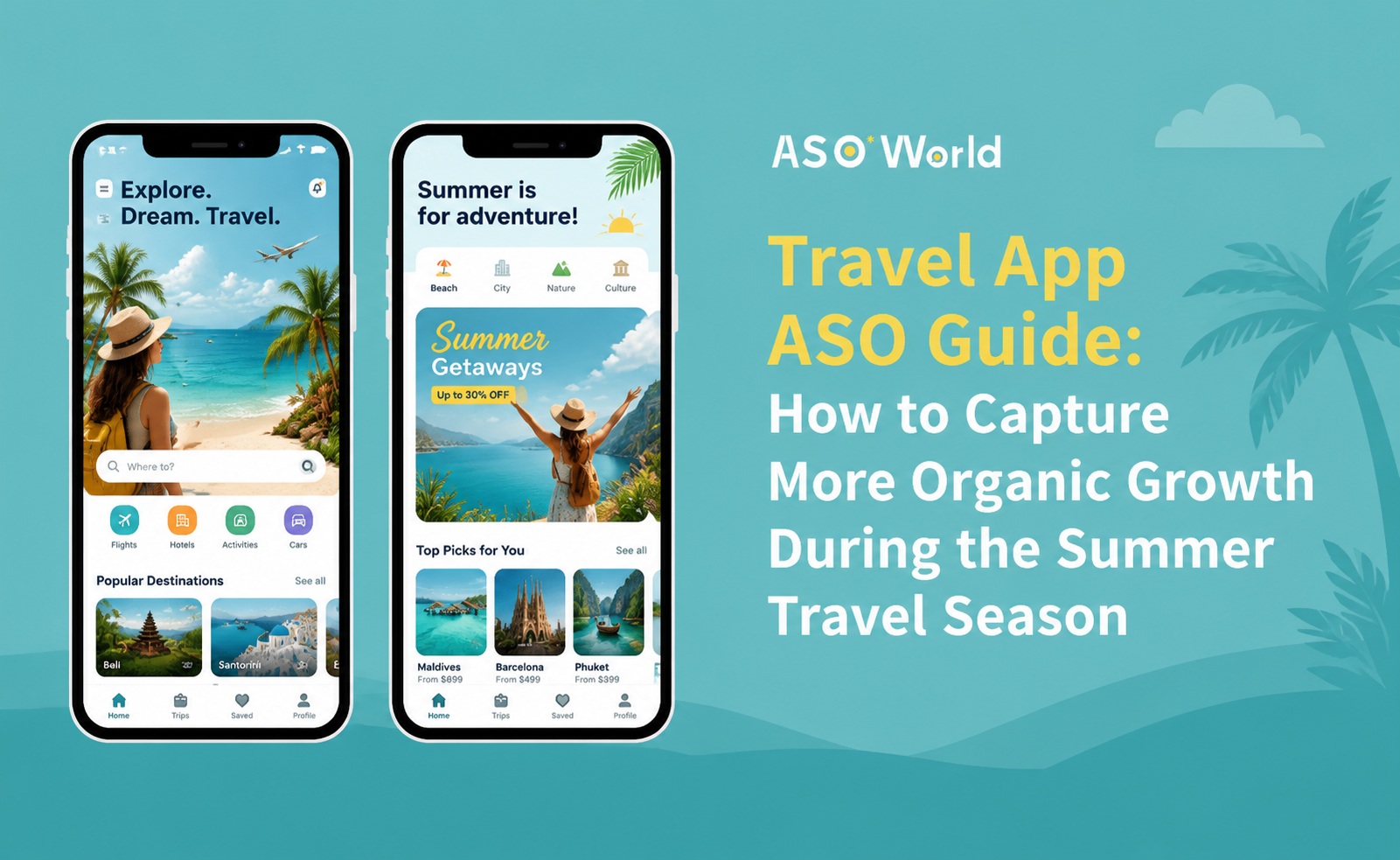
Summer is one of the most important seasonal growth windows for travel apps. As users begin searching for flights, hotels, routes, local experiences, family trips, and last-minute vacation deals, app stores become a high-intent discovery channel. For developers and app marketers, this means summer growth should not depend only on paid acquisition. A strong App Store Optimization strategy can help travel apps capture seasonal demand, improve keyword visibility, and convert more browsing users into active travelers.
Travel apps are no longer used only for booking. Users now rely on them to plan trips, compare options, navigate destinations, manage reservations, receive alerts, and make decisions during the trip itself. For summer app marketing, your ASO strategy should reflect this full travel journey rather than focusing only on installs.
Summer travel demand is seasonal, but it is also highly searchable. Users often enter the app stores with clear intent, using terms such as “cheap flights,” “hotel deals,” “trip planner,” “road trip,” “vacation planner,” “train tickets,” or “things to do.” These searches reveal immediate travel needs, which makes ASO especially important for apps competing in crowded travel, navigation, booking, and mobility categories.
The challenge is that broad travel keywords are usually dominated by well-known apps. Smaller and mid-sized travel apps should avoid relying only on generic terms like “travel” or “booking.” Instead, they should build a layered keyword strategy around seasonal intent, trip type, destination behavior, and specific user pain points.
If your team is still building the foundation of app store visibility, this guide to App Store Optimization provides a useful framework for understanding how metadata, ranking signals, conversion, and organic installs work together.
Before summer traffic peaks, audit your current keyword rankings and identify which seasonal keywords are already close to page-one visibility. These “near-win” keywords often offer faster growth potential than completely new, highly competitive terms.
A strong summer keyword strategy should begin with user intent, not only search volume. Travel users move through different stages: inspiration, planning, booking, preparation, in-trip support, and post-trip sharing. Each stage creates different keyword opportunities.
For example, users in the inspiration stage may search for “summer vacation,” “beach trip,” or “family travel.” Users closer to booking may search for “cheap flights,” “hotel deals,” “flight tracker,” or “car rental.” During the trip, they may search for “offline maps,” “train tickets,” “airport transfer,” or “local guide.” Your metadata should prioritize the terms most aligned with your app’s strongest value proposition.
For iOS, focus on the app name, subtitle, and keyword field. For Google Play, optimize the title, short description, long description, and semantic keyword coverage. The goal is not to repeat keywords mechanically, but to connect your app’s core function with summer-specific use cases in natural language.
For a more structured research process, this article on how to conduct ASO keyword research can help teams organize keyword discovery, prioritization, and testing.
Group summer keywords into clusters such as “flight booking,” “hotel deals,” “trip planner,” “navigation,” “local experiences,” and “family travel.” Then map each cluster to one app store asset: metadata, screenshots, promotional text, or custom product pages.
Seasonal visibility is only valuable if the product page converts. During summer, users often compare multiple apps quickly. Your screenshots and preview video should immediately show why your app helps them plan, book, manage, or enjoy a better trip.
Instead of using generic feature screenshots, build a summer-focused visual story. A flight app can highlight price alerts, flexible date search, and last-minute deals. A hotel app can show beach stays, family rooms, cancellation flexibility, and map-based discovery. A trip planner can show itinerary building, booking storage, offline access, and real-time reminders.
Your first three screenshots matter most because they shape the user’s first impression in search results and product pages. Use benefit-driven copy such as “Find cheaper summer flights,” “Plan your whole trip in one place,” or “Stay updated before and during your vacation.”
For teams optimizing iOS creatives, this guide on how to optimize App Store screenshots offers practical guidance for improving visual conversion.
Test summer-themed screenshots before the demand peak. If your app supports multiple markets, avoid using one generic creative set globally. A beach vacation message may work well in one region, while city breaks, rail travel, or family road trips may perform better elsewhere.
Summer travel behavior varies significantly by market. Users in the United States may search for road trips, national parks, and domestic flights. European users may focus on rail travel, city breaks, and accommodation deals. Southeast Asian travelers may search for island trips, local transport, and short-haul flights. Chinese outbound travelers may care more about visa information, translation, currency exchange, flights, and hotel booking.
Localization should go beyond translation. It should adapt keywords, screenshots, seasonal messaging, currencies, destination examples, and social proof. A localized listing should feel like it was built for that market’s travel behavior.
For example, a travel app targeting Japan and South Korea may emphasize city guides and transit convenience, while the same app targeting Europe may highlight rail routes and multi-city planning. This type of localization improves relevance, which can increase both search visibility and conversion rate.
This guide on how localization differs across Google Play and the App Store is useful when planning regional ASO execution.
Build a separate keyword list for each priority market. Do not simply translate English keywords. Local users often describe travel needs differently, especially around transportation, accommodation, and destination discovery.
Many travel apps release new features before the summer season, such as AI itinerary planning, flexible booking, offline maps, group trip sharing, or real-time delay alerts. However, launching a new version without updating ASO assets weakens the growth opportunity.
Before release, align your metadata, screenshots, in-app events, promotional text, and release notes with the new summer use case. If your app adds price alerts, the store page should make that feature visible. If your app improves itinerary planning, screenshots should show the complete planning flow. If your app launches destination guides, use seasonal examples that match current travel demand.
This app new version launch ASO checklist can help teams coordinate metadata, creative, ratings, and post-launch tracking before a seasonal update.
Treat the summer update as a campaign, not just a product release. The app store page, paid ads, website landing pages, and push notifications should communicate the same seasonal value proposition.
Paid acquisition can create short-term traffic, but ASO determines how efficiently that traffic converts. If a YouTube ad promotes “summer hotel deals,” but the app store listing does not mention hotel savings or show relevant screenshots, users may drop off before installing.
The best summer strategy connects paid campaigns with organic optimization. Use paid channels to generate demand and use ASO to capture high-intent users who search after seeing an ad. App Store Search Ads and Google App Campaigns can also help validate which seasonal keywords convert best. These learnings should feed back into your metadata and creative testing.
For apps that already have keyword opportunities but need more ranking momentum, this guide to App Store keyword installs explains how keyword-driven install activity can support visibility and organic traffic growth when used strategically.
Do not separate paid and organic teams during summer campaigns. Paid search terms, ad creative CTR, product page conversion rate, and organic keyword rankings should be reviewed together.
Ratings and reviews are especially important for travel apps because users are making time-sensitive decisions. A user booking a hotel, checking a flight, or navigating a new city needs confidence that the app is reliable. Poor reviews about bugs, failed bookings, payment issues, inaccurate information, or delayed customer support can quickly reduce conversion.
Before the summer season, analyze review themes from the previous peak period. Identify complaints around pricing, cancellation, login issues, maps, notifications, customer support, or booking confirmation. Fixing these issues can improve both product quality and store conversion.
During summer, ask for reviews after successful moments, such as completing a booking, saving an itinerary, receiving a useful price alert, or finishing a trip. Avoid asking when users are stressed, delayed, or resolving a support issue.
ASO execution requires continuous keyword tracking, metadata updates, creative testing, ranking improvement, and conversion analysis. For travel apps, this becomes more complex during summer because demand changes quickly and competitors update their campaigns aggressively.
For teams that need additional ranking momentum around priority seasonal search terms, ASOWorld's Keyword Installs service can be considered as part of a broader organic growth strategy. The service is most effective when paired with well-optimized metadata, relevant creatives, localized product pages, and continuous performance tracking.
The key is to use ASO as a system. Keyword optimization brings users into the funnel. Creative optimization improves conversion. Localization expands market reach. Ratings and reviews build trust. Performance tracking helps teams adjust before competitors capture seasonal demand.
ASOWorld First Order Discount
Get 50% off on your first order to start your app growth!

Once the campaign is live, monitor performance by keyword cluster, market, channel, and product page variant. A travel app should not only measure total installs. It should track keyword ranking movement, impressions, product page conversion rate, install source, retention, booking actions, and revenue events.
If “cheap flights” brings many impressions but low conversion, the creative or offer may not match user intent. If “trip planner” converts well but has low visibility, it may deserve more metadata support or paid testing. If one localized market performs better than others, study whether the difference comes from keyword relevance, screenshots, pricing, or travel season timing.
For a more structured approach, this article on how to monitor ASO performance and KPIs can help marketers connect ranking movement with real growth outcomes.
Travel apps should start ASO preparation before search demand peaks. Metadata updates, creative testing, localization, and review improvements need time to influence rankings and conversion. Waiting until the middle of the summer season usually limits the growth opportunity.
The best keywords depend on the app category. Flight apps may focus on cheap flights, flight tracker, and airfare deals. Hotel apps may focus on hotel booking, vacation rentals, and last-minute hotels. Trip planners may target itinerary planner, vacation planner, and road trip planner. The most effective strategy is to combine high-volume seasonal terms with more specific long-tail keywords.
Screenshots should be updated when user intent changes or when campaigns promote a new seasonal value proposition. For summer, it is useful to test creatives around vacation planning, savings, convenience, and in-trip support. Apps targeting multiple regions may need different screenshot sets by market.
Yes. Travel behavior, destination preferences, and search language vary greatly across regions. Localization improves keyword relevance and user trust, especially for apps targeting international travelers or multiple travel markets.
Travel apps should track keyword ranking movement, impressions, product page conversion rate, organic installs, retention, booking actions, and revenue events. The goal is not only to increase downloads, but also to attract users who continue using the app throughout the travel journey.
Get a good start for your app optimization with practical ASO guideline!
Want to get the latest Guides & Insights from ASOWorld?
Related posts