COVID-19 UPDATE


Important Notice:Beware of scams using ASOWorld's name for part-time recruitment or ASO earning app activities. ASOWorld is not hiring any part-time staff. Trust only official information posted by ASOWorld.

The 2026 FIFA World Cup is the largest sporting event ever staged on North American soil. Forty-eight teams. Sixteen host cities spanning three countries. Over 5 billion cumulative TV viewers expected globally. For app marketers, this is not a branding opportunity — it is a 39-day stress test on your App Store presence.
During the 2022 Qatar World Cup, the data was clear: sports app downloads surged 3x during peak match weeks, search volume for "World Cup betting" spiked over 400% on both the App Store and Google Play, and apps that had aligned their metadata early captured disproportionate organic traffic at significantly lower acquisition costs.
But the 2026 edition is structurally different — and the opportunity is larger. With the tournament hosted in the USA, Mexico, and Canada, the majority of matches will take place during North American prime-time hours, creating sustained engagement windows that previous World Cups (held in Qatar, Russia, Brazil) could not deliver for Western audiences. This means App Store search demand in English and Spanish will be unprecedented.
This guide is your complete ASO checklist for the 2026 World Cup. It covers what to do now, what to activate during the tournament, and how to measure real impact afterward. Whether you are marketing a sports streaming app, a betting platform, a gaming title, or even an e-commerce or lifestyle app, the frameworks here apply.
The first mistake app marketers make is treating the World Cup as a single traffic event. It is not. It produces a sequence of concentrated, high-intent demand spikes — each tied to a specific match, result, or cultural moment.
Analysis of the 2022 World Cup reveals that the highest single-day download spike for U.S. sports betting apps occurred the day before the USA vs. England group-stage match. Not during the match. Not after. Before — when anticipation and planning behavior peaked.
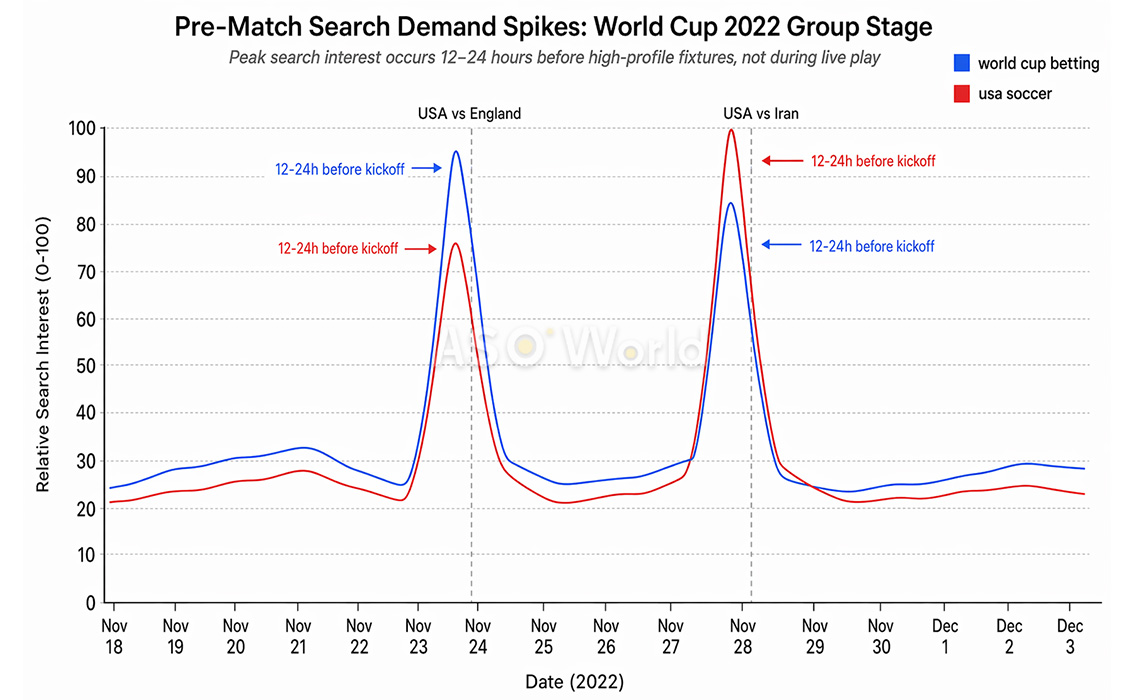
This pattern repeats throughout every major tournament. Saudi Arabia's shock win over Argentina in 2022 triggered a national holiday and a concentrated surge in football-related app downloads across the Middle East. When a host nation advances — or when a dramatic upset occurs — local demand intensifies far beyond what global averages suggest.
For 2026, the implication is clear: demand will spike hardest around USA, Mexico, and Canada fixtures. If your priority market is the United States, the match schedule for the USMNT is your demand calendar. Every group-stage match, every potential knockout fixture, represents a discrete window where search behavior shifts from browsing to action.
As the tournament progresses, user search patterns evolve predictably:
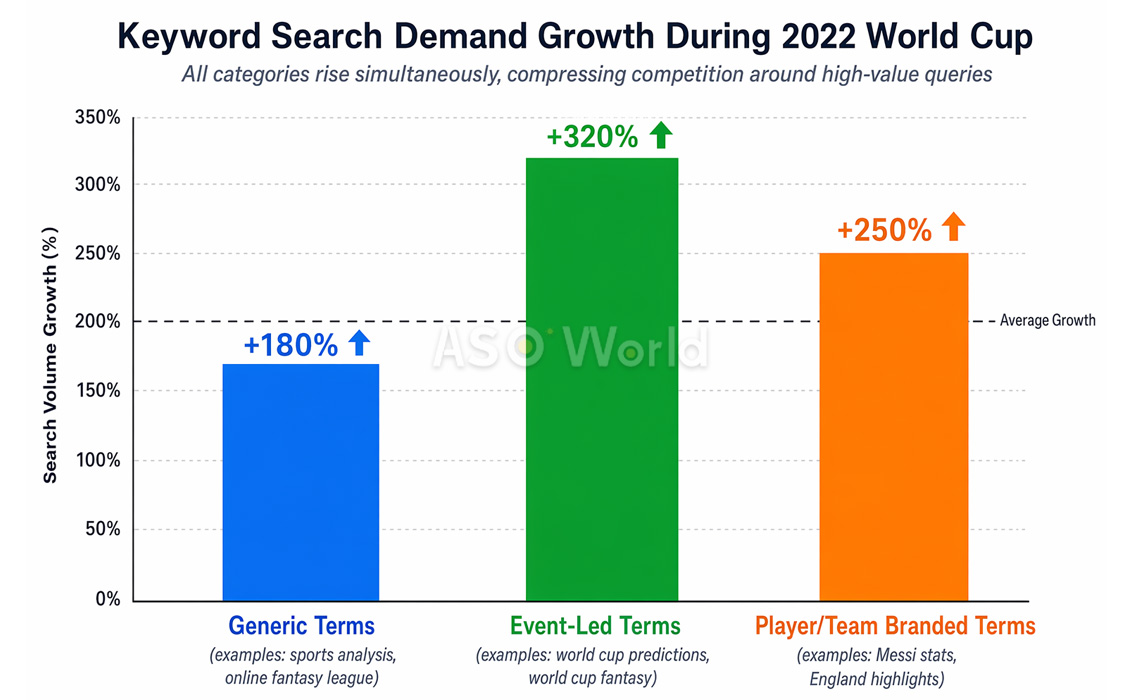
This compression of competition around high-value terms is why preparation timing matters so much. Apps that wait until the group stage to update metadata are competing for relevance at the exact moment everyone else is, too — and paying premium CPIs for the privilege.
Understanding these demand patterns is the foundation of App Store seasonality strategy. The World Cup is the most intense seasonal event in mobile — and the most predictable.
If the World Cup teaches one lesson about ASO, it is this: the apps that win during the tournament are the ones that prepared before it.
This is not abstract advice. It reflects how App Store indexing actually works.
When you update your metadata with new keywords, the App Store does not immediately rank you for those terms. According to current understanding of the 2026 App Store search algorithm, keyword positions typically require 2–3 weeks to stabilize after a metadata update — and that is before factoring in the time needed to build sufficient download velocity on those terms.
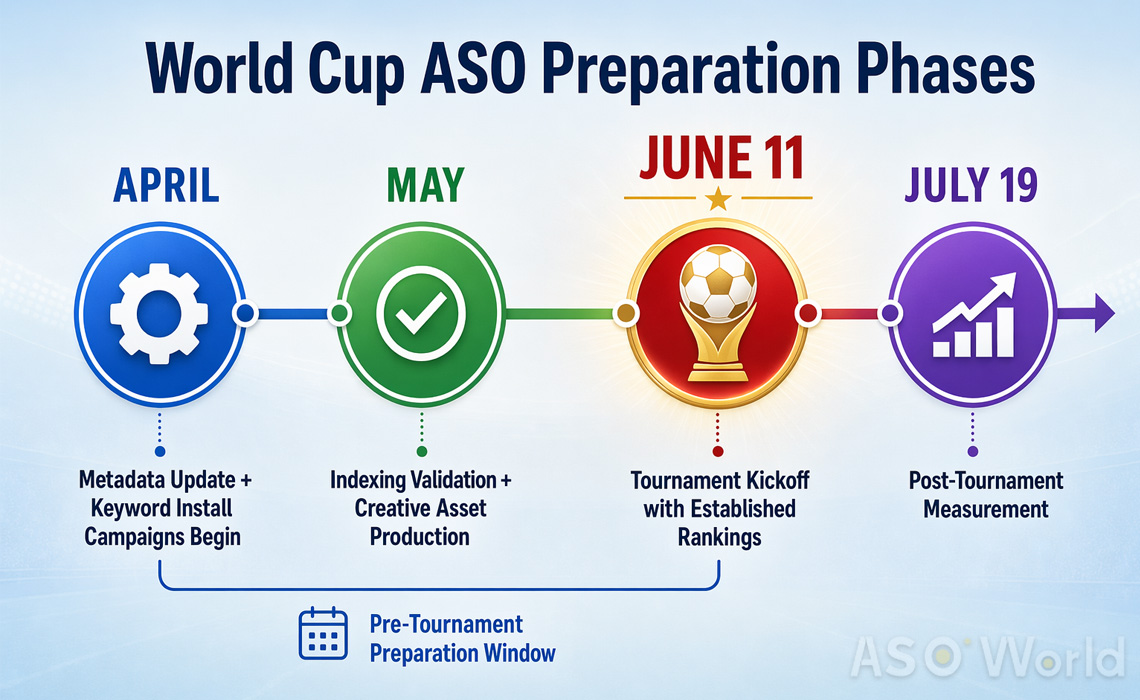
This means if the tournament kicks off on June 11, your World Cup metadata update needs to be live by mid-to-late April at the latest. An early May update is the absolute floor. Anything after that and you are gambling that indexing will happen fast enough — at a time when thousands of other apps are submitting competing updates.
Submit your first World Cup metadata update 6 weeks before kickoff (early May) to establish baseline indexing. Then plan a second refinement update 2 weeks before (late May) based on which terms are gaining traction. This two-phase approach lets you validate keyword choices with real indexing data before peak competition arrives.
On iOS, remember: the app description is NOT indexed for search ranking. Your Title (30 chars), Subtitle (30 chars), and Keyword Field (100 chars) are the only metadata elements that drive keyword visibility. On Google Play, the long description does contribute, so integrate tournament terms naturally there.
When teams wait until the tournament is underway to build keyword relevance, they face a compounding problem: competition intensifies, CPIs rise, and algorithm trust has not been established. It is the most expensive time to try to become relevant.
A more effective approach — demonstrated by apps like HBO Max during March Madness — is to begin ranking for seasonal terms immediately after a version update weeks before peak demand. This early alignment builds algorithmic trust, which then supports both organic visibility and paid campaign efficiency once the event arrives.
For apps using keyword install campaigns, this timeline is critical. Keyword installs work by generating real search-and-download behavior on target terms, signaling relevance to the algorithm. But that signal needs time to compound. Starting keyword campaigns on World Cup terms in late April or early May gives you 4–6 weeks of progressive ranking momentum — arriving at tournament kickoff with established positions rather than starting from zero.
The second major mistake is treating World Cup ASO as a flat list of high-volume keywords. Targeting "world cup" and "soccer" without further structure is like trying to rank for "app" — technically relevant, practically useless against established competitors.
The strategic approach is to organize keywords into intent clusters that map to different user motivations and different stages of tournament engagement.
| Intent Category | Example Keywords | Primary App Categories | Search Volume Timing |
|---|---|---|---|
| Live viewing | watch world cup live, stream world cup 2026, world cup live tv | Streaming, media | Peaks during match windows |
| Scores & tracking | live score football, world cup results, match schedule 2026 | Sports, news | Steady throughout tournament |
| Betting & odds | world cup odds, bet on usa match, live betting soccer | Sports betting | Spikes 12–24h before fixtures |
| Team/nation queries | usa soccer 2026, mexico world cup schedule, canada football team | All categories in host markets | Peaks around national team matches |
| Fantasy & prediction | world cup fantasy, predict winner, football bracket 2026 | Gaming, sports | Pre-tournament + group stage |
| Adjacent fan behavior | watch party setup, football jersey, sports bar near me | E-commerce, food, lifestyle | Peaks on match days |
Each cluster requires different treatment. Live viewing keywords belong in the metadata of streaming apps. Betting keywords map to different custom product pages than score-tracking keywords. Team/nation queries demand localization. And adjacent fan behavior keywords represent opportunities for non-sports apps to capture tournament-adjacent demand.
For a detailed breakdown of how to build and layer keyword clusters for maximum search coverage, see our comprehensive guide on expanding App Store search traffic through keyword research and optimization.
The term "world cup" will have enormous search volume — and enormous competition. Every sports app, every streaming platform, every betting operator will target it. For most apps, ranking in the top 5 for that term is unrealistic without massive existing authority.
Mid-tail keywords — "world cup live score app," "stream usa world cup game," "football betting world cup 2026" — have lower absolute volume but significantly higher conversion rates and achievable ranking positions. These are the terms where keyword install campaigns produce the strongest ROI, because the competition is lower and the user intent is more specific.
For sports and betting apps during the World Cup, target a minimum of 50 high-intent keywords per market. Distribute them across your intent clusters: ~10 live viewing terms, ~10 scores/tracking terms, ~10 betting terms, ~10 team/nation terms, and ~10 adjacent/long-tail variations.
Use the first 2–3 weeks of your campaign to identify which terms gain traction fastest, then consolidate budget onto the top 15–20 performers. This mirrors the approach outlined in our keyword installs vs. guaranteed ranking framework — start broad, then consolidate on validated winners.
The 2026 World Cup is the first ever hosted across three countries with two primary languages. This creates a metadata challenge that most previous tournaments did not require: simultaneous localization for the US (English), Mexico (Spanish), and Canada (English + French).
Users in Mexico do not search for the same terms as users in the United States, even when looking for the same thing. "Copa del mundo en vivo" and "watch world cup live" represent identical intent but require separate keyword targeting in separate localized metadata sets.
Similarly, Canadian search behavior may blend English and French terms depending on region — and the cultural significance of Canada qualifying for its first World Cup since 1986 will drive nationally-specific search patterns that US-focused metadata will not capture.
Localization checklist for World Cup 2026:
Product page localization is no longer optional for World Cup strategy — it is the difference between capturing demand in one market versus three. For implementation frameworks, read our guide on how iOS product page localization improves ASO performance.
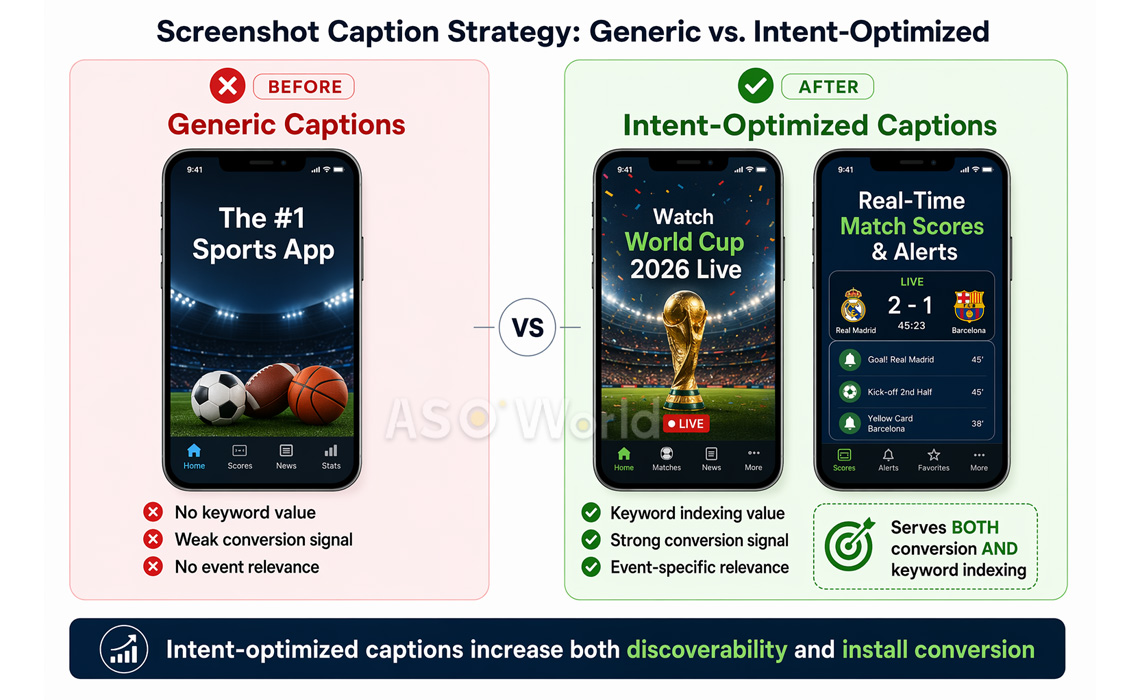
An often-overlooked 2026 algorithm update: Apple now indexes caption text overlaid on screenshots as a ranking signal. This means your screenshot captions are not just conversion tools — they are keyword real estate.
Replace generic captions like "Best Sports Experience" with intent-specific phrases: "Watch World Cup Live," "Real-Time Match Scores," "Bet on Every Fixture." Each screenshot caption becomes an additional indexing opportunity that reinforces your keyword strategy.
The World Cup does not unfold in a straight line. User intent shifts as the tournament progresses, and your App Store presence needs to shift with it.
Pre-tournament (now through June 10): Creatives should emphasize preparation and anticipation — "Get Ready for World Cup 2026," tournament countdown messaging, schedule/fixture features.
Group stage (June 11–28): Shift to live-experience messaging — "Watch Live Now," "Every Match, Every Goal," real-time score interfaces. Highlight breadth of coverage.
Knockout rounds (June 29 – July 19): Emphasize urgency and specificity — "Don't Miss the Quarter Final," "Live Now: [Matchup]," single-match focus rather than tournament-wide messaging.
This phased approach means preparing multiple creative sets in advance and scheduling their deployment around the match calendar.
Apple allows up to 35 Custom Product Pages (CPPs), each serving as a tailored landing experience for different search intents. During the World Cup, this capability transforms from a nice-to-have into a conversion multiplier.
Recommended CPP architecture:
CPPs now appear organically in search results and can link to specific keywords — functioning as targeted landing pages for different user intents. When a user searches "watch usa world cup" and lands on your USA-themed CPP instead of your generic product page, conversion rates improve measurably.
Map out every USA, Mexico, and Canada fixture now. For each match:
This requires pre-production of all creative variants and a clear deployment schedule — but it ensures your store presence reflects the urgency users feel at each specific moment. Manual rotation is possible for small teams; larger operations should use automated scheduling where available.
In-app events on iOS and promotional content on Google Play provide additional search result real estate and editorial placement opportunities without requiring metadata changes.
During the 2022 World Cup, apps like Paddy Power Sports Betting tied in-app events directly to tournament phases — "World Cup Final Betting Special," "Knockout Round Free Bets" — creating urgency that converted browsing into installs. These events appeared in search results alongside the main listing, effectively doubling the visual footprint of the app for relevant queries.
| Tournament Phase | Event Theme | Example Event Copy | Duration |
|---|---|---|---|
| Opening week | Welcome/onboarding | "World Cup 2026 is HERE — Get live access to every match" | June 11–18 |
| Group stage peak | Engagement challenge | "Predict the Group Winners — Daily prizes" | June 18–28 |
| Round of 32/16 | Knockout urgency | "Knockout Rounds LIVE — Don't miss a single upset" | June 29 – July 8 |
| Semi-finals & final | Peak urgency | "The World Cup Final — Watch history unfold" | July 14–19 |
For non-sports apps, in-app events are equally powerful. A gaming app can run a "World Cup Challenge" country-vs-country event. A fitness app can launch a "Train Like a Champion" challenge. An e-commerce app can create a "Match Day Deals" promotional event. The key is connecting your app's value to the moment without forcing an unnatural fit.
Our detailed guide on maximizing user engagement with in-app events covers implementation best practices for both stores.
During the World Cup, CPIs rise across all sports-related categories. In 2022, average CPIs for sports betting apps in the US increased by 40–60% during peak tournament weeks. Simply spending more is not a strategy — it is a cost escalation.
The apps that acquire users most efficiently during the World Cup treat paid and organic as a combined system where each channel reinforces the other.
This flywheel does not work if you start both channels simultaneously during the tournament. The organic foundation must be established first — which is why the 4–6 week preparation window is non-negotiable.
For the complete framework on combining these channels, see our guide on balancing paid UA and ASO for app growth.
Do not distribute Apple Ads budget evenly across the tournament. Allocate disproportionately to high-intent windows:
Critically, align campaign timing with user activity patterns. Sports and entertainment app engagement peaks between 7–11 PM local time. Scale bids during these windows on match days; reduce during off-hours to maintain efficiency.
The World Cup is not exclusively a sports-app opportunity. It fundamentally changes how millions of people spend time, money, and attention for 39 days. Any app that connects to fan behavior — even tangentially — has an opportunity.
During matches, users engage in pre-game preparation (buying merchandise, upgrading TV setups) and match-day consumption (ordering food, organizing watch parties). E-commerce apps that reflect these use cases in screenshots, metadata, and in-app events can capture intent that has nothing to do with sport but everything to do with the sporting occasion.
The World Cup mirrors natural gaming mechanics: country-based competition, bracket progression, prediction challenges. Roblox ran a FIFA World Cup festival during 2022 that drove significant engagement. Gaming apps that introduce tournament-themed events — prediction leagues, country leaderboards, time-limited challenges — can ride the attention wave without repositioning their core product.
A lighter approach works here. Performance and competition themes ("train like a champion," "world-class endurance") connect to the cultural moment without forcing a direct football link. Nike extended its Footballverse campaign into its fitness apps during 2022 through in-app events — framing the World Cup around athlete mindset and training rather than the sport itself.
Relevance over decoration. A themed screenshot alone will not convert. The connection between your app's value and the World Cup experience must be logical from the user's perspective. When that link is clear, the tournament becomes a growth driver across categories — including those far outside sport.
Executing a World Cup ASO strategy requires both planning and velocity. Here is how specific services fit into the tournament preparation timeline:
The phased approach ensures each service builds on the previous — keyword installs validate which terms deserve guaranteed ranking investment, ratings improvements compound conversion rates before peak traffic arrives, and execution-phase scaling capitalizes on established momentum rather than building from scratch during competition.
For teams evaluating which service combination fits their growth stage, our guide on buying keyword installs safely during seasonal events provides a detailed case study of this exact approach applied during Black Friday — a comparable demand spike scenario.
Preparation matters, but the World Cup does not reward static planning. It rewards teams that adapt as the tournament evolves.
When a national team captures attention — whether through victory or upset — local demand can rise dramatically within hours. The apps that benefit most are the ones positioned to respond: refreshing CPP messaging, scaling keyword budgets in that market, and activating relevant in-app events.
Build conditional response plans before the tournament starts:
During normal periods, weekly keyword monitoring is sufficient. During the World Cup, rankings can shift daily as competitors update metadata, launch campaigns, and activate events. Apps that monitor and respond daily maintain positions; apps that check weekly lose ground without realizing it until it is too late.
The current App Store algorithm demonstrates increasing volatility, with AI-generated tags and real-time download velocity signals making "static ASO strategies increasingly risky" even outside event periods. During the World Cup, this volatility amplifies further.
The World Cup will inflate install numbers for many apps. But not all growth is incremental. The critical question is: what holds after the tournament ends?
The 39-day tournament creates an accelerated testing environment. You can learn more about keyword performance, creative effectiveness, and market-specific behavior in 5 weeks than you typically would in 5 months.
Document everything. Which keywords converted best? Which CPPs outperformed? Which markets showed the strongest organic response? These insights do not expire with the tournament — they inform your ASO strategy for every future seasonal event and ongoing optimization.
For apps that want to extend World Cup gains into long-term positioning, the relationship between AI-driven discovery and App Store presence is increasingly important. Our analysis of how to get your app recommended by AI systems explores how web visibility and ASO work together — a dynamic that amplifies during high-attention events like the World Cup.
The principles in this checklist are not theoretical. They reflect patterns we have seen across client campaigns during major sporting events:
+210%
organic installs growth after ranking top 10 for 45+ keywords through strategic keyword install campaigns
+80%
visibility increase using seasonal keyword strategy before Valentine's Day — same playbook applies to World Cup timing
+171%
weekly organic installs through keyword optimization combined with targeted install campaigns
The common thread: early preparation, intent-based keyword clustering, phased service deployment, and measurement of what persists after peak demand. These are the same principles that will determine World Cup 2026 outcomes.
The 2026 FIFA World Cup is not a single spike in the App Store. It is a 39-day sequence of high-intent moments — each one an opportunity to capture users who are searching with purpose and making faster decisions than usual.
The apps that win will not simply be the most visible. They will be the most relevant at the right time, with metadata that matches what users search for, creatives that reflect the urgency they feel, and product pages that convert the specific intent they bring.
Start now. The indexing clock is already running.
Ready to build your World Cup keyword strategy? Explore ASOWorld's Sports App Marketing solutions or contact our team for a personalized tournament growth plan.
Submit your first metadata update with World Cup keywords by early May 2026 at the latest — ideally 6 weeks before the June 11 kickoff. App Store algorithms need 2–3 weeks to index new keywords, and keyword install campaigns need additional time to build ranking momentum. Apps that wait until the tournament starts will face peak competition with zero established relevance.
Avoid relying solely on broad terms like "world cup" or "soccer." Build intent-based keyword clusters: live viewing terms (watch world cup live stream), score tracking (live score football 2026), betting (world cup odds, bet on usa match), national team queries (usa soccer schedule, mexico copa del mundo), and adjacent behavior (watch party, football jersey). Target 50+ keywords per market across these clusters, focusing on mid-tail terms where ranking is achievable.
Yes — the World Cup changes user behavior far beyond sports categories. E-commerce apps can target match-day purchasing behavior (merchandise, viewing equipment, food delivery). Gaming apps can introduce tournament-themed events or country-vs-country competition. Fitness apps can use performance/competition themes. The key requirement is a logical connection between your app's value and how users experience the tournament. A themed screenshot without functional relevance will not convert.
Keyword installs generate real search-and-download behavior on target terms, signaling to the algorithm that your app is relevant for those keywords. Starting keyword install campaigns 4–6 weeks before the World Cup builds progressive ranking momentum — so your app arrives at tournament kickoff with established positions rather than starting from zero when competition is fiercest and CPIs are highest. The approach works best on mid-tail keywords with moderate competition rather than ultra-competitive head terms.
Look beyond total installs during the tournament — that number will be inflated by seasonal demand regardless of your strategy. Instead, measure: (1) Do keyword rankings persist after July 19 or drop immediately? (2) Did conversion rates improve independently of traffic volume? (3) Do tournament-acquired users retain at acceptable rates? (4) Did paid campaigns bring genuinely new users or cannibalize organic demand? Rankings and conversion gains that hold post-tournament represent real strategic value; anything that disappears immediately was seasonal noise.
Custom Product Pages are one of the highest-impact World Cup tactics available. Create separate pages for different user intents — a live-match urgency page, national team-specific pages (USA, Mexico, Canada), and a general tournament discovery page. Rotate them according to the match schedule: activate team-specific pages 24 hours before relevant fixtures, switch to live-match messaging during games, and revert to general tournament messaging between fixtures. CPPs now also appear organically in App Store search results, making them both a paid and organic conversion tool.
Get a good start for your app optimization with practical ASO guideline!
Want to get the latest Guides & Insights from ASOWorld?
Related posts