COVID-19 UPDATE


Important Notice:Beware of scams using ASOWorld's name for part-time recruitment or ASO earning app activities. ASOWorld is not hiring any part-time staff. Trust only official information posted by ASOWorld.

Learn how to identify overly competitive ASO keywords and find lower-competition, high-intent long-tail keywords your app can realistically rank for.


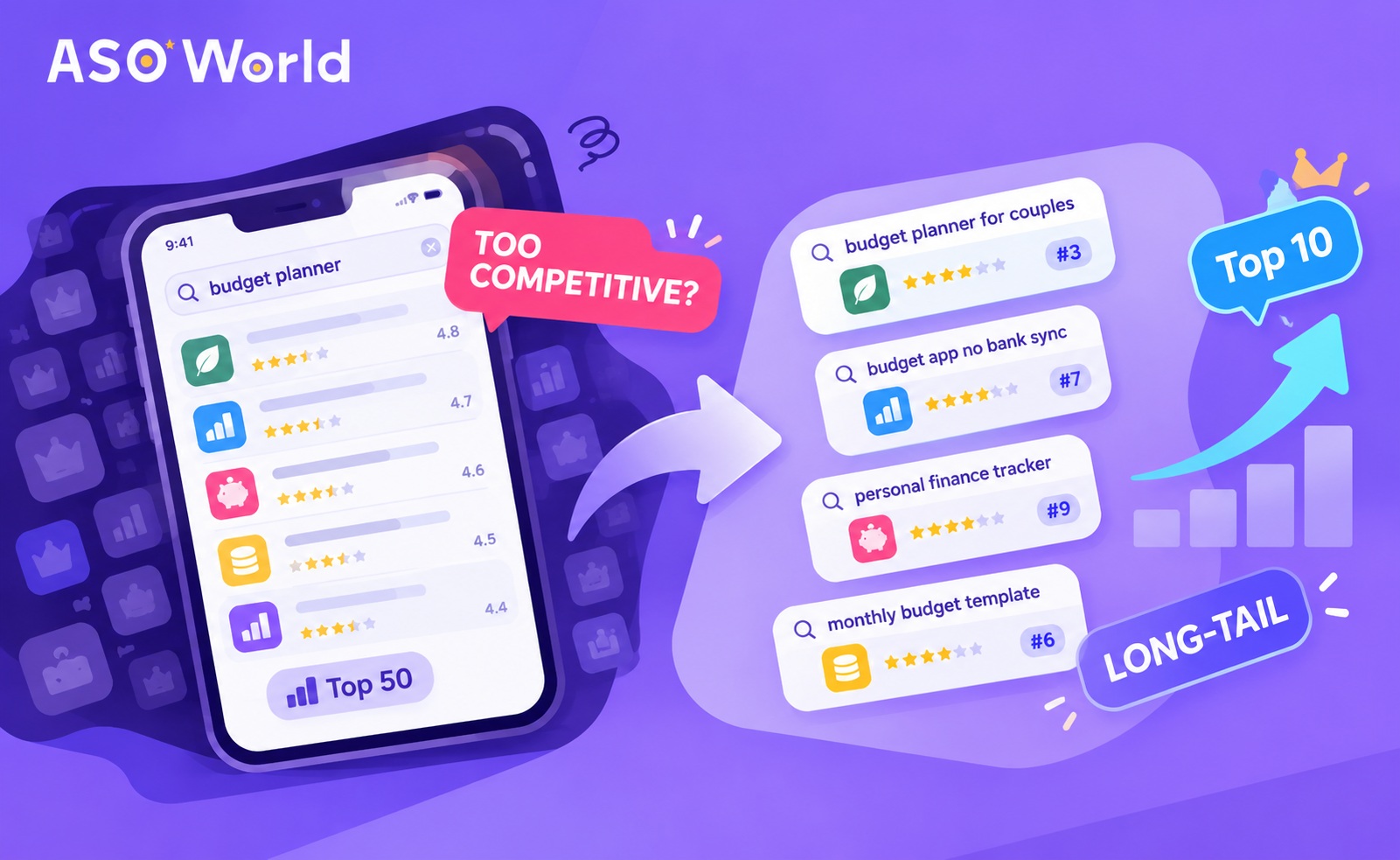
TL;DR: If you've been stuck outside the Top 50 for months on the keyword that best describes your app, the problem usually isn't your metadata — it's that you picked a keyword dominated by apps with far more reviews, downloads, and history than yours. The fix isn't to work harder on the same keyword; it's to build a portfolio of lower-competition, high-intent alternatives around it (autocomplete mining, competitor gap analysis, and long-tail modifiers), rank those first, and let the resulting downloads, reviews, and engagement earn you the right to compete for the harder term later.
Every app has one or two keywords that feel obvious. A budgeting app "has" to rank for "budget planner." A language app "has" to rank for "learn spanish." These are usually the highest-volume terms in the category — and also the ones where five to ten apps with hundreds of thousands of reviews have owned the top spots for years.
Chasing them anyway is the single most common keyword mistake developers make, for one simple reason: position, not volume, is what actually drives installs. Ranking #1 for a keyword with real but modest demand consistently outperforms sitting at position 40–60 for a keyword ten times as popular. Store search results are dominated by the first three to five positions — everything past that gets a fraction of the taps, and past position 30 or so, for most categories, the traffic is close to zero.
So the real question isn't "which keyword has the most searches." It's "which keywords can my app realistically break into the Top 10 for, this quarter — not eventually."
Keyword difficulty isn't really about the word itself. It's about the strength of the apps currently occupying the results page for it. Three signals matter most:
None of this means the keyword is permanently off-limits. It means it's not where a smaller or newer app should be spending its keyword-install budget first.
Difficulty isn't uniform across categories — a "hard" score in Utilities and a "hard" score in Productivity or Health & Fitness mean very different things in practice, because category crowding varies enormously.
| Category type | Typical competitive pressure | What this means for you |
|---|---|---|
| Fragmented utility categories (flashlight, unit converter, QR scanner, calculator) | Lower — no single publisher dominates | Core terms may be realistically reachable even for a newer app |
| Productivity & lifestyle (to-do list, habit tracker, journal) | Medium — a handful of established leaders, but room below them | Core terms need a long-tail on-ramp first; long-tail terms often convert fastest |
| Health, fintech, dating, and other "trust-heavy" categories | High — ratings, reviews, and brand recognition compound quickly | Head terms are usually a 6–12 month goal, not a launch-week target; long-tail is where early traction has to come from |
| Brand-adjacent terms (a competitor's name, a category-defining app name) | Very high, often unrealistic | Rarely worth budget unless you're running a specific competitive-conquesting play |
How to use this table: find your category's row, then be honest about where your app currently sits — reviews, ratings, and install history — relative to the apps already ranking. If you're a new or mid-stage app in a "medium" or "high" pressure category, your near-term keyword plan should lean heavily toward the long-tail strategies below.
Type your core term into the App Store or Google Play search bar, one letter at a time, and record every suggestion. Autocomplete only surfaces phrases people actually search — it's a free, real-time list of demand you didn't have to guess at. "Budget" alone is brutally competitive; "budget planner for couples" or "budget app no bank sync" are autocomplete-sourced variants with a fraction of the competition and a much clearer signal of intent.
Don't just look at whoever ranks #1 for your target term. Look at whoever ranks #6 through #10. Those positions are almost always held by smaller apps than the leader, and they tell you what a realistic near-term competitor looks like. If an app with a fraction of your review count is sitting at #7, that keyword is more winnable than the raw search volume suggests.
Long-tail keywords aren't just "longer" versions of your core term — they add a modifier that narrows intent: use-case ("budget planner for freelancers"), audience ("workout app for beginners"), or problem ("habit tracker that actually sends reminders"). Each modifier peels off a slice of demand with meaningfully less competition, and because the intent is more specific, conversion rate on these terms is typically higher too.
If you search a candidate keyword and only two or three of the Top 10 results actually have that exact phrase in their title, most of the field is ranking there incidentally — not by design. That's a gap you can take deliberately, simply by putting the term where it belongs in your own metadata.
If your app sits near position 150–200 in a massive, crowded category, moving to a smaller, more specific subcategory where you can realistically reach the Top 20 can generate more organic visibility than any amount of keyword tweaking in the original category. This is a bigger structural move and worth revisiting quarterly, not weekly.
Recommended keyword portfolio split: most ASO practitioners land on roughly 10–30% core keywords and 70–90% long-tail keywords, rather than betting the whole metadata budget on one or two head terms. Long-tail terms individually bring in less traffic, but stacked together, and because they convert at a higher rate, they consistently outperform a single overloaded head term — while quietly building the download, review, and engagement history that eventually makes the head term reachable too. ASOWorld's keyword-picking framework walks through scoring every candidate keyword on volume, difficulty, and your app's realistic chance of breaking into the Top 10, so you're weighing all three together instead of chasing volume alone.
One ASOWorld client's keyword campaign followed almost exactly this arc: instead of continuing to push a single saturated head term, the strategy shifted toward a broader long-tail portfolio, which pushed the priority keyword set into the Top 3 and delivered a 160% increase in daily downloads with a 60% lift in conversion rate. The full approach is outlined in ASOWorld's keyword ranking solution.
How do I know if a keyword is genuinely too competitive for my app right now?
Compare your app's review count and rating against the apps sitting in positions 6–10 (not position 1) for that term. If they're meaningfully stronger than your app across the board, it's a mid-term goal rather than a this-month target.
Should a brand-new app avoid head terms completely?
Not forever — just not first. Build coverage and ranking on long-tail terms, let the resulting installs and reviews accumulate, then revisit head terms once your app has a track record the algorithm can weigh.
How many keywords should I actually be targeting at once?
There's no fixed number, but a small set of 2–4 core terms alongside 10 or more long-tail terms is a reasonable starting portfolio — reviewed and refreshed every few weeks as some terms prove easier to move than others.
Is it better to promote one keyword heavily or spread volume across several?
Spreading it across at least 8–10 keywords tends to look more natural to the store algorithms and gives you more shots at finding which terms move fastest, rather than betting everything on a single high-risk, high-competition term.
Does keyword difficulty change over time, or is it fixed?
It changes constantly — new apps enter, existing apps update their metadata, and seasonal demand shifts who's actively competing for a term. A quarterly refresh of your keyword list, rather than a "set once" approach, is what keeps a difficulty assessment accurate.
What's the fastest way to find long-tail alternatives right now, without expensive tooling?
Autocomplete mining costs nothing but time: type your core term into the store search bar one character at a time and record every suggestion. It's the single highest-signal, lowest-cost keyword research method available, because every suggestion reflects real, current search behavior rather than a modeled estimate.
If your target keyword's difficulty genuinely outweighs your app's current strength, the fastest path forward is usually a structured audit of where you actually have a realistic shot. ASOWorld's ASO service can score your full keyword list on volume, difficulty, and chance, and build the long-tail-first campaign that gets you ranking on realistic terms while the harder ones become reachable.
 App Store Optimization,Keyword Research,
Get FREE Optimization Consultation
Let's Grow Your App & Get Massive Traffic!
All content, layout and frame code of all ASOWorld blog sections belong to the original content and technical team, all reproduction and references need to indicate the source and link in the obvious position, otherwise legal responsibility will be pursued.