TL;DR
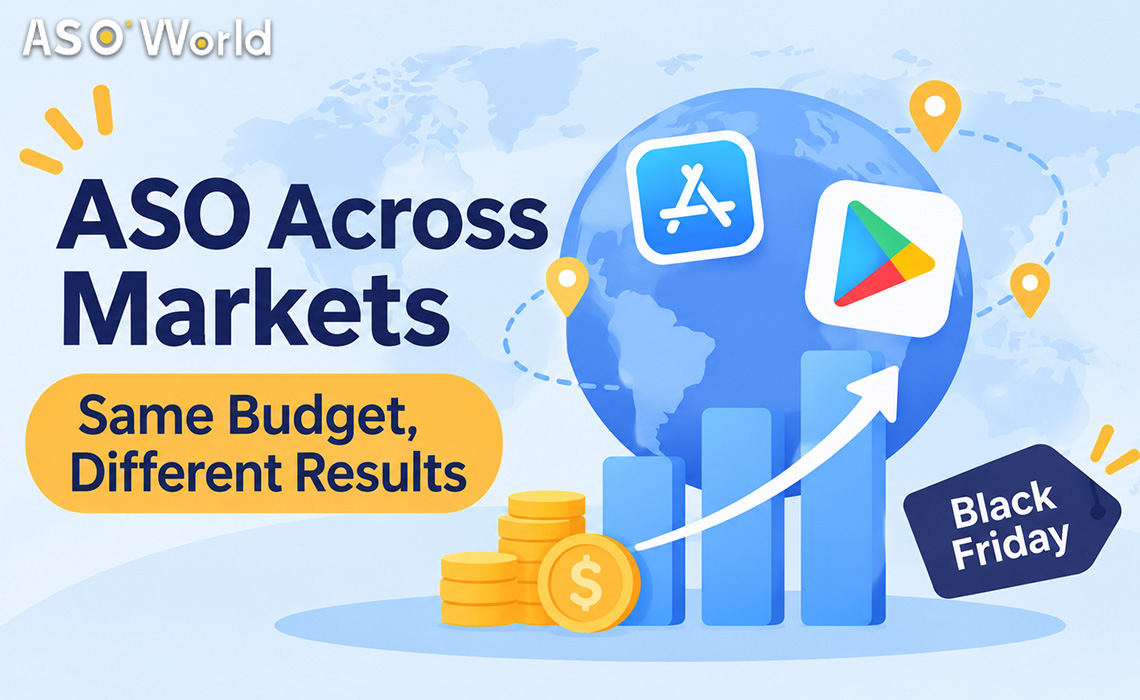
- If your app runs in many countries, you've probably seen the same budget work very differently from one storefront to the next. That's normal. Storefronts differ in install volume, paid-ad competition, keyword demand and seasonal intensity.
- Before Black Friday, the gap widens. US, UK, Canada and Australia get the most expensive, because retail and shopping apps raise budgets there first.
- Paid acquisition costs follow the same order. In the first half of 2026, average CPI was about $4–6 on iOS and rarely above $3–3.5 on Android, with the US, Canada, UK and Australia at the top and India, Southeast Asia and Africa at the bottom (Mapendo).
- Cheaper storefronts aren't automatically better. Some convert poorly, some are very price-sensitive, and some react so fast that rankings overshoot and then drop back.
- Use the five-question self-check below to rank your markets before you set a Black Friday budget for each.
Why does the same ASO budget perform differently by country?
Most multi-market teams see the same pattern: a keyword budget that moves an app into the Top 5 in Turkey barely moves it in the US, while a campaign that looked strong in a smaller African storefront fades within days.
There are four reasons.
1. The install volume needed to rank is very different
Ranking thresholds depend on how many installs the apps around you get — one reason the eight reasons app store rankings don't match include the storefront you are checking. Historical estimates show the gap: reaching #1 in a Google Play Sports category was estimated at about 13,000 installs a day in the US, 30,000 in Brazil and 87,000 in India, while a Travel category in Spain needed about 4,400. Large storefronts need more volume, and on Google Play, large populations (India, Brazil) can be harder than wealthy ones.
2. Paid acquisition sets the competitive pressure
Where paid installs are expensive, competitors spend more to get them, and that raises the bar for everyone. Mapendo groups countries into four CPI tiers:
| CPI tier |
Countries |
Relative cost |
| Tier 1 |
US, Canada, UK, Australia |
Highest |
| Tier 2 |
Western Europe, Japan, South Korea |
High |
| Tier 3 |
Brazil, Mexico, Turkey, Malaysia and similar |
Lower |
| Tier 4 |
India, Southeast Asia, Africa |
Lowest |
3. Keyword demand is spread differently
The same English keyword can be much less popular outside the US. Sonar found that keywords typically score 9–28 points lower in popularity in the UK, Australia and Canada than in the US. What low keyword popularity really means explains how to read those scores before you translate a list. In non-English storefronts, the terms that matter may not be the English ones at all.
4. Seasonal intensity isn't the same everywhere
Black Friday is huge in the US and UK and growing in Western Europe and Latin America. In many Asian markets it's smaller than local peaks such as Singles' Day (11.11), Lunar New Year or Diwali. A storefront with a weaker Black Friday has less competition but also less seasonal traffic — for markets where the peak is a different event, a seasonal event marketing program can map the calendar properly.
What does each storefront type mean for ASO?
Here is how the main market types behave in keyword and ranking campaigns:
| Market type |
Typical examples |
Competition |
How rankings behave |
What to watch |
Black Friday role |
| High-competition, high-value |
US, UK, Canada, Australia |
Highest |
Slow to move; expensive to hold; dropped positions are costly to recover |
Cost per extra organic install |
Core revenue market. Protect your best keywords instead of chasing new head terms |
| High-value, mid-competition |
Germany, France, Japan, Korea |
High |
Moves with steady effort; language-specific keywords matter |
Localized keywords, not translated ones |
Strong second tier; good for long-tail coverage |
| High-value, higher-risk |
Russian-language storefronts and some regulated markets |
Mixed |
Separate store ecosystems (e.g. RuStore); stricter enforcement in some categories |
Conservative, steady pace; policy compliance first |
Only with a cautious plan |
| Growth, low threshold |
Turkey, Southeast Asia, Brazil, Mexico |
Medium–low |
Moves quickly; lower revenue per user |
Conversion and retention, not just rank |
Good test markets and volume support |
| Price-sensitive, high volume |
India, Pakistan, Bangladesh |
Low CPI, but huge install volume on Google Play |
Large-category charts need big volume; long-tail moves fast |
Quality signals, refund and dispute risk, local-language terms |
Local festivals often matter more than Black Friday |
| Low-competition |
Many African storefronts, small European markets |
Lowest |
Can move too fast, then drop back |
Keep the pace steady and in line with organic installs |
Cheap visibility, but plan the pace carefully |
The main takeaway: don't spread one Black Friday budget evenly across countries. Each market type needs its own goal, pace and success metric — country-level keyword installs let you fund each market to its own pace.
How do you rank your markets before Black Friday? Five questions
Answer these for each country and score them 1–3:
- Revenue per user. Do users here pay, subscribe or watch ads at a useful rate?
- Current position. Do you already rank 11–40 on relevant keywords here? Those are the cheapest gains.
- Seasonal fit. Is Black Friday (or a local peak in the same window) a real event for your category here?
- Competition level. How many installs a day do the apps ranked above you get? Check the category chart in that country.
- Operational risk. Are there policy, payment or support issues (language, refunds, local regulation) that make growth here harder to sustain?
| Total score |
What to do before Black Friday |
| 13–15 |
Priority market: full keyword plan plus a timed chart push |
| 9–12 |
Support market: long-tail keyword coverage at a steady pace |
| 5–8 |
Test or hold: small test only, or wait for a local peak |
If your keyword list for each market was translated rather than researched, fix that first. The keyword selection guide covers how to build candidates from autocomplete, competitors and local language.
Worked example: scoring five markets for a budgeting app
| Market |
Revenue per user |
Current position |
Seasonal fit |
Competition (3 = low) |
Operational risk (3 = low) |
Total |
Plan |
| US |
3 |
2 (core terms at 25–40) |
3 |
1 |
3 |
12 |
Support: long-tail only, protect current Top 10 terms |
| UK |
3 |
3 (several terms at 11–20) |
3 |
2 |
3 |
14 |
Priority: full keyword plan + timed push |
| Germany |
3 |
2 |
2 |
2 |
3 |
12 |
Support: localized long-tail |
| Turkey |
2 |
3 |
2 |
3 |
2 |
12 |
Support: steady pace, watch conversion |
| India |
1 |
2 |
1 |
2 |
1 |
7 |
Hold: test around local festivals instead |
The result often surprises teams. The UK, not the US, is the best Black Friday bet here, because the app already sits close to the Top 10 and the bar to move is lower. The US stays important, but the money there goes to protecting what already works.
What are the common misreadings in multi-market ASO?
- "Cheap country = good country." Low CPI often comes with low revenue per user. Judge by cost per valuable install.
- "It worked in Turkey, so it will work in the US." A pace that works in a low-threshold market rarely moves a Tier 1 storefront.
- "Faster is better." In low-competition storefronts, a ranking that jumps in two days often drops back just as fast. Steady pace is more durable.
- "Black Friday is global." Many Asian and Middle Eastern markets peak on other dates.
- "One English keyword list for every country." Local search behavior differs, even between English-speaking storefronts.
- "Low rank means low budget." Sometimes it's a relevance or conversion problem that more spend won't fix.
How should a multi-market team plan the next two weeks?
| Week |
Priority markets |
Support markets |
Test / hold markets |
| Nov 16–22 |
Keyword runs on proven terms; product page refresh |
Long-tail coverage at steady pace |
Small tests to confirm the score |
| Nov 23–29 |
Hold keywords; timed category push if it fits |
Maintain |
Keep tests running only if they show a signal |
| Nov 30–Dec 6 |
Taper gradually |
Maintain winners |
Decide: promote to support, or stop |
To see how chart visibility and keyword work combine market by market, see the boost app rankings and user acquisition solution. If your listings in some markets are still English-only or machine-translated, an app store optimization service package can localize the title, description and screenshots before the peak.
FAQ
Why is ASO more expensive in the US than in other countries?
The US has more competing apps, higher paid acquisition costs, and the most intense Black Friday spending, so the install volume needed to move and hold rankings is higher. Revenue per user is also higher, which is why many apps still prioritize it.
Which countries are easiest to rank an app in?
Smaller storefronts with fewer competing apps and lower install volumes, such as many African and smaller European markets, are usually easiest. But easy markets can also see rankings rise too fast and fall back, so keep the pace steady.
Is it worth running Black Friday ASO in India or Southeast Asia?
Sometimes, but local peaks such as Diwali, Singles' Day or Lunar New Year often matter more there. India's Google Play also has very large install volumes in big categories, so focus on long-tail and local-language terms.
Should I use the same keywords in every English-speaking country?
No. Keyword popularity and wording differ between the US, UK, Canada and Australia. Research each storefront separately.
How many countries should I target before Black Friday?
Focus on a few priority markets where you already rank close to the Top 10, add support markets for long-tail coverage, and keep everything else as small tests.
What is a good metric to compare countries?
Cost per extra organic install, weighted by revenue per user. Rank alone hides big differences in value between markets.
 COVID-19 UPDATE