COVID-19 UPDATE


Important Notice:Beware of scams using ASOWorld's name for part-time recruitment or ASO earning app activities. ASOWorld is not hiring any part-time staff. Trust only official information posted by ASOWorld.

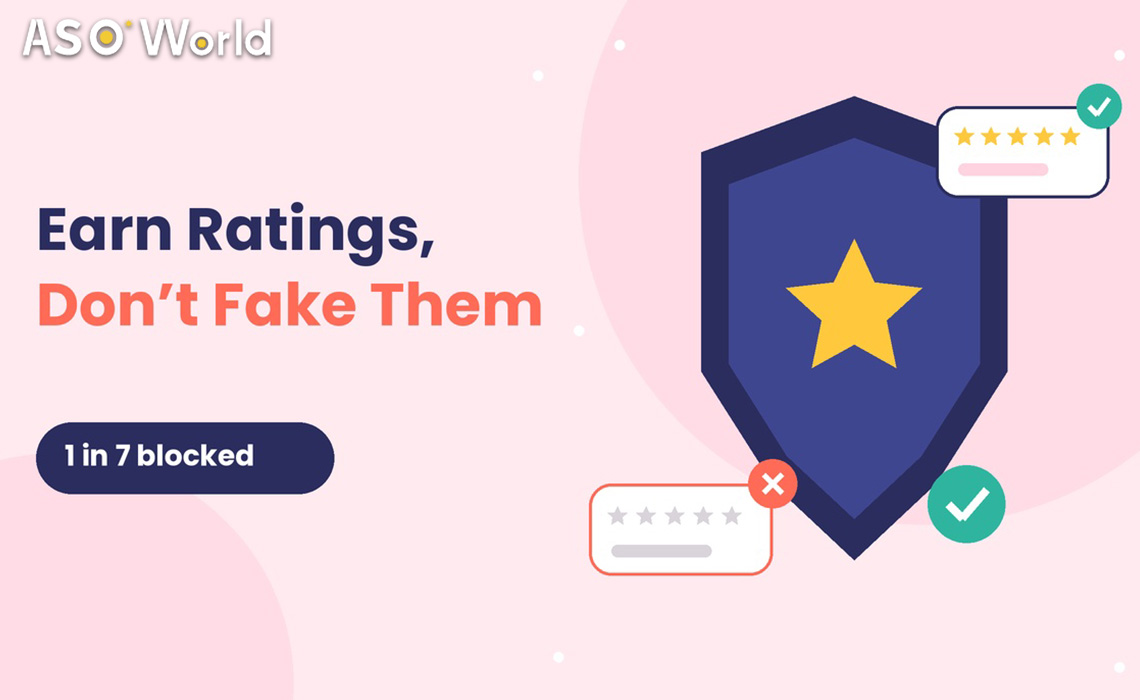
Apple blocked ~195M fake ratings in 2025. See what a healthy rating profile looks like, which rating sources are allowed, and a 30-day review plan.


TL;DR
Holiday traffic exposes a weak rating faster than any other time of year. More people see your product page, and they compare you with the app next to you in seconds. The question for most teams is not whether ratings matter, but where new ratings should come from, and which sources put the developer account at risk.
Apple's annual fraud report, published in May 2026, gives the clearest picture yet of how much review activity is filtered.
| 2025 App Store figure | Value |
|---|---|
| Ratings and reviews processed | 1.3 billion+ |
| Fraudulent ratings and reviews blocked | close to 195 million |
| Developer accounts terminated over fraud concerns | 193,000 |
| Fraudulent customer account creations rejected | 1.1 billion+ |
| Customer accounts deactivated for fraud and abuse | 40.4 million |
Source: Apple Newsroom, "The App Store stopped over $2.2 billion in fraudulent transactions in 2025," May 20, 2026.
Two numbers matter for app marketers. First, about 15% of submitted ratings and reviews never appeared. Second, Apple rejected more than a billion fraudulent account creations, so a large share of fake reviews never had an account to post from. Apple says it uses human review together with AI to identify problematic reviews and inflated ratings.
Google Play's rule is just as direct. Its User Ratings, Reviews, and Installs policy says it prohibits any manipulation of ratings, reviews or install counts, including incentivizing feedback, using forced pop-ups and paying for fake reviews.
Filters are not perfect, and plenty of real reviews are delayed or removed. Common reasons include new accounts, reviews posted in a burst from one region, copied or very short text, and reviews written before the app version they describe was live. We cover the five most common causes and what to check in App ratings and reviews not appearing? Five reasons they're delayed, hidden or taken down.
The practical lesson is the same whether reviews are organic or not: patterns that look unnatural get filtered, even when each review is real.
Stores do not publish their detection rules, and we will not guess at thresholds. What they do publish, and what we see across campaigns, points to the same picture of a profile that holds up.
| Signal | Healthy pattern | Pattern that tends to be filtered or flagged |
|---|---|---|
| Rating velocity | Rises and falls with daily installs | Jumps while installs stay flat |
| Star distribution | Mostly 4-5 stars, with some 1–3 | Almost only 5 stars, overnight |
| Review text | Varied length, mentions real features and versions | Short, generic, repeated phrasing |
| Recency | New ratings every week | Long gaps, then a burst |
| Countries | Matches where the app is installed | Many reviews from one country the app barely serves |
| Developer replies | Replies to complaints within days | No replies, or replies asking for a higher rating |
Recency carries extra weight on Google Play, which gives more emphasis to recent ratings. On the App Store, you can choose to reset your summary rating when you release a new version, which helps after a fixed bug but also wipes your rating count.
| Source | Store position | Effect on profile | Use it? |
|---|---|---|---|
| Native in-app review prompt (SKStoreReviewController, Play In-App Review API) | Allowed; Apple shows the prompt at most 3 times in 365 days, Google applies an unpublished quota | Natural velocity, matches installs | Yes, first priority |
| Asking in email, push or support replies, with no reward | Allowed | Small, steady lift | Yes |
| Replying to reviews and fixing the issue | Allowed; Google says not to ask for a higher rating in replies | Raises updated ratings, improves conversion | Yes |
| Offering a discount, coins or rewards for a rating | Prohibited (incentivized) | High filter rate, account risk | No |
| Forced pop-ups that block the app until the user rates | Prohibited on Google Play | Negative ratings, policy risk | No |
| Paid review services | Both stores prohibit manipulation; the risk sits with the developer account | Depends entirely on volume and pacing | Only as a small, time-limited top-up, if at all |
The prompt is the engine. The most common mistake is showing it at the wrong time: on first launch, after an error, or in the middle of a task. Show it after a success moment, such as a completed workout, a finished level or a saved document, and only to users who have opened the app several times.
ASOWorld sells reviews, so we should be clear about where we think they help and where they do not.
If you use guaranteed reviews, the written term is specific: more than 80% of the reviews you order stay live for 30 days or longer, or ASOWorld refunds you. Prices start at $1.50 per review on Google Play and iOS (checked November 24, 2026). The guarantee covers retention, not platform policy risk. No provider can remove that risk, and you should be wary of one that says it can.
For a longer comparison of buying versus earning ratings on Android, read Google Play reviews that stay: buying vs earning ratings in 2026.
| Your situation | What to do first | What to avoid |
|---|---|---|
| New app, zero ratings | Turn on the native prompt after the first success moment; build installs from relevant keywords so the prompt has an audience | Ordering reviews before the app has organic installs |
| Rating dropped after an update | Find the complaint theme, ship a fix, reply to every 1-3 star review, consider a rating reset on iOS | Burying complaints with new 5-star reviews |
| Good rating, low count in a new country | Localize the prompt and the store listing; a small, paced top-up of local reviews can help | Large volumes in a market with few installs |
| Holiday traffic, rating below 4.0 | Fix the product page first: screenshots, first-screen message, answers in replies | Expecting reviews alone to recover conversion |
| Received an App Store warning | Pause all paid activity and read the notice carefully | Any new promotion until the issue is resolved |
For a zero-rating app, the order matters. Ratings come from users, and users come from visibility. Building installs on relevant, winnable keywords first, for example with keyword installs for terms where the app already ranks in the top 250, gives the in-app prompt real people to ask.
If your app has received a warning, our guide Received an App Store "Fraudulent Activity" warning? What it means and how to respond covers the official response path.
Our app reputation and negative review management solution follows the same four stages, diagnosis, recovery, sentiment improvement and long-term maintenance, for teams that want help running it.
There is no official minimum, and star rating alone is not the whole story. In our analysis of public research, rating count correlated more strongly with top-10 positions than half a star did. The full breakdown is in How many ratings do you need before the holiday rush?
What matters most for conversion is what a visitor sees in the first two seconds: the star average, the count, and the two or three most visible recent reviews. If those reviews describe a bug you fixed last month, reply to them. Your reply is part of the product page. See how ratings, screenshots and first-screen messaging work together in our organic conversion and user experience solution.
How many fake reviews did Apple block in 2025?
Close to 195 million ratings and reviews, out of more than 1.3 billion processed, according to Apple's May 2026 fraud report.
Why were my app reviews removed?
Usually because they matched a pattern the store filters: new accounts, bursts from one region, repeated text, or reviews that look incentivized. Real reviews can be caught too. Check timing, countries and wording before assuming a penalty.
Is it against the rules to ask users for a review?
No. Asking is allowed, and the native prompt is the recommended way. Offering a reward for a rating, or forcing a pop-up, is not.
How often can I show the App Store review prompt?
Apple shows it at most three times in a 365-day period per user. Google Play applies a quota but does not publish the number.
Are paid reviews safe?
No provider can guarantee that. Both Apple and Google prohibit rating manipulation. If you use a review service, keep volume small relative to organic ratings, get the retention terms in writing, and stop if you receive a store warning.
Should I reset my App Store rating?
Only when a new version fixes the main reason for low ratings. A reset removes your rating count as well as your average, so the page looks newer but less proven.
This is the first guide in our 2026 Ratings & Reviews series. One more page worth reading before you change your prompt:
 App Store Optimization,User Retention,
Get FREE Optimization Consultation
Let's Grow Your App & Get Massive Traffic!
All content, layout and frame code of all ASOWorld blog sections belong to the original content and technical team, all reproduction and references need to indicate the source and link in the obvious position, otherwise legal responsibility will be pursued.