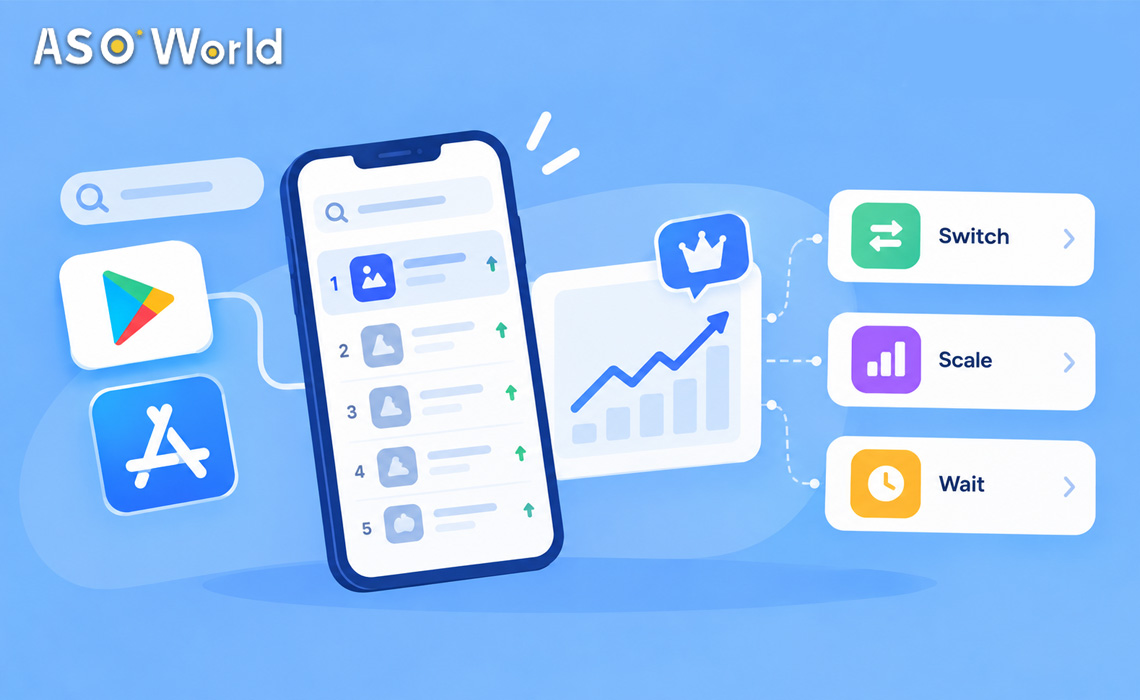
A keyword that won't move after a full campaign cycle has exactly three honest explanations: it's genuinely too competitive for your current volume, your volume is fine but needs more time to register, or the keyword itself is the wrong target and a lower-difficulty alternative would perform better. Most developers guess at which one it is. This framework tells you which, using signals you already have.
Three questions to ask before touching your campaign
Question 1: How many competitors are already holding Top 10 with visible, sustained volume?
Check the same keyword weekly for 2–3 weeks. If the same 6–8 apps rotate through Top 10 consistently, that's a high-competition keyword and matching them requires meaningfully more volume than a light or moderate keyword needs — not a different strategy, just more scale.
Question 2: Has a full cycle actually completed with uninterrupted volume?
iOS needs a minimum of about 3 days per cycle; Google Play needs 7–9. If volume was inconsistent — even a single gap day — you don't have a clean read yet, and the "stuck" keyword may simply be an incomplete test.
Question 3: Does this keyword actually match what your app's content and metadata support?
A keyword can be technically relevant but poorly supported by your current title, description, or in-app content. Stores weigh relevance alongside install signal — pushing volume against a mismatched keyword has a lower ceiling no matter how much volume you add.
Symptom → likely cause → fix
| What you're seeing |
Likely cause |
Fix |
| No movement at all after a full cycle, high competitor density on this term |
Keyword too competitive for current volume |
Switch to a lower-difficulty variant or long-tail alternative, or significantly scale volume if the keyword is business-critical |
| Small, inconsistent movement, cycle wasn't fully completed |
Incomplete test / volume gap |
Restart cleanly with consistent daily volume for a full cycle before judging again |
| Position moved, then reversed after volume stopped |
Expected drop-off, not a real problem |
Resume volume if the keyword is worth defending, or accept the natural decay if it wasn't a priority term |
| Volume is consistent and sufficient by competitor comparison, but still nothing |
Relevance mismatch between keyword and app metadata/content |
Revisit title, subtitle, description before adding more volume — see metadata guidance in the internal links below |
| Whole category is volatile, not just this keyword |
Platform-side algorithm shift or seasonal swing |
Hold steady and compare against 2–3 competitors on the same term before reacting |
For the metadata-relevance case specifically, see Strategy About Keywords Optimization In App Store, and for the volatility case, Google Play Ranking Drop: Why It Happens & How to Recover.
When to switch to a different keyword
Switching makes sense when a keyword has real, sustained high competition and the term isn't uniquely important to your positioning — a long-tail or lower-difficulty variant with 60–80% of the search intent can often deliver a working ranking faster than out-scaling entrenched competitors on the head term. Long Tail Keywords explains how to identify these variants, and Why Promoting Only One Keyword Is Risky covers why concentrating everything on a single hard keyword is fragile in general.
Don't switch away from a keyword just because it's competitive if it's the one term your target users actually search — in that case, scaling is usually the better move than abandoning it.
When to add volume instead
Scaling makes sense when the keyword is business-critical, competition is real but not insurmountable, and your current volume is simply undersized relative to what Top 10 competitors are running. This is the more common fix for head terms that matter to your positioning. How Many Installs Are Required For One Keyword? gives a starting framework for sizing volume to difficulty.
Check difficulty before deciding: Use
ASOWorld's free ASO tools to see your current position and coverage before switching or scaling.
Once you know the target volume, ASOWorld's Guaranteed Keyword Ranking Service configures volume against a target position rather than a flat number, which removes most of the guesswork in this step.
When the answer is genuinely "wait"
If the full cycle hasn't completed, or if the whole category is moving due to a platform-side shift, the correct action is often no action — reacting mid-cycle is one of the most common ways a working campaign gets misdiagnosed as a failing one. Give it the remaining days of the cycle, then re-run the three questions above before making a change.
FAQ
How long should I wait before concluding a keyword genuinely isn't working?
At minimum, one full completed cycle with consistent volume — 3+ days for iOS, 7–9 for Google Play. Judging before that point is judging an incomplete test.
Is it better to run one hard keyword or several easier ones with the same budget?
It depends on whether the hard keyword is core to your positioning. If it is, concentrating budget on it (scaling) usually outperforms spreading thin across several. If it's a nice-to-have term, several lower-difficulty keywords often deliver more total visibility for the same spend.
Can I switch keywords mid-campaign without losing progress on my other terms?
Yes — keyword campaigns are typically configured per term, so adjusting one doesn't reset the others. The keyword you're dropping will naturally lose position over time once volume stops, same as any keyword without ongoing support.
What if the keyword matters but I truly can't out-scale the competition?
Consider a long-tail variant that captures a meaningful share of the same search intent at lower difficulty, while keeping the head term in your metadata for organic relevance even without dedicated volume behind it.
 COVID-19 UPDATE