TL;DR
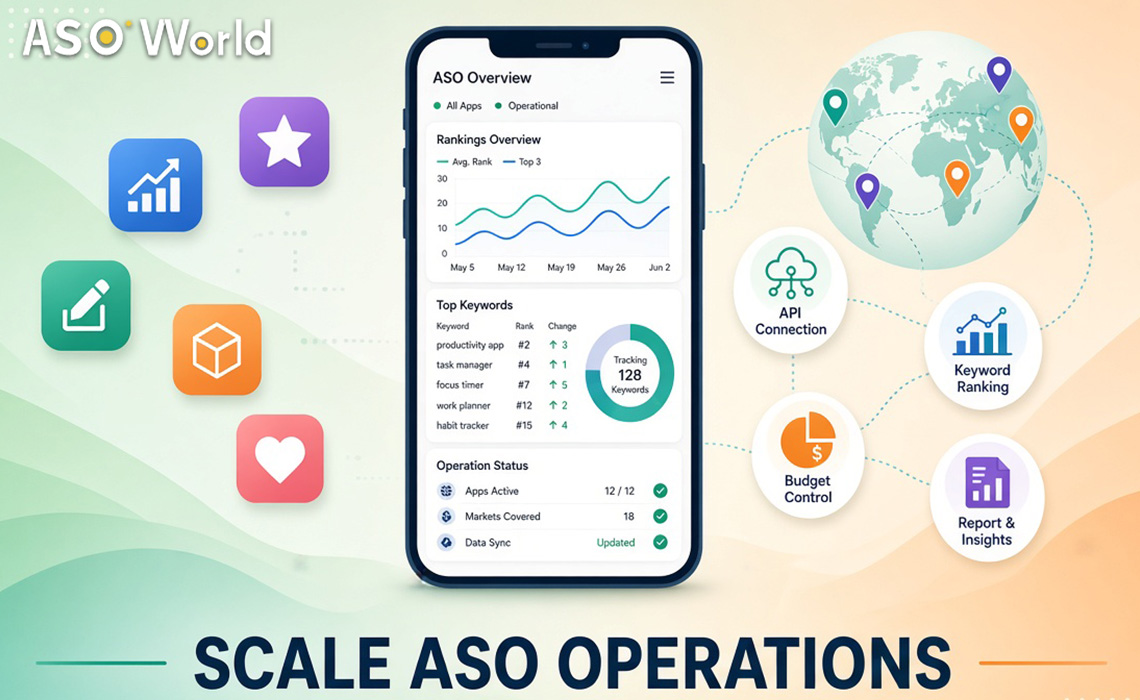
- Once you manage more than a handful of apps or a dozen markets, ASO becomes an operations problem as much as a marketing one. You're dealing with keyword lists per market, pacing rules, approvals, reporting and spend control.
- There are three main operating models: an in-house team with tools, a full-service agency, and a per-unit service provider with an API. Each is strongest at a different scale.
- A useful rule of thumb: in-house for a few apps in a few markets, agency when you need strategy and creative across many markets, and service + API when execution volume is high and your team already knows what to run.
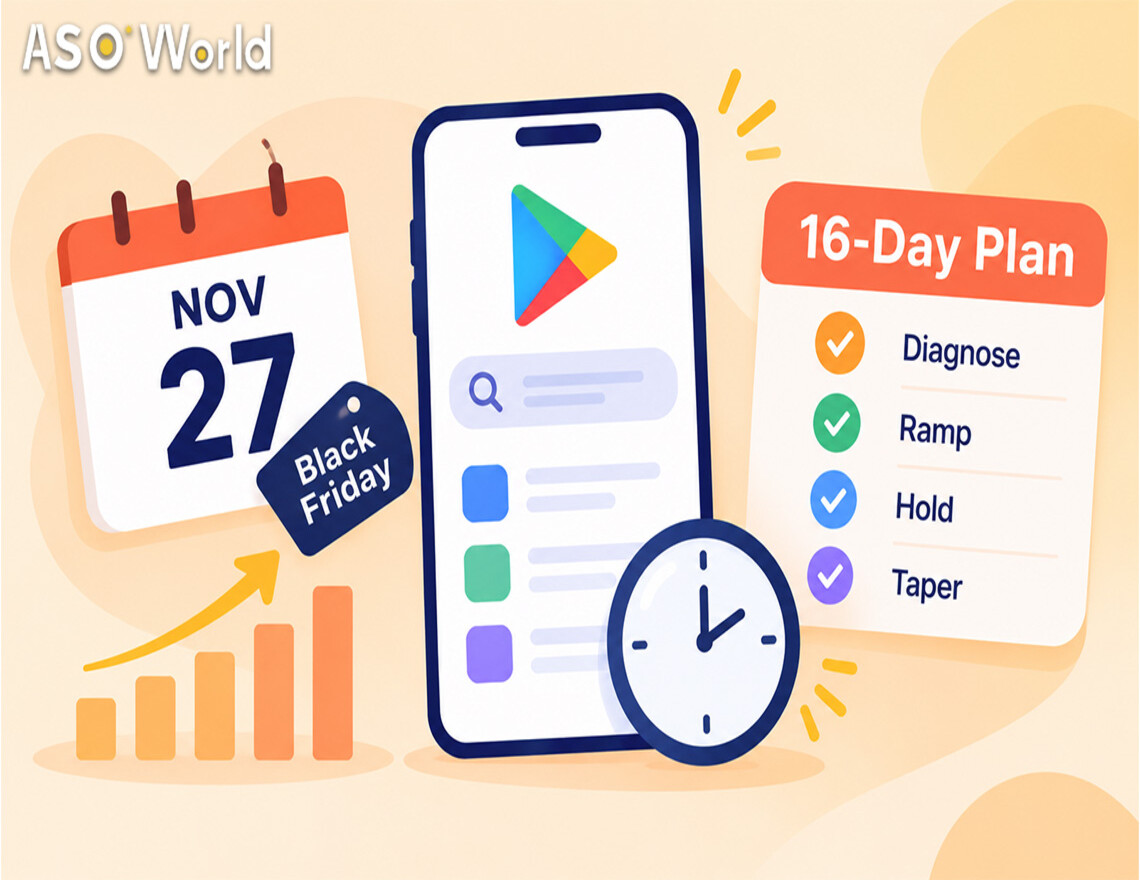
- Before Black Friday, the biggest risks at scale are running out of pre-approved budget mid-week, uneven pacing across markets, and reports that don't match between teams. Sort these out by around November 20.
- When you compare providers, check country coverage, API access, volume pricing, pacing control, reporting and support languages. Headline unit prices matter less than these.
What breaks when ASO scales?
Running keyword campaigns for one app is mostly about choosing keywords. Running them for 20 apps across 15 countries brings new problems:
| Problem at scale |
What it looks like |
Cost |
| Keyword lists drift |
Each market manager keeps their own spreadsheet; nobody knows which list is current |
Spend on outdated or overlapping keywords |
| Uneven pacing |
One market ramps hard while another stalls; pace changes aren't coordinated |
Rankings jump and drop; wasted budget |
| Draft orders never launched |
Campaigns are set up but not started before the deadline |
Missed peak days |
| Budget runs out mid-campaign |
Prepaid balance or approval limit reached on day 4 of a 7-day push |
Rankings fade before the peak |
| Reporting gaps |
Different teams report rank, installs and spend differently |
Hard to judge payback; slow decisions |
| Single point of failure |
One person knows how campaigns are set up |
Delays when they're away, often during holidays |
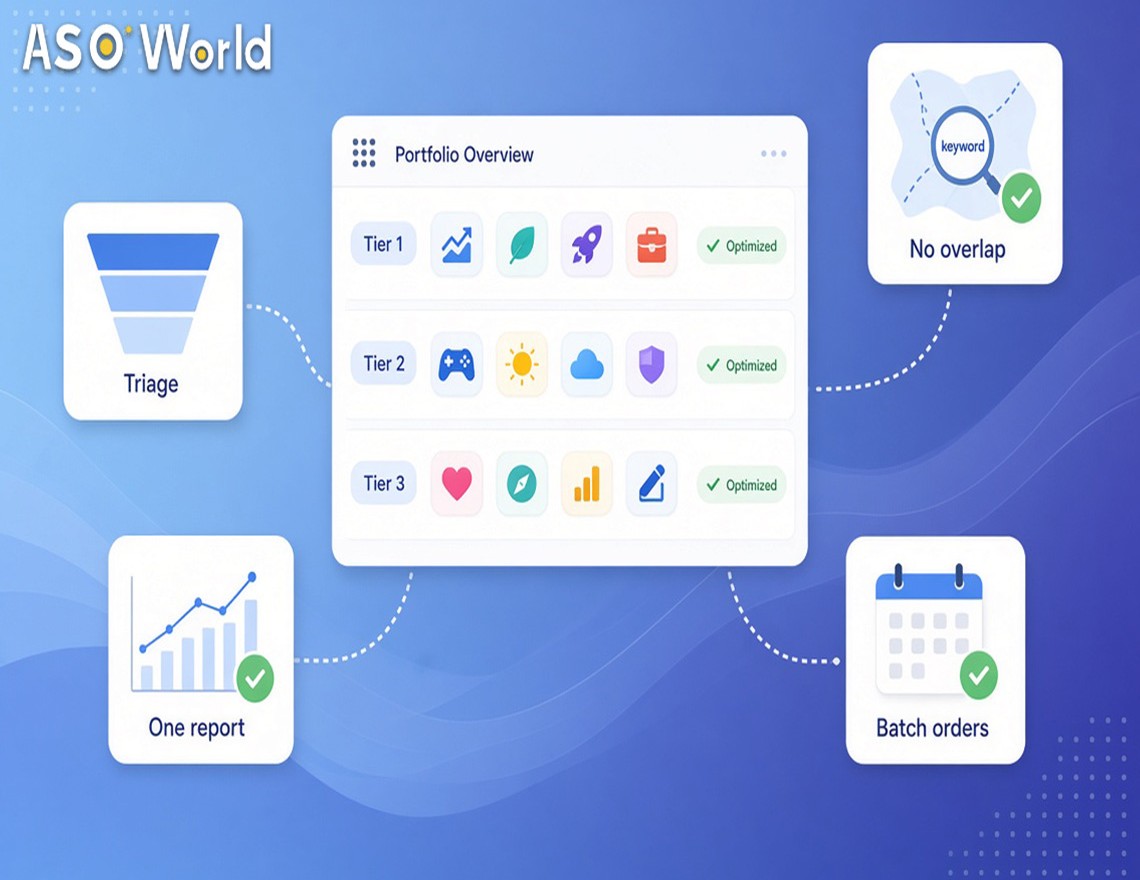
Each operating model handles these problems differently. Before you choose one, it helps to write the workflow itself down — a portfolio workflow for 10+ apps covers tiering, keyword maps and weekly reviews."
In-house, agency, or service + API: how do they compare?
| |
In-house team + tools |
Full-service agency |
Service provider + API |
| What you get |
Full control; your own strategy and execution |
Strategy, metadata, creatives, testing, reporting |
Per-unit execution (keyword installs, package installs, reviews) through dashboard or API |
| Typical cost |
Salaries + tools (tools from ~$69/month to enterprise suites) |
Often $2,500–$15,000+/month retainers, 3–6 month minimums (AppAgent) |
Pay per unit; volume pricing as spend grows |
| Speed to launch a new market |
Slow (research + setup) |
Medium (onboarding) |
Fast, once your keyword list exists |
| Scales with volume? |
Only by hiring |
Partly; cost rises with scope |
Yes; API handles many apps and markets |
| Who owns the strategy |
You |
Agency (shared) |
You |
| Best for |
1–5 apps, 1–5 markets, ASO expertise in-house |
Brands needing full creative + strategy across many markets |
Publishers, studios and agencies running high execution volume |
| Main risk |
Bandwidth during peaks |
Cost; less control over pace |
Needs clear keyword plans and internal rules |
Many large teams combine the models: in-house strategy, an agency or fixed-price packages for creative refreshes, and a service + API layer for execution.
Which model fits your portfolio? A decision matrix
| Apps × markets |
ASO expertise in-house |
Recommended model |
| 1–3 apps, 1–5 markets |
Yes |
In-house + tools; per-unit services for peak pushes |
| 1–3 apps, 1–5 markets |
No |
Fixed-price metadata package + guided campaigns |
| 4–20 apps, 5–15 markets |
Yes |
In-house strategy + service provider via dashboard or API |
| 4–20 apps, 5–15 markets |
No |
Agency for strategy; service provider for execution |
| 20+ apps or 15+ markets |
Yes |
Service + API as the execution layer, with internal pacing rules and reporting |
| You are an agency or reseller |
— |
Service + API, plus volume pricing so your margin holds as you grow |
For agencies and resellers, the per-unit model has one more advantage. Your cost per unit falls as your clients' combined volume grows, instead of rising with each new client.
What should you check before choosing a provider? Eight criteria
| # |
Criterion |
What to ask |
Why it matters at scale |
| 1 |
Country coverage |
Which storefronts and stores (App Store, Google Play, Galaxy Store, RuStore)? |
Gaps force you to manage several providers |
| 2 |
API access |
Can orders be created, paced and tracked through an API? What are the quotas? |
Manual ordering doesn't scale past a few apps |
| 3 |
Pacing control |
Can you set daily volume per keyword and per country, and change it mid-campaign? |
Even pacing protects rankings |
| 4 |
Volume pricing |
Do unit prices drop automatically as spend grows? At what thresholds? |
Decides your margin and cost per install |
| 5 |
Reporting |
Can you export rank, delivery and spend per app and market? |
One report for all teams |
| 6 |
Team access |
Can several people work on the account with clear roles? |
Removes single points of failure |
| 7 |
Support languages and hours |
Who answers on the Friday before Black Friday? |
Problems on peak days are expensive |
| 8 |
Prerequisites and limits |
Which apps, stores or keyword states aren't supported? |
Avoids failed orders and disputes |
ASOWorld's app promotion service includes API services for apps and keywords in 100+ countries, combo packages and customized solutions. Unit prices drop automatically through membership tiers as cumulative spend passes thresholds such as $1,000, $5,000 and $10,000. If your team needs shared access, ask about team setup when you onboard.
What does a scaled keyword workflow look like?
A simple operating rhythm that works for most portfolio teams:
- One master keyword sheet per app, with one tab per market: keyword, current rank, target window, daily pace, owner.
- Weekly pacing review (one meeting, all markets): keep, raise, lower or drop each keyword based on the 7-day average.
- Orders created from the sheet, through API or bulk setup, so the sheet is the single source of truth.
- Daily delivery check: are all orders running? Is any balance or quota close to the limit?
- Weekly report: Top 10 coverage, search impressions, installs from search and spend by app and market.
Keyword installs suit the per-keyword layer of this workflow. They start from $0.20 per install on Google Play and $0.30 on iOS at base rates (checked November 10, 2026). Chart pushes for priority markets run through package installs, from $0.15 on Google Play and $0.30 on iOS.
How should a portfolio team prepare for Black Friday?
| Date (2026) |
Task |
| By Nov 18 |
Keyword sheets final for all priority markets; iOS metadata submitted |
| By Nov 20 |
Budget pre-approved for the whole peak, including a 10–15% reserve; balance and API quotas checked |
| Nov 20–22 |
All orders created and started; no drafts left |
| Nov 23–29 |
Daily delivery check; pacing changes only through the weekly rule (or for real emergencies) |
| Nov 28–Dec 4 |
Taper plan by market; post-peak report template ready |
Tip: name a backup owner for every market for the Thanksgiving weekend. The bigger planning question is where to spend — why the same budget performs differently by country explains the storefront gap.
How should agencies and resellers price client campaigns?
If you resell keyword or install campaigns, three habits protect your margin through peaks:
- Price clients per outcome window, not per install. For example, "Top 10 coverage on 15 keywords for 4 weeks". This leaves room to adjust pace without renegotiating.
- Pool client volume with one provider. Combined spend moves your account through volume tiers faster, so your unit cost falls as your client base grows.
- Pass through transparency, not raw data. Share rank screenshots, delivery summaries and search-install trends with clients. Clear evidence prevents most disputes, which matter more at scale than unit price.
Agencies should also agree on peak-week rules with each client in advance: approval limits, who can pause a campaign, and how the taper is handled after Black Friday.
Common mistakes when scaling ASO
- Scaling execution before the keyword plan is ready. More volume on the wrong keywords costs more, faster.
- Using one pace everywhere. Low-competition markets need a gentler pace, and high-competition ones need more patience.
- Spreading spend across many providers. You lose volume pricing and get reports that don't match.
- No quota or balance alerts. A campaign that stops on day 4 of a peak week loses most of its value.
- Reporting rank only. Portfolio decisions need installs from search and cost per extra organic install by app and market.
If your teams need a shared view of what "working" means across apps, the keyword ranking and organic downloads solution is built around keyword coverage and organic downloads rather than single positions.
FAQ
When should a publisher move from in-house ASO to an API-based provider?
Usually once you're running keyword campaigns for more than a few apps or a dozen markets. Manual ordering and spreadsheets start to cause pacing errors and missed launches at that point.
Do ASO agencies use per-unit providers?
Many do. Agencies handle strategy and creative and use per-unit services for execution, which keeps their costs tied to client volume.
What should an ASO API let me do?
Create orders by app, store, country and keyword, set and change daily pace, check delivery status and export results. Also check quotas so campaigns don't stop mid-peak.
How do volume discounts work for keyword installs?
With tiered pricing, unit prices drop automatically once your cumulative spend passes set thresholds. That's why consolidating spend with one provider can lower your cost per install.
How many markets can one team manage well?
With a master keyword sheet, weekly pacing reviews and API-based ordering, a small team can manage dozens of app–market pairs. Without them, quality usually drops after about 10.
What's the biggest Black Friday risk for large ASO portfolios?
Campaigns stopping mid-week because budget, approval or quota runs out, and drafts that were never started. Check both by November 20.
 COVID-19 UPDATE