TL;DR
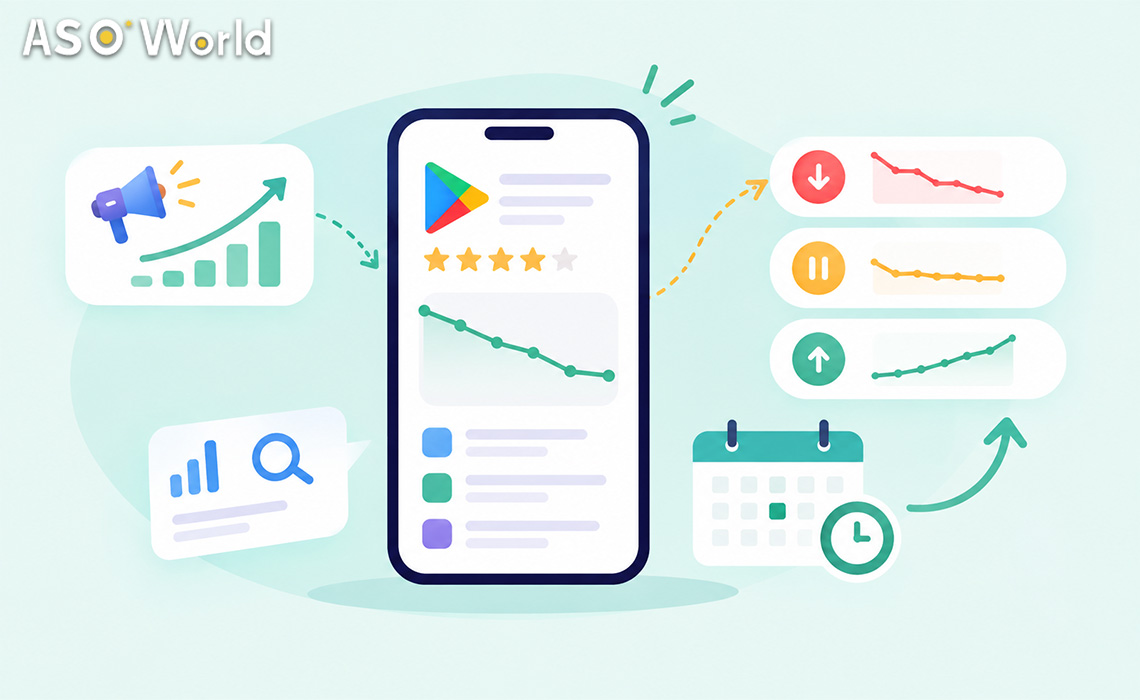
- Rankings that fall a few days after a campaign ends are normal: both stores weight recent installs and engagement, so removing a large share of daily activity overnight removes the signal that held the position.
- The fix is not "buy the same campaign again". It is a taper: step down from a higher-intensity pace to a maintenance pace over 2–3 weeks while organic installs, conversion and ratings take over.
- Google Play usually reacts slowly in both directions (about 7–9 days); the App Store reacts fast in both directions. Taper Google Play gradually and never leave iOS gaps.
- Use a simple decision matrix: hold, taper, rotate or stop — based on rank band, organic share and conversion rate.
- The goal of maintenance is not to hold a ranking forever with paid activity; it is to buy enough time for organic signals to carry the position.
You ran a keyword campaign, watched your app climb into the top five for a term that matters, and then — a few days after the order finished — the ranking slid back to page two. This is one of the most common experiences in app growth, and it usually leads to one of two bad decisions: give up on the keyword, or repeat the same campaign at the same intensity. This guide shows a third option.
Why do rankings drop after a campaign ends?
Store algorithms do not "remember" a ranking. They recalculate it continuously from recent signals. When a campaign ends, several of those signals change at once.
1. Install velocity falls off a cliff
Both stores weigh recent installs for a keyword heavily. If 70% of your daily installs for a term came from the campaign, the day it ends your velocity drops by 70%. The ranking adjusts to the new reality.
2. Conversion rate was never strong enough to hold the position
At position 3, your listing is shown to far more searchers than at position 15. If those searchers don't install at a competitive rate — because of weak screenshots, a low rating or an unclear value proposition — the store gradually moves you back to where your conversion rate "belongs".
3. Competitors kept spending
Seasonal periods, and especially Q4, bring more apps bidding for the same terms. A position that was cheap to hold in September can be expensive in November.
4. Ratings and reviews didn't keep up
Rising rankings with a flat or falling rating send a mixed signal. On Google Play in particular, a meaningful share of reviews is filtered or removed, so the social proof you expected may not be visible.
5. Store-specific reaction speed
Google Play tends to respond slowly — rankings often need about a week to stabilise, and they decline gradually. The App Store responds within days, which also means positions fade quickly once daily activity stops. Treating both stores the same way is a frequent cause of "sudden" drops.
What does a healthy post-campaign curve look like?
A good maintenance plan does not keep the ranking perfectly flat. It aims for a controlled glide where organic installs replace paid ones:
| Phase |
Paid share of keyword installs |
Expected ranking behaviour |
What you are waiting for |
| Peak (campaign) |
60–80% |
Climbs to target band |
Visibility and impressions |
| Taper (days 1–14 after peak) |
40% → 20% |
Small fluctuations within the band |
Organic installs from the new visibility |
| Maintenance (days 15–30) |
10–20% |
Holds within 2–5 positions |
Conversion rate and ratings to stabilise |
| Organic (day 30+) |
0–10% |
Settles at a sustainable level |
A position your app can defend on its own |
If the organic share is not rising during the taper, the problem is not the campaign — it is the listing, the rating or the keyword choice.
The 30-day ranking maintenance plan
Days 1–3: measure before you change anything
- Record your rank for each target keyword daily, by country and store, along with impressions and conversion rate from App Store Connect or Play Console.
- Separate keywords into three groups: reached the target band, moved but stalled, didn't move.
- Check your rating trend and how many new reviews are actually visible.
Days 4–14: taper, don't stop
- For keywords in the target band, reduce daily volume by roughly 25–30% every 3–4 days rather than ending at once. On iOS, keep activity continuous; even a short gap can cost several positions.
- On Google Play, change volumes gradually and wait about a week before judging the effect, because the store reacts slowly.
- For keywords that moved but stalled, decide whether to rotate to a closely related, less competitive term.
- Stop spending on keywords that didn't move; put that budget into conversion work.
Days 15–21: fix conversion while you still have visibility
You are still ranking higher than before the campaign, so every improvement in conversion is multiplied. Refresh the first two screenshots, tighten the subtitle or short description, and run a listing experiment. ASO World's case work on how to increase keyword rankings and organic downloads shows the same pattern: rankings held best where conversion improved alongside visibility.
Days 22–30: settle at a maintenance pace
- Keep a small, steady daily volume on the two or three keywords that drive the most organic installs.
- Review weekly instead of daily, and resist the urge to restart a full campaign at the first small drop.
- Plan your next push around a demand peak (a holiday, a feature launch, a sports season) rather than around a ranking dip.
Decision matrix: hold, taper, rotate or stop?
| Situation after 7 days |
Organic share rising? |
Conversion rate vs. before |
Decision |
| Rank held in target band |
Yes |
Up or flat |
Taper to maintenance pace |
| Rank held in target band |
No |
Down |
Hold volume one more week and fix the listing |
| Rank slipping 5–10 positions |
Yes |
Up |
Taper slower; organic is catching up |
| Rank slipping 5–10 positions |
No |
Flat or down |
Rotate to a less competitive related keyword |
| Rank fell back to pre-campaign level |
No |
Down |
Stop; fix rating and creative before spending again |
A note on ratings: if your rating is below about 4.0, or reviews keep disappearing on Google Play, fix that before investing in more visibility. Services with a written retention commitment are safer here — for example, guaranteed reviews where more than 80% are expected to stay for 30 days or are refunded — but they work best paced over time and combined with in-app review prompts.
A worked example (hypothetical)
Consider a hypothetical habit-tracker app targeting a mid-competition keyword in the US App Store and Google Play.
| Day |
iOS rank |
GP rank |
Paid share |
Organic installs/day (index) |
Action |
| Before campaign |
38 |
45 |
0% |
100 |
Baseline |
| End of campaign (day 0) |
4 |
9 |
70% |
160 |
Begin taper |
| Day 7 |
5 |
8 |
45% |
210 |
Taper continues; new screenshots shipped |
| Day 14 |
6 |
10 |
25% |
240 |
Rotate one stalled keyword |
| Day 30 |
7 |
12 |
10% |
255 |
Maintenance pace on 2 keywords |
The app did not keep its peak position. It did keep a top-10 iOS ranking and a top-15 Google Play ranking with a fraction of the original spend, and its organic installs settled roughly 2.5 times higher than before. That is what success usually looks like.
Compare that with the most common alternative — stopping completely on day 0. In that scenario the iOS ranking typically drifts back toward the 20s within one to two weeks, Google Play follows more slowly, and organic installs return close to the starting baseline.
How should you budget for maintenance?
A practical rule: plan maintenance at 30–40% of the peak campaign budget, spread over the following 30 days. If you are using keyword installs (from $0.20 on Android and $0.30 on iOS at the time of writing; your app must already appear in the first 250 results for the keyword), the maintenance phase means fewer installs per day over a longer period, not a second burst.
For category or overall chart positions rather than keywords, the logic is the same but the timeline is shorter, because charts respond to very recent velocity. If your goal is broader visibility rather than a handful of terms, a blended plan that combines search, chart position and conversion — such as the approach described in boosting app rankings and user acquisition — is usually more stable than any single tactic.
What to measure every week
- Rank by keyword, store and country — plotted, not just a single number, because daily fluctuations are normal.
- Organic installs from search — the real indicator of whether maintenance is working.
- Conversion rate (product page views to installs) — the signal that decides whether you can keep a position.
- Visible rating and new visible reviews — not just how many were submitted.
- Paid share of daily keyword installs — should trend down week after week.
Common maintenance mistakes
- Stopping on the day the order ends. The steepest drops come from going from full volume to zero.
- Restarting at full intensity after a small dip. This builds an unnatural on-off pattern and resets your spend.
- Repeatedly cancelling and restarting orders. Constant changes make results hard to read and rankings less stable.
- Treating iOS and Google Play the same way. iOS needs continuity; Google Play needs patience.
- Ignoring conversion. Visibility you cannot convert will always slide back.
- Using volumes far above your organic baseline. Keep paid activity proportional to what your app normally receives.
FAQ
Why did my app's ranking drop right after the campaign ended?
Because both stores rank on recent signals. When campaign installs stop, install velocity falls, and the ranking adjusts. A gradual taper softens this.
How long does a keyword ranking last after a campaign?
It varies by keyword competition, store and your app's conversion rate. On iOS, positions often fade within days without continued activity; on Google Play the decline is usually slower.
Should I run another campaign immediately?
Usually not at the same intensity. Taper to a maintenance pace and fix conversion first; save the next push for a demand peak.
What is a maintenance pace?
A smaller, steady daily volume — typically a fraction of the peak volume — that keeps a keyword's signal alive while organic installs take over.
Why are my rankings different on my phone and in my ASO tool?
Rankings vary by device, account, location and the time of the check, and tools sample at different times. Track trends from one consistent source rather than single snapshots.
When should I give up on a keyword?
If rankings fell back to the pre-campaign level, organic share never rose and conversion did not improve after two weeks of fixes, rotate to a more relevant or less competitive term.
 COVID-19 UPDATE