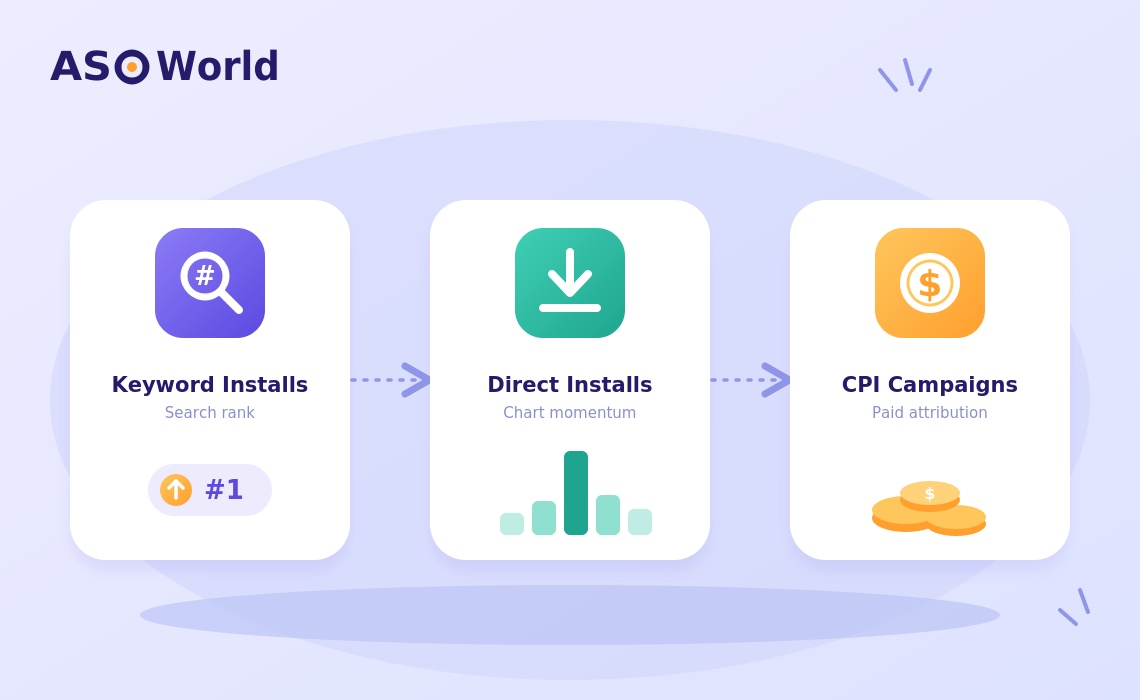
TL;DR: These three options solve different problems. Keyword installs aim to improve your app's rank for specific search terms. Direct (package) installs add to total download volume, which can support category and top chart position. CPI campaigns (Apple Search Ads, Google App campaigns, ad networks) buy attributable installs from paid placements. Most “it didn't work” complaints come from measuring one tool against another tool's goal - for example, expecting keyword installs to create a visible spike in your total install count. Pick the tool by goal, then judge it by the metric that tool actually moves.
Every week we talk to developers who ran a campaign, opened App Store Connect or Google Play Console, and saw almost nothing change in their install chart. Some assume the campaign failed. Often it didn't - they were looking at the wrong number.
This guide compares the three most common ways apps buy growth, explains why results show up in different places, and gives a simple decision matrix for choosing between them.
What Is the Difference Between Keyword Installs, Direct Installs, and CPI?
Keyword installs.
A user searches a specific keyword in the store, finds your app in the results, and installs it. The purpose is to strengthen the connection between that keyword and your app so your search rank improves. The installs themselves are not the product; the ranking is.
Direct installs (package installs).
Installs that are not tied to a specific search term. Their job is to raise total download volume over a short period, which feeds into category rank and top charts.
CPI (cost-per-install) campaigns.
Paid placements - Apple Search Ads, Google App campaigns, or third-party ad networks - where you pay for each install that comes from an ad. Installs are attributed to the ad source and measured through your attribution tool.
How Do They Compare?
| Comparison |
Keyword installs |
Direct installs |
CPI campaigns |
| Main goal |
Search rank for chosen keywords |
Total downloads, category/top chart momentum |
Attributable paid installs |
| What to measure |
Keyword rank, search impressions, organic installs from search |
Category rank, total downloads during the campaign |
Cost per install, retention, ROAS |
| Shows up as a big install spike? |
Usually no - volume is modest and spread out |
Yes, during the campaign window |
Yes, under the paid source |
| Time to see movement |
iOS: a few days; Google Play: roughly 7–9 days |
1–3 days for chart effects |
Immediate while ads run |
| Prerequisite |
App should already rank in the top 250 for the keyword |
None specific |
Ad account, creatives, budget |
| Typical ASOWorld starting price* |
Android from $0.20, iOS from $0.30 |
Android from $0.15, iOS from $0.30 |
Set by the ad platform and market |
| Best for |
Owning specific search terms |
Launches, chart pushes, seasonal peaks |
Scale with tracking and retention data |
Why Don't Keyword Installs Show Up as a Spike in My Install Count?
This is the single most common misunderstanding. Several things are going on at once:
- The volume is deliberately modest. Keyword campaigns work best at a steady, believable pace spread across several days. That rarely looks like a spike on a daily install chart.
- Consoles group installs by source and with delays. App Store Connect and Google Play Console report downloads by traffic source and often lag by a day or more. A modest increase in one source is easy to miss in the total.
- Attribution differs by tool. Your analytics SDK, attribution partner, and the store console each count installs in their own way. Numbers will not match exactly.
- The payoff is indirect. The value of a keyword campaign is what happens after the rank improves: more impressions on that search term and more organic installs from people who were never part of the campaign.
What to measure instead: keyword rank (daily, same time), search impressions for that term, and organic search installs over the following two to four weeks.
Why Does My Phone Show a Different Rank Than My Tracking Tool?
Another frequent source of confusion. Search results can vary by:
- Country and storefront - rankings are per country.
- Device model and OS version - some results display differently, and some app types are not shown on every device.
- Signed-in account and history - personalisation can shift results.
- Time of day - ranks move throughout the day.
A tracking tool samples results consistently; your phone shows one slice. Use the tool for trends and your phone only as a spot check.
Which One Should You Choose? A Decision Matrix
| Your goal |
Start with |
Add later |
Measure by |
| Rank for 3–5 important search terms |
Keyword installs |
Small direct-install support during launches |
Keyword rank, search impressions |
| Climb a category chart before a seasonal peak |
Direct installs |
Keyword installs to hold key terms afterwards |
Category rank, total downloads |
| Acquire users you can attribute and retarget |
CPI campaigns |
Keyword work on terms your ads prove convert |
CPI, day-7 retention, ROAS |
| Fix a low or thin rating |
In-app rating prompt + better-matched traffic |
Review support with retention terms |
Rating trend, review retention |
| New app, no history |
Keyword installs on long-tail terms |
Direct installs at launch |
Rank on long-tail terms, first ratings |
How Do the Three Work Together?
The strongest results usually come from combining tools in sequence rather than choosing one forever:
- Launch or seasonal push: a short burst of direct installs for chart visibility, while keyword work starts on a handful of relevant terms.
- After the push: taper direct installs; continue keyword work at a steadier maintenance pace so the search terms you gained don't fade.
- Once you have data: use CPI campaigns on the terms and audiences that convert best, and feed what you learn back into keyword selection.
On iOS, keyword installs work on terms where your app already ranks in the top 250 for the target country. For download volume and chart momentum, direct app installs are the more appropriate tool. If you want help deciding the mix, the full app promotion service covers planning across both stores.
A Sample 30-Day Plan Using All Three
Here is how a hypothetical new fitness app might sequence the tools in its first month on iOS in one country:
| Days |
Keyword installs |
Direct installs |
CPI campaigns |
Check |
| 1–7 |
3 long-tail terms already in the top 250, steady daily pace |
Short launch support for category visibility |
Off - creatives still in testing |
Rank on the 3 terms; category rank |
| 8–14 |
Continue; add 1 mid-volume term |
Taper off |
Small test on Apple Search Ads |
Which terms reached the top 10? |
| 15–21 |
Step top-10 terms down to maintenance pace |
Off |
Scale the best-converting ad group |
Search impressions, cost per install |
| 22–30 |
Add terms the ads proved convert well |
Off unless a seasonal push is planned |
Hold |
Organic search installs vs. day 1 |
The specific volumes will differ for every app. The point is that each tool has a job, a time window, and its own success metric.
What About Ratings and Reviews?
None of these three tools is a rating strategy. Installs from users who did not find what they were looking for can even hurt your rating. To build ratings that last:
- Send relevant users - people who searched for what your app actually does.
- Time the native rating prompt after a moment of success.
- Respond to reviews and fix the issues they raise.
- If you use review support, choose a provider with clear, checkable terms. For example, Guaranteed Reviews states that more than 80% of reviews should remain for at least 30 days, or the order is refunded.
What Are the Limits and Risks?
Be clear-eyed about a few things:
- Store policies. Both Apple and Google prohibit manipulating charts, search results, and reviews. Pacing, relevance, and natural patterns matter; sudden bursts and activity disconnected from your real audience raise risk.
- Installs are not active users. None of these tools guarantees retention or in-app engagement. Retention depends on your product.
- Platform coverage. Some app types and platforms - for example certain Mac apps and Android TV apps - are not supported by every service. Check before ordering.
- Google Play this season. Many developers report that Google Play keyword ranks have been less predictable lately. Plan in weekly blocks and judge results after the ranking has had time to settle.
How Should You Report Results Without Confusing Your Team?
Report each tool against its own metric:
| Tool |
Headline metric |
Supporting metrics |
| Keyword installs |
Rank on target keywords |
Search impressions, organic search installs |
| Direct installs |
Category / top chart position |
Total downloads, organic uplift after the campaign |
| CPI |
Cost per install |
Retention, ROAS |
When keyword ranks improve, the real proof is in organic results over the next few weeks. Teams that track this well tend to see the effect described on our keyword rankings and organic downloads page: rank first, then the downloads that follow.
Common Misconceptions
“Keyword installs should double my daily downloads.”
They aim at rank. Downloads follow when the higher rank brings more search traffic.
“Direct installs will rank me for keywords.”
Not reliably. They support chart position, not a specific search term.
“CPI is always the expensive option.”
Not always - it depends on market and category. Its advantage is attribution and retention data.
“If my phone doesn't show the new rank, the campaign failed.”
Check the target country and device, and rely on consistent tracking.
FAQ
Do keyword installs count as downloads?
They are real installs, but the volume is modest, spread out, and reported through store consoles by source with delays, so they rarely show as a visible spike. Judge them by keyword rank and the organic installs that follow.
What is the difference between keyword installs and app installs?
Keyword installs come from users who searched a specific term, aiming to improve that term's rank. Direct app installs raise total download volume, which supports category and top chart position.
Is CPI better than keyword installs?
They serve different goals. CPI gives attributable paid installs and retention data; keyword installs target search rank for chosen terms.
How long do keyword installs take to work?
On iOS, movement often appears within a few days of continuous activity. On Google Play, allow about seven to nine days for ranks to stabilise.
Why is my rank different on my phone?
Rankings vary by country, device, OS version, account, and time of day. Use a tracking tool for trends.
Can I combine all three?
Yes. A common sequence is direct installs for launch momentum, keyword installs to hold priority search terms, and CPI to scale what converts.
Choose the tool by goal, measure it by its own metric, and the numbers stop contradicting each other.
 COVID-19 UPDATE