Key Takeaways
- Why is paid ad ROI declining across app categories, and what structural forces are driving up acquisition costs?
- How can App Store Optimization (ASO) systematically reduce your customer acquisition cost while attracting higher-quality users?
- What role do app ratings and reviews play in converting paid traffic — and how does poor reputation management waste your ad budget?
- How does a coordinated strategy of keyword optimization, review management, and data-driven diagnostics create a self-reinforcing organic growth loop?
For years, paid user acquisition was the default growth playbook for mobile apps. Run ads on Meta, Google, or TikTok, scale what works, and watch the installs climb. But in 2026, that formula is breaking. CPIs are rising, post-ATT attribution remains fractured, and the users coming through paid channels often churn faster than they convert. If your ad spend is going up while your return on investment keeps going down, you are not alone — and the answer is not simply to optimize your creatives one more time.
The real solution requires a fundamental shift: moving from paid-traffic dependency to organic growth as your primary acquisition engine. This article breaks down exactly how to do that using ASO, reputation management, and keyword strategy — and how ASOWorld's services fit into each stage of that transformation.
Why Is Ad ROI Declining for App Developers in 2026?
The decline in advertising ROI is not a temporary dip — it is a structural shift shaped by multiple converging forces. Understanding these root causes is essential before choosing the right response.
First, privacy regulations and platform changes have fundamentally altered how ad networks target and measure users. Apple's App Tracking Transparency (ATT) framework, now in its fifth year, continues to limit the precision of audience targeting on iOS. Google's Privacy Sandbox on Android is moving in the same direction. The result is that advertisers are bidding on less precise audiences, which means higher costs per acquisition and lower-quality matches between ads and users.
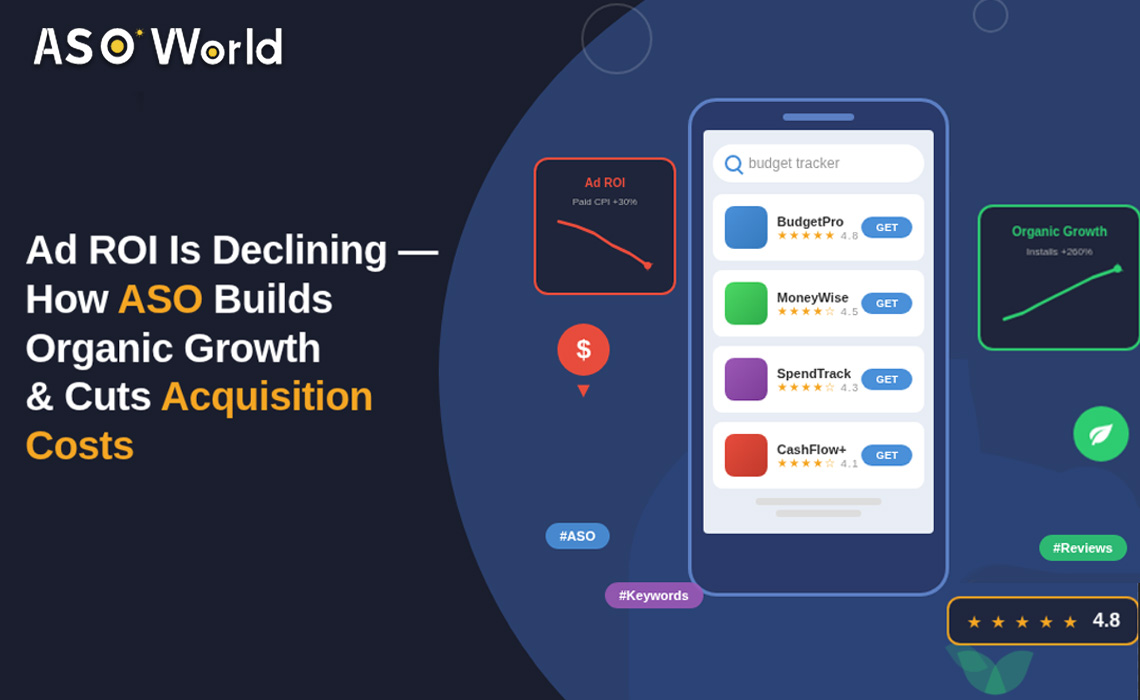
Second, competition for paid inventory has intensified. According to industry data, the average cost-per-install across major ad networks has increased by over 30% since 2023 in competitive categories like fintech, health, and gaming. More apps are competing for the same finite pool of high-intent users, and auction-based pricing ensures that costs keep climbing. Meanwhile, the surge in app submissions driven by AI coding tools has flooded both stores with new competitors, further fragmenting user attention.
Third, there is a quality problem. Users acquired through broad paid campaigns often have lower lifetime value (LTV) than those who discover apps organically. They install because an ad interrupted their feed, not because they were actively seeking a solution. This mismatch shows up in Day-1 and Day-7 retention rates, in-app purchase conversion, and ultimately in unit economics that no longer support the ad spend required to acquire them.
⚡ Expert Tips
- Audit your paid channel performance by cohort, not just in aggregate. Identify which campaigns deliver users with above-average LTV and which are burning budget on low-retention installs.
- Calculate your blended CAC (customer acquisition cost) including both paid and organic installs. If organic represents less than 30% of your total installs, your growth model is fragile.
What Happens When You Over-Rely on Paid User Acquisition?
Over-dependence on paid channels creates a dangerous growth trap. When you stop spending, growth stops immediately — there is no residual momentum, no compounding effect, and no brand equity being built in the app stores. Every new user costs the same as the last one, and that cost only goes up over time.
This stands in sharp contrast to organic growth, which compounds. A well-optimized app store listing continues to attract users 24 hours a day without incremental spend. A strong rating and review profile builds trust that converts browsing users into installers at a higher rate. And a solid keyword ranking position generates ongoing visibility that paid ads cannot replicate at the same cost.
The strategic imperative is clear: you need to build an organic foundation that reduces your marginal cost of acquisition over time. Paid channels still have a role, but they should amplify organic momentum rather than serve as the sole growth driver.
👉 Understanding different traffic sources on Google Play and iOS is the first step toward rebalancing your acquisition mix.
How Can ASO Reduce Your Customer Acquisition Cost?
App Store Optimization is the most direct lever for lowering CAC because it targets users who are already searching for solutions. When someone types "budget tracker" or "meditation app" into the App Store or Google Play, they have declared intent. Ranking in the top results for those queries puts your app in front of a user who is ready to install — no ad spend required.
The mechanics of ASO involve optimizing every element that influences search ranking and conversion: your app title and subtitle with strategic keyword placement, your description with natural keyword density, your visual assets (icon, screenshots, preview video) for maximum conversion, and your metadata alignment with how real users actually search. A comprehensive keyword research and optimization strategy ensures you are targeting the right terms with adequate search volume and manageable competition.
The data supports this approach decisively. Industry research consistently shows that 65-70% of all app store downloads originate from search, and users who find apps through search exhibit significantly higher retention and monetization rates compared to those acquired through display advertising. This is not surprising — search-driven discovery reflects genuine need, while ad-driven installs often reflect momentary curiosity.
ASOWorld's App Store Optimization Service addresses this opportunity comprehensively, covering title and description optimization, visual asset design, and keyword strategy tailored to your app's competitive landscape. For developers new to ASO, a structured ASO plan for beginners provides a clear starting framework.
Why Do App Ratings and Reviews Directly Impact Your Ad ROI?
Here is a scenario that plays out thousands of times every day: you spend money to drive a user to your app store listing through an ad. They arrive, see a 3.2-star rating and a handful of negative reviews complaining about bugs or poor UX, and they leave without installing. You just paid for a click that converted into nothing. Multiply that by thousands of ad impressions, and you begin to see how poor reputation management silently destroys your advertising ROI.
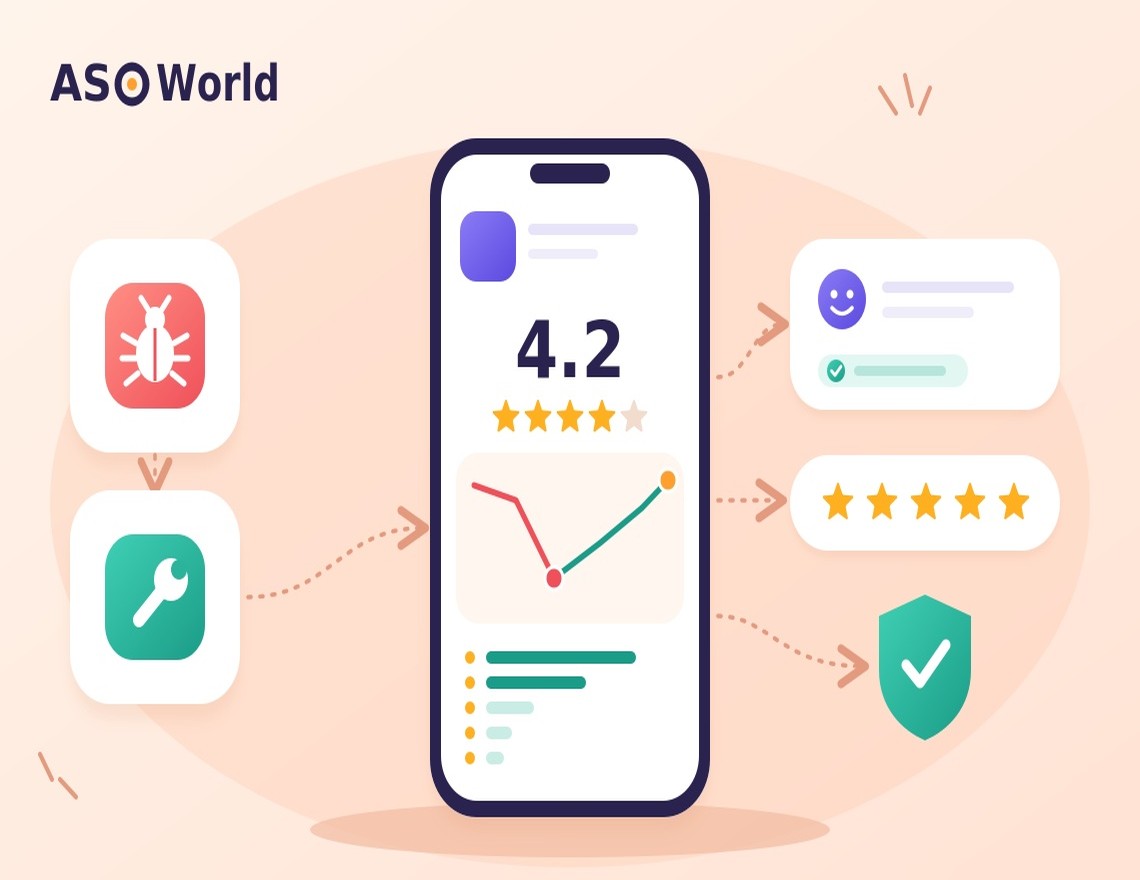
App ratings and reviews function as social proof at the most critical moment in the user journey — the install decision. Research from both Apple and Google has consistently shown that apps with ratings above 4.0 convert at materially higher rates than those below that threshold. The difference can be 2-3x in conversion rate, which means the same ad budget can yield two to three times more installs simply by improving your store rating.
Beyond conversion rate, ratings and reviews also influence app store algorithms. Both the App Store and Google Play factor rating quality and velocity into their ranking algorithms. An app with improving ratings receives algorithmic tailwinds that boost its organic visibility, creating a positive feedback loop between reputation and discoverability.
👉 App Store vs Google Play: How Each Platform Weighs Ratings & Reviews
Proactive review management — encouraging satisfied users to leave reviews, responding thoughtfully to negative feedback, and addressing the product issues that drive complaints — is therefore not a vanity metric exercise. It is a core growth function. ASOWorld's comprehensive guide to app store reviews details how to build a review strategy that strengthens both conversion and ranking performance.
⚡ Expert Tips
- Monitor your store listing conversion rate (impressions to installs) weekly. If it drops below your category benchmark, investigate your rating and review profile before increasing ad spend.
- Implement in-app review prompts triggered by positive user actions (completing a level, achieving a goal) to systematically build your review volume with satisfied users.
- Respond to every negative review within 48 hours. This signals to both algorithms and potential users that you actively support your product.
How Does Keyword Install Strategy Strengthen Organic Visibility?
App store algorithms determine ranking based on a complex set of signals, and one of the most powerful is the association between specific search terms and install behavior. When users search for a keyword and then install your app, the algorithm receives a strong relevance signal: this app satisfies the intent behind this query. Over time, consistent keyword-to-install signals elevate your natural ranking for those terms.
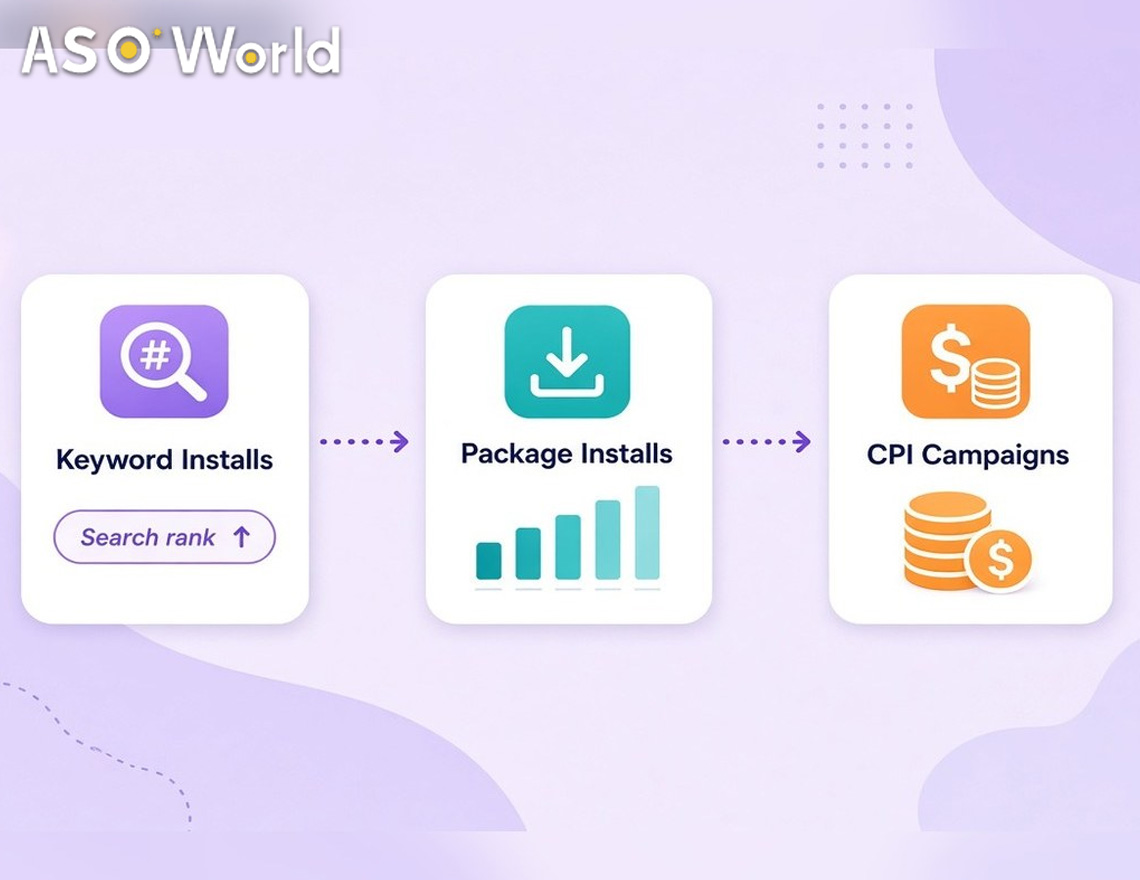
This is where strategic keyword installs become a catalyst for organic growth. By driving targeted installs through specific high-value keywords, you accelerate the algorithmic learning process and establish your app's relevance for terms that matter most to your business. The result is a virtuous cycle: higher keyword ranking leads to greater organic visibility, which drives more natural installs, which further reinforces your ranking position.
The key is selecting the right keywords — terms with sufficient search volume, manageable competition, and strong alignment with your app's value proposition. A focused approach to Google Play keyword optimization ensures you are investing in terms that will deliver sustainable ranking improvements rather than vanity positions on irrelevant queries.
ASOWorld's Guaranteed Keyword Ranking Service is designed specifically for this purpose, providing managed keyword promotion with guaranteed Top 1-5 positions and sustained ranking maintenance. Real-world results demonstrate the impact: one trading app client achieved a move from position 29 to Top 2 for their primary keyword in the UK market, resulting in 260% daily install growth and 3.5x revenue increase.
What Does a Data-Driven ASO Diagnostic Reveal About Your Growth?
Many developers invest in ASO sporadically — optimizing their listing at launch and then neglecting it for months. This approach misses the dynamic nature of app store competition, where keyword opportunities shift, competitor strategies evolve, and algorithm updates change the ranking landscape continuously.
A data-driven ASO diagnostic provides a comprehensive snapshot of where your app stands and where the highest-impact opportunities lie. This includes analyzing your current keyword coverage and identifying gaps where competitors rank but you do not, evaluating your conversion funnel from impression to install to identify drop-off points, benchmarking your rating and review velocity against category leaders, and assessing your visual asset performance through A/B testing insights.
The value of this diagnostic approach is that it transforms ASO from guesswork into precision allocation. Instead of spreading your budget across dozens of keywords or making arbitrary creative changes, you invest in the specific actions that will move the needle most. For apps facing declining ad ROI, this diagnostic often reveals that significant organic growth potential has been left untapped — keyword positions that could be captured with modest investment, conversion rate improvements achievable through visual optimization, or user retention insights that reshape how you think about acquisition quality.
| Growth Lever |
Impact on CAC |
Time to Results |
Compounding Effect |
| ASO Keyword Optimization |
Reduces CAC 40-60% |
2-4 weeks |
High — rankings compound |
| Rating & Review Management |
Improves conversion 2-3x |
1-2 weeks |
Medium — requires ongoing effort |
| Keyword Install Campaigns |
Accelerates organic ranking |
3-7 days |
High — triggers organic loop |
| Data-Driven Diagnostic |
Eliminates wasted spend |
Immediate |
Foundational — informs all tactics |
How Do You Build a Sustainable Growth Engine Beyond Paid Ads?
The transition from paid-dependent growth to organic-first growth is not about abandoning advertising entirely. It is about restructuring your growth architecture so that organic channels provide the foundation and paid channels provide targeted amplification. When your app ranks well organically for high-intent keywords, maintains a strong rating that converts browsers into installers, and has a review profile that builds trust at scale, every dollar you do spend on ads works harder because it sends users to a listing that converts at a higher rate.
This integrated approach — where ASO, reputation management, and keyword strategy work together as a coordinated system — is what separates apps that achieve sustainable growth from those trapped on the paid acquisition treadmill. The apps that will thrive in an era of rising ad costs and tightening privacy restrictions are those that invest in organic discoverability now, building assets that compound in value over time rather than expenses that reset to zero when the budget runs out.
If your current growth strategy feels increasingly expensive and decreasingly effective, now is the time to assess your organic growth potential. Whether you need a full user engagement and CLTV optimization strategy or a targeted keyword ranking campaign, building organic momentum today reduces your dependence on paid channels tomorrow.
FAQs
Can ASO really replace paid user acquisition?
ASO does not replace paid acquisition entirely, but it fundamentally changes the economics of your growth. By building strong organic visibility through keyword rankings, optimized listings, and positive ratings, you reduce the proportion of installs that require ad spend. Many ASOWorld clients find that a well-executed ASO strategy can shift their organic-to-paid install ratio from 20:80 to 60:40 or better, dramatically lowering blended CAC.
How long does it take to see results from ASO optimization?
Keyword ranking improvements can begin appearing within days of a targeted campaign, with significant ranking shifts typically visible within 2-4 weeks. Conversion rate improvements from visual and metadata optimization often show measurable impact within the first week. The compounding benefits of ASO — where improved rankings drive more installs, which further strengthen rankings — accelerate over time, making early investment particularly valuable.
What is the difference between keyword installs and regular paid installs?
Regular paid installs come from ad networks and are attributed to the ad campaign. Keyword installs are driven through app store search for specific terms, sending relevance signals to the store algorithm that improve your organic ranking for those terms. This means keyword installs have a dual benefit: the install itself plus the long-term organic ranking improvement that generates future installs without additional cost.
How do I know which keywords to target for my app?
Effective keyword selection requires analyzing search volume, competition intensity, and relevance to your app's core value proposition. ASOWorld's keyword research tools and diagnostic services help identify terms where you have realistic ranking potential and where ranking would drive meaningful install volume. The goal is to find the intersection of sufficient demand and achievable competition — not the highest-volume terms, but the highest-opportunity terms for your specific app.
Why are organically acquired users more valuable than paid users?
Organic users actively searched for a solution and chose your app based on its listing, ratings, and reviews. This self-selection means they have genuine intent and pre-existing interest, which translates to higher Day-1 retention (typically 15-25% higher than paid users), greater in-app engagement, and stronger monetization rates. These users also have higher potential for word-of-mouth referral, further compounding your organic growth.
 COVID-19 UPDATE