COVID-19 UPDATE


Important Notice:Beware of scams using ASOWorld's name for part-time recruitment or ASO earning app activities. ASOWorld is not hiring any part-time staff. Trust only official information posted by ASOWorld.

Featuring requests for Google Play promotional content need 14 days. Deadlines, keyword installs + CPI roles, a 6-phase schedule and budget for Black Friday.


TL;DR
This is a Google Play–specific execution plan. If you need the cross-store overview, start with our Black Friday ASO timeline; if you want the data behind store differences, see iOS vs Google Play ranking stability.
| Asset | Google Play rule | Deadline for a Nov 20 start | Deadline for a Nov 27 start |
|---|---|---|---|
| Promotional content with featuring request | Submit at least 14 days before start | Nov 6 | Nov 13 |
| Promotional content without featuring | Approval can take up to 4 days; submit at least 4 days before | Nov 16 | Nov 23 |
| Store listing changes (title, descriptions, graphics) | Review can take up to 7 days for some apps; use managed publishing to control go-live | Submit by Nov 12 | Submit by Nov 19 |
| Keyword campaigns | Rankings typically need about a week to settle | Start by Nov 9–13 | Start by Nov 16–18 |
Source: Play Console Help (Promotional content; publishing and review); ASOWorld user case observations | checked November 3, 2026
A single promotional content event can run for up to four weeks, and you can choose to preview it on Google Play up to 14 days before it starts. A Black Friday event running November 20 to December 17 covers the European peak, Black Friday, Cyber Monday and the start of the holiday period in one submission.
What this means for your app: if you want Google to consider your Black Friday event for featuring, this week is the deadline. Everything else can follow over the next ten days.
| Tool | Main job | When it matters most | Watch out for |
|---|---|---|---|
| Promotional content | Explore visibility on Google Play surfaces; Google reports featured events can more than double explore acquisitions | Event window (Nov 20–Dec 17) | Must be new and user-facing; no evergreen content |
| Keyword installs | Move rank for specific search terms | Ramp from Nov 9–13; hold through Dec 1 | App must already rank in the top 250 for each keyword |
| CPI (paid user acquisition) | Add real, engaged users who can open, register and rate | Nov 16–30 | Ad review rules; gambling-style apps may be rejected |
| Direct (package) installs | Short-term chart momentum | 1–3 days before the peak | Keep volumes proportional to your baseline |
| In-app review prompts | Ratings from real users that stay visible | All window long | Follow Google's prompt rules |
Source: Play Console Help; ASOWorld service pages | checked November 3, 2026
The pairing that holds up best on Google Play is keyword installs plus CPI: keyword installs tell Google Play which searches your app should rank for, while CPI adds users whose engagement supports the ranking. For apps where review retention has been a problem, this mix also grows ratings from real users rather than relying on bought reviews.
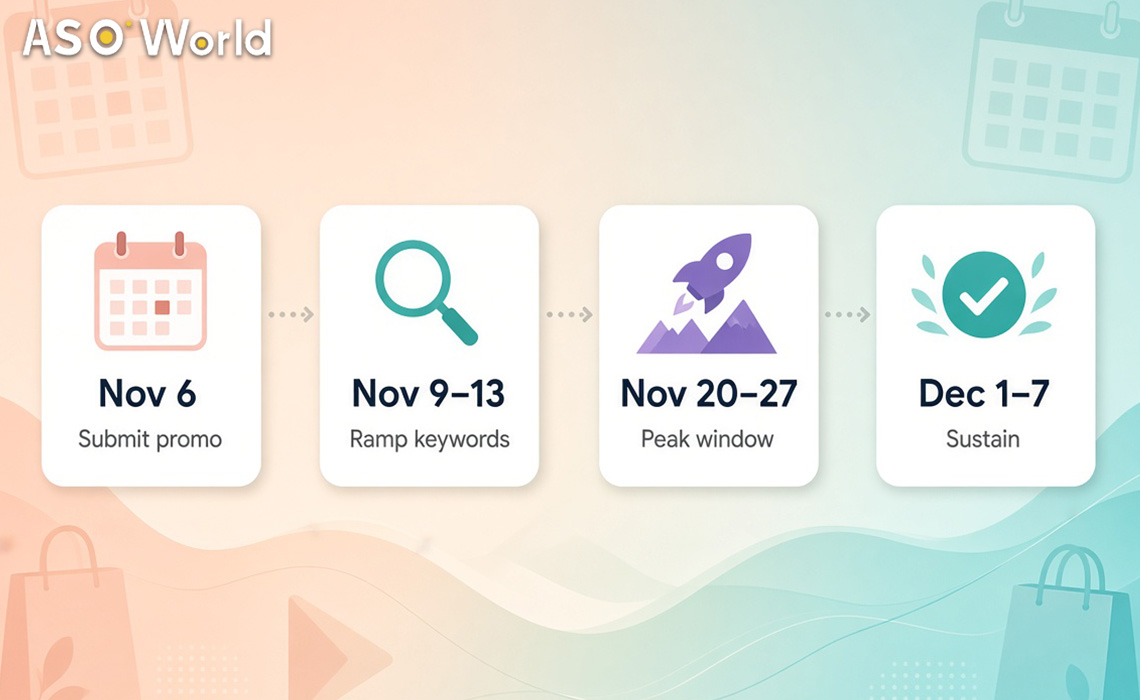
| Phase | Dates (2026) | Actions |
|---|---|---|
| 1. Submit | Nov 3–6 | Submit a promotional content event (Nov 20–Dec 17) with a featuring request; draft the offer copy and visuals |
| 2. Prepare the listing | Nov 6–12 | Update short description and screenshots for the season; submit with managed publishing; localize for Germany, the UK and France |
| 3. Ramp keywords | Nov 9–19 | Start keyword installs on 8–15 terms at a moderate pace; launch CPI at a test budget |
| 4. EU peak | Nov 20–24 | Increase keyword and CPI volume in European markets; promotional content goes live |
| 5. US node | Nov 25–30 | Shift weight to the US; consider 1–3 days of direct installs for chart position if your app already has a strong rating |
| 6. Sustain | Dec 1–7 | Step down to a maintenance pace rather than stopping; keep promotional content running |
Source: ASOWorld planning framework; 2025 demand timing from FoxData estimates (UK, Germany and France peaked Nov 23–24, 2025)
Developers have recently reported Google Play keyword campaigns responding well in several European markets, including Germany, while some markets such as Brazil have been slower. Weight your budget toward the markets that are responding in your own data, and re-check after the first week of phase 3.
What this means for your app: the biggest Google Play mistake is a gap. Rankings slide when campaigns stop between orders, so plan continuous coverage from Nov 9 to Dec 7 and pre-fund it, rather than ordering week by week.
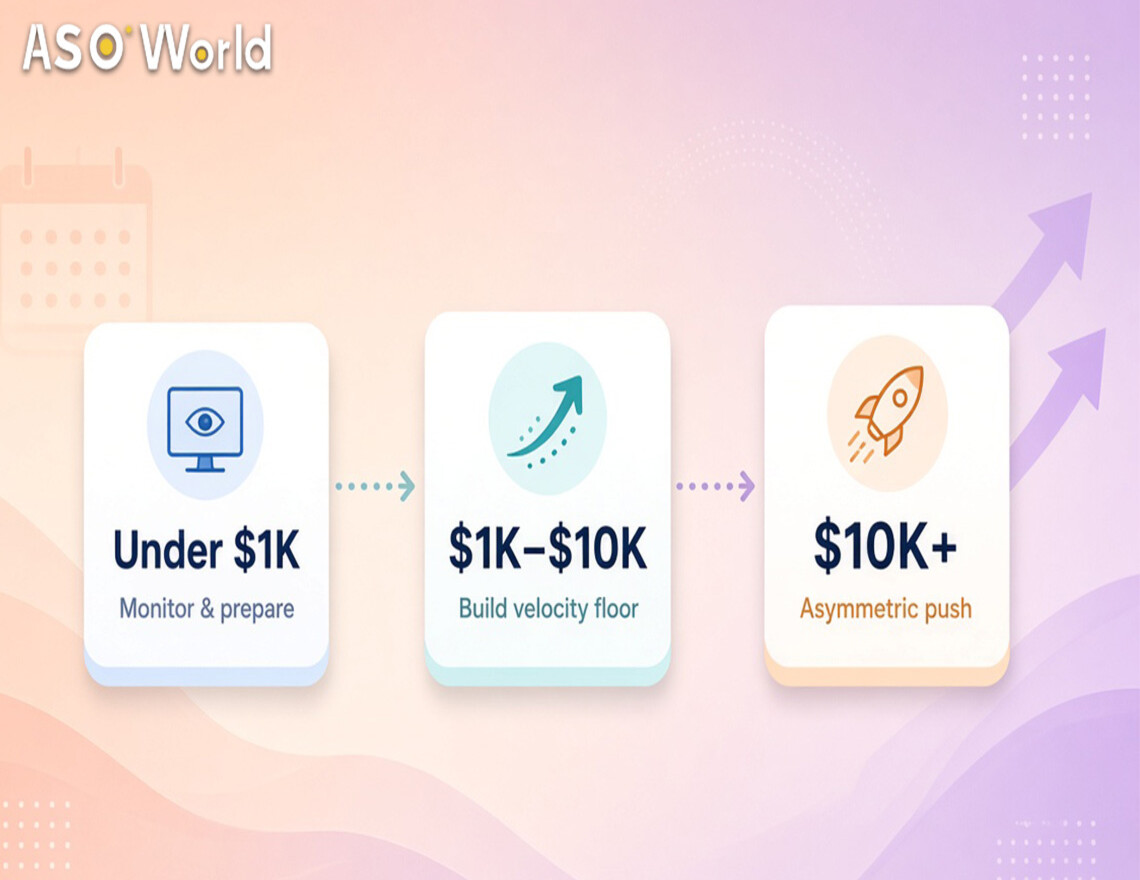
| Tier | Budget | What it covers on Google Play |
|---|---|---|
| Tier 1 | Under $1,000 | Promotional content event, listing refresh, in-app review prompts, keyword installs on 3–5 terms in one country |
| Tier 2 | $1,000–$10,000 | Keyword installs on 8–15 terms across 2–3 countries, test-scale CPI, paced review support |
| Tier 3 | $10,000+ | Multi-country keyword and CPI program, direct installs for chart pushes, sustain phase through December; often scoped as a customized solution |
Source: ASOWorld planning framework; prices verified November 3, 2026
Keyword installs on Google Play start from $0.20 per install, and package (direct) installs from $0.15. CPI campaigns are scoped and quoted per app because costs depend on category, country and the event you optimize for.
Consider a hypothetical utility app on Google Play with about 3,000 organic downloads a day across the US, UK and Germany, a 4.4 rating, and eight target keywords where it ranks between #15 and #80.
| Item | Plan | Volume | Estimated cost |
|---|---|---|---|
| Keyword installs | 8 keywords, 3 countries, Nov 9–Dec 1 | ~900 a day in total (30% of organic), 23 days ≈ 20,700 | ~$4,140 at $0.20 |
| Direct installs | US chart push, Nov 26–28 | ~1,000 a day for 3 days ≈ 3,000 | ~$450 at $0.15 |
| Paced reviews | Local-language gaps in Germany | ~5 a day for 20 days ≈ 100 | ~$150 at $1.50 |
| CPI | Test then scale in the UK and Germany | Quoted separately | — |
| Promotional content | One event, Nov 20–Dec 17 | — | No fee |
Source: hypothetical illustration; ASOWorld prices verified November 3, 2026
That's roughly $4,700 before CPI, with every daily volume kept well below the app's organic baseline. Because Google Play positions tend to decay slowly, the sustain phase in early December often returns more per dollar than the same spend on Black Friday itself.
What this means for your app: for a Tier 2 Google Play plan, the money goes into continuous keyword coverage first, real-user acquisition second, and short chart pushes last.
Check once a week during phases 3–6, and daily only during the US node:
| Metric | Where to find it | What good looks like |
|---|---|---|
| Keyword positions by country | Your ASO tool | Steady climb in phase 3, holding through phase 6 |
| Search + Explore acquisitions | Play Console acquisition reports | Rising together; judge them combined |
| Promotional content performance | Play Console promotional content page | Event impressions and acquisitions during the window |
| Visible new reviews and rating | Play Console ratings and reviews | Rating stable or rising as traffic grows |
Remember that generic keyword searches are often reported as Explore rather than Search in Play Console, so a rising Explore line during a keyword campaign is usually a good sign.
For a plan that lines up promotional content, keyword campaigns and the December sustain phase in one calendar, see ASOWorld's seasonal and event marketing program. For longer-term category positioning beyond the season, the boost app rankings and user acquisition approach covers the ongoing mix.
When should I submit Google Play promotional content for Black Friday?
If you want featuring, at least 14 days before the event starts: by November 6 for a November 20 start, or by November 13 for a November 27 start. Without featuring, submit at least four days ahead, because approval can take up to four days.
How long can a Google Play promotional content event run?
Up to four weeks. A Black Friday event from November 20 to December 17 covers the European peak, Black Friday, Cyber Monday and early December.
When should Google Play keyword campaigns start for Black Friday?
About a week before the demand you want to catch. For the European peak around November 20–24, start by November 9–13.
Should I combine keyword installs and CPI on Google Play?
Yes, for most apps. Keyword installs move rank for specific searches, while CPI adds engaged real users who support the ranking and can leave reviews.
How much does a Google Play Black Friday campaign cost?
It depends on countries and keywords. In our hypothetical example, a three-country keyword program with a short chart push and paced reviews cost about $4,700 before CPI, using ASOWorld prices verified November 3, 2026.
Should I stop campaigns after Cyber Monday?
No. Step down to a maintenance pace through early December. Google Play rankings decay slowly, so sustaining positions is usually cheaper than rebuilding them.
 User Acquisition,Google Play Ranking Algorithm,
Get FREE Optimization Consultation
Let's Grow Your App & Get Massive Traffic!
All content, layout and frame code of all ASOWorld blog sections belong to the original content and technical team, all reproduction and references need to indicate the source and link in the obvious position, otherwise legal responsibility will be pursued.