COVID-19 UPDATE


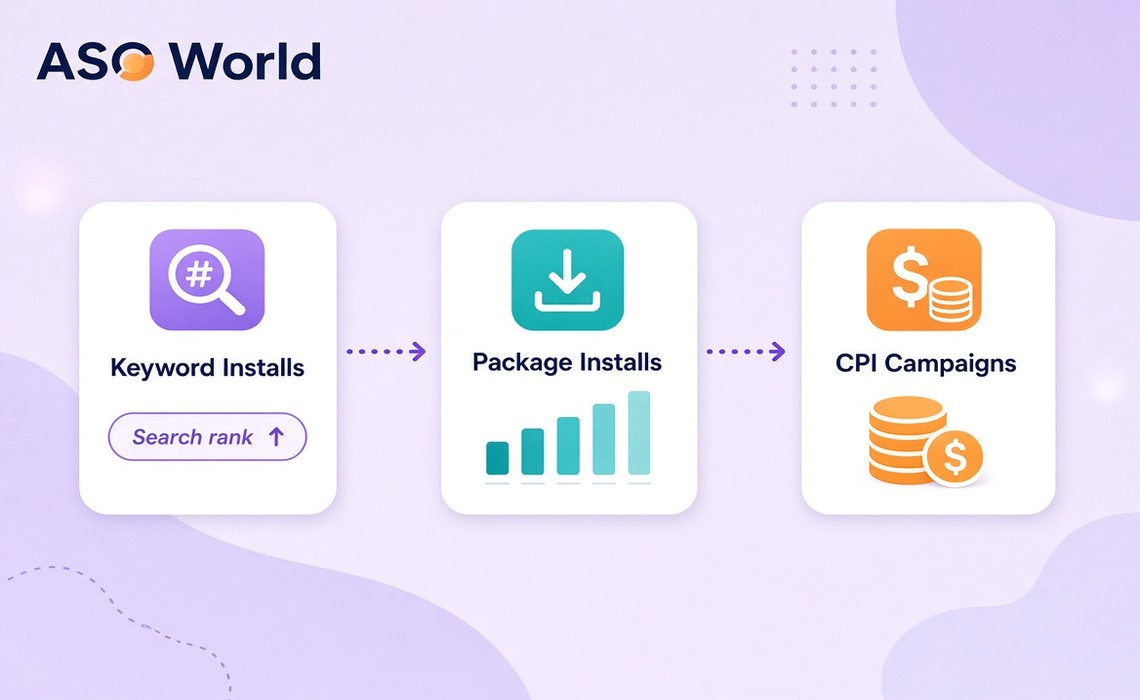
- CPI ads charge you per install from an ad network. Best when you need volume and can measure retention — but you pay per install whether or not your ranking moves.
- Keyword installs send users who search a specific keyword before installing. Best for improving search ranking on a short list of keywords your app already appears for.
- Package (direct) installs deliver installs in a chosen country without a search step. Best for testing a market or supporting category rank, not for keyword ranking.
- On a $20–$100 test budget, start with ASO basics plus a small, gradual keyword campaign on 10+ long-tail keywords. Add CPI only when you can track retention — and only while your app is live and policy-compliant.
If you're an indie developer with a small promotion budget, you'll quickly run into three terms that sound similar but work very differently: CPI, keyword installs and package installs. Choosing the wrong one is how $100 disappears without a single keyword moving.
This guide compares the three models side by side — what you pay for, what each one actually changes in the store, and which fits your budget and stage.
What is the difference between CPI, keyword installs and package installs?
The core difference is what the install is meant to influence.
- CPI (cost per install) is an advertising pricing model. You run ads on a network (Google App Campaigns, Meta, in-app ad networks) and pay each time someone installs. The goal is users; any ranking effect is a side effect.
- Keyword installs are installs that start with a search for a specific keyword in the app store. The goal is to tell the store's algorithm that your app is a relevant answer for that query, improving your keyword ranking and, as a result, organic downloads from that search.
- Package installs (also called direct installs) are installs delivered in a target country without a search step. They add install volume in a country or category but don't target a particular search query.
| CPI ads | Keyword installs | Package installs | |
|---|---|---|---|
| What you pay for | Each install from an ad click | Each install that follows a keyword search | Each install in a chosen country |
| Main goal | User acquisition | Keyword ranking → organic search traffic | Install volume / category rank / market test |
| Targets a search query? | Only in search-ad formats | ✅ Yes | ❌ No |
| Typical starting price on Google Play | Varies widely by country and category (often several times higher in the US than in India) | From $0.20 per install on ASOWorld* | From $0.15 per install on ASOWorld* |
| Time to see effect | Same day (installs) | About 7–10 days for ranking movement on Google Play | 1–7 days (volume) |
| Compounds over time? | Stops when spend stops | Yes, if the keyword ranking holds and converts | Limited |
| Main risk | Paying for low-retention users; spend continuing after a listing issue | Policy risk if overused; wasted spend on keywords you're not indexed for | Policy risk if overused; little ranking effect |
*Prices checked October 14, 2026 on ASOWorld's product pages; shown as "from" prices and may reflect a first-order promotion.
How does CPI advertising work for small apps?
With CPI, you set a budget and a target cost per install, and the ad network finds users. Benchmarks published by Business of Apps put the average Android CPI on Google Ads at around $2.65 and Meta at around $3.75 (global averages heavily influenced by Tier-1 markets). Costs in India and Pakistan are typically far lower, but so is the revenue per user — which is why many South Asian developers who test CPI find the real question isn't "how cheap is the install?" but "does this user stay?"
CPI works best when:
- You can measure retention and in-app events (with an attribution tool or at least Firebase).
- Your store listing already converts well — every listing visitor who doesn't install still costs you indirectly.
- You have a monetization model that pays back in weeks, not months.
CPI works poorly when:
- You only have $20–$50 to test. Ad networks need data to optimize; tiny budgets often end before the algorithm learns.
- Your app's listing status isn't stable. If an app is suspended or removed from the store while a CPI campaign keeps running on some channels, you may still be charged for traffic that can't convert — and, on prepaid platforms, the account can go into a negative balance. Before running any paid install campaign, confirm the app is live, compliant with store policy, and that you hold the rights to any content it streams or displays (this is especially important for live-sports and media apps).
How do keyword installs improve search ranking?
App store search ranking is driven by two things: relevance (do your title, short description and full description match the query?) and performance signals for that query (do people who search it install your app and keep it?). Keyword installs work on the second part.
That's why keyword installs only help on keywords your app is already covered for — meaning it appears somewhere in the top 250 results. If you're not indexed for a keyword at all, no amount of installs will move it; fix your metadata first.
Effective keyword campaigns on Google Play follow a few rules (these are also the guidelines in ASOWorld's own keyword-picking guide):
- Run many keywords at once — at least 10 per day — rather than pushing one big keyword.
- Favor long-tail keywords (roughly 70–90% of the list). They rank faster, convert better and cost less to move.
- Ramp up gradually instead of spiking volume on day one.
- Keep keyword installs well below your organic baseline — a common guideline is no more than 30% of total daily installs.
- Give Google Play time. Expect about 7–10 days before ranking changes are readable.
An honest note on policy: Google Play's policies prohibit manipulating store placement through fraudulent or incentivized installs. Promotional installs carry policy risk, and that risk rises with volume and spikes. Treat keyword installs as a supporting signal on top of a strong listing — not a replacement for one — and keep the volumes modest and natural.
You can see current keyword targeting options, per-store pricing (Google Play, App Store, Galaxy Store and RuStore) and add-on tiers on the keyword installs page.
When do package installs make more sense?
Package installs are useful when you need volume in a specific country without tying it to a search term. Common uses:
- Market testing: checking whether a listing converts and retains in, say, India vs. Bangladesh before localizing further.
- Launch support: giving a new app initial install volume in its home market so it's not starting from zero.
- Category rank support: helping an app hold a category chart position during a seasonal window.
What package installs won't do is reliably move a specific keyword ranking — they don't include the search step that tells the store which query you're relevant for. ASOWorld's package installs start from $0.15 per install on Google Play at the time of writing; the same policy considerations as keyword installs apply.
Which model should you choose for your budget?
Use this decision matrix as a starting point. The figures are planning ranges, not guarantees — your category, country and listing quality will shift them.
| Budget (first month) | Your situation | Recommended mix | Avoid |
|---|---|---|---|
| $20–$50 | New app, few organic installs, testing the waters | Fix metadata and screenshots first; small keyword test on 10–15 long-tail terms you're already indexed for | CPI (too little data for networks to optimize); single high-volume keywords |
| $100–$300 | Listing converts decently; some organic installs | Gradual keyword campaign on 15–30 terms across 2–3 weeks; optional package installs to test one new country | Spending everything in week one |
| $300–$1,000 | Clear retention data; monetization in place | Keyword campaign for ranking + small CPI test with retention tracking; consider professional ASO for the listing | CPI without attribution; promoting before fixing a low rating |
| $1,000+ / agency | Multiple apps or clients | Keyword matrix per app, CPI for proven geos, regular metadata refresh | Treating all apps with the same keyword list |
Not sure whether your problem is visibility or conversion? The difference decides which column you belong in. If you rank but nobody installs, fix the listing before buying any traffic. If you convert well but nobody sees you, ranking work is the right investment — ASOWorld's boost app rankings and user acquisition solution page shows how metadata, creatives and install support fit together.
What mistakes do small developers make when choosing a promotion model?
- Comparing price per install across models as if they were the same product. A $0.20 keyword install and a $1.50 CPI install are buying different outcomes.
- Pushing keywords the app isn't indexed for. Check coverage first.
- Going all-in on one head keyword. "Music player" or "photo editor" are brutally competitive; long-tail clusters move faster.
- Running paid installs while the rating is falling. New users land on a 3.6-star listing, many don't install, and the ones who do may not stay. Fix the rating cause first.
- Ignoring listing status. Paid traffic to an app that's been suspended, removed or region-blocked is pure loss.
- Stopping too early. Google Play typically needs a sustained 7–10 day cycle before ranking changes are visible.
How do you get started without wasting your first $20?
- List 20–30 keywords your app should rank for; keep the ones where you already appear in the top 250.
- Pick 10–15 long-tail terms from that list.
- Confirm your listing basics: clear icon, first two screenshots that explain value, a short description that includes your main keyword naturally.
- Start a small, gradual keyword campaign and keep it under 30% of your daily installs.
- Wait 7–10 days, then record rank changes and organic installs per keyword.
- Scale keywords that rank and convert; drop the rest; add new long-tail terms.
ASOWorld's app promotion service brings keyword installs, package installs, ASO and custom campaigns into one dashboard, so you can start small and scale only what works.
FAQ
Is CPI or keyword installs better for app store ranking?
For a specific keyword ranking, keyword installs are more targeted because they include the search step. CPI campaigns can lift overall install volume and category rank, but most ad installs don't come from the keyword you care about.
What is a good cost per install for a small app?
It depends heavily on country and category. Published global averages for Android are in the $2–$4 range on major ad networks, while CPIs in India and Pakistan are usually much lower. The better question is cost per retained user: an install that's gone in a day is expensive at any price.
Can I start app promotion with $20?
Yes, as a test. Spend most of your effort on free listing improvements and use the budget for a small keyword test on long-tail terms you're already indexed for. Don't expect CPI networks to optimize on $20.
Do package installs help keyword ranking?
Not reliably. Package installs add volume in a country but don't include a keyword search, so they're better for market tests and category support than for specific keyword ranking.
Are promotional installs allowed on Google Play?
Google Play's policies prohibit manipulating store placement with fraudulent or incentivized installs, so promotional installs carry policy risk. Keep volumes modest, ramp gradually, stay well below your organic baseline and never use them as a substitute for a good product and listing.
What happens to a CPI campaign if my app is removed from the store?
Depending on the channel, traffic may continue for a period and you can still be charged. Pause all paid campaigns immediately if your app is suspended or removed, and check listing status before every new campaign.
Next step: Before you spend, check whether your app has a visibility problem or a conversion problem — then pick the model that fixes the one you actually have.