Apple just introduced a new subscription option that could reshape how users pay for apps — and how developers monetize them. Here's what the monthly subscription with 12-month commitment means for your pricing strategy, conversion optimization, and long-term retention, and how to make the most of it.
What Did Apple Announce?
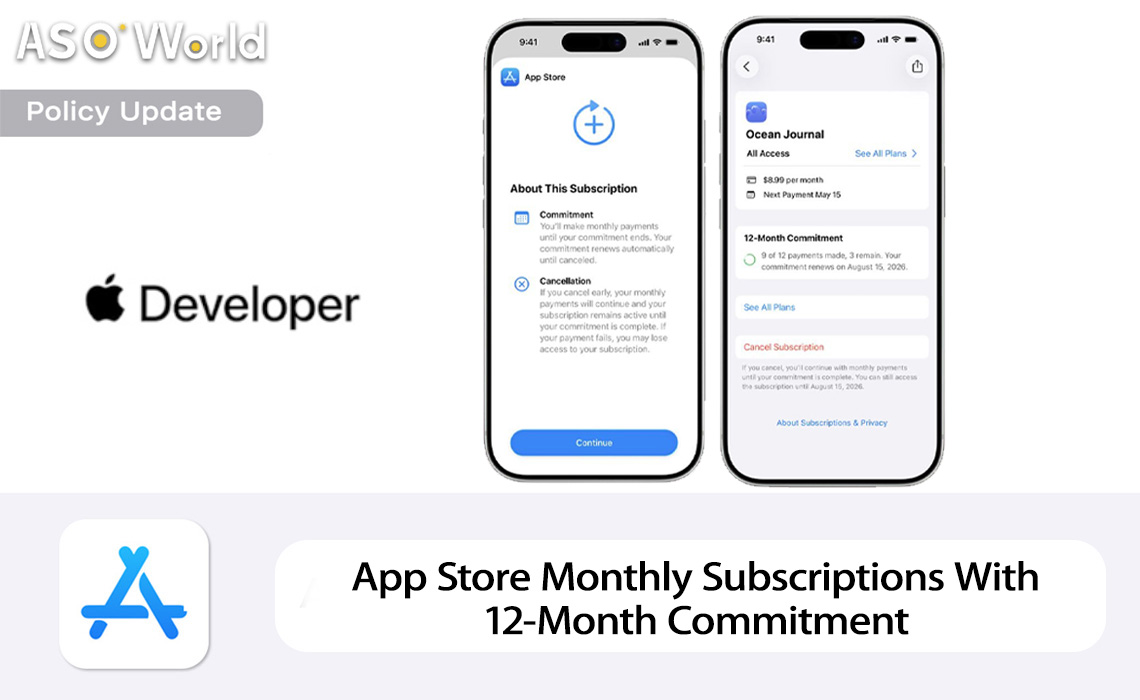
On April 27, 2026, Apple officially launched a new subscription type in App Store Connect: monthly subscriptions with a 12-month commitment. This model allows developers to offer the discounted annual pricing users expect — but billed in smaller, monthly installments rather than a single upfront payment.
Key details from the announcement:
- Users commit to 12 months but pay month by month at a discounted rate (compared to standard monthly pricing).
- Users can cancel at any time, which prevents renewal after they've completed their remaining committed payments.
- Apple provides transparency features: users can view completed and remaining payments, and receive email and optional push notifications ahead of renewals.
- Developers can create these subscription types in App Store Connect and test via Xcode starting now; the feature goes live to users with iOS 26.4 and equivalent platform updates next month.
- Notable exclusion: The United States and Singapore are excluded at launch, with no confirmed timeline for availability in those markets.
If you've worked with subscription apps in any capacity, you immediately recognize the strategic implications. This isn't just a billing change — it's a shift in how users perceive and commit to subscriptions.
🔑 KEY TAKEAWAY
This new model sits between the flexibility of monthly subscriptions and the revenue predictability of annual plans. For developers, it opens a third pricing lane that could meaningfully improve conversion rates — especially in price-sensitive international markets where the upfront cost of an annual plan is a known barrier to conversion.
Why This Matters: The Psychology Behind Subscription Pricing
Subscription pricing has always been a balancing act between two competing forces:
- Annual plans deliver higher LTV and lower churn — but the upfront price tag creates friction at the point of purchase. Many users hesitate to commit $49.99 or $99.99 upfront, even when the per-month cost is lower.
- Monthly plans reduce purchase friction — but suffer from higher churn rates and lower overall revenue per subscriber.
Apple's new 12-month commitment model directly addresses this tension. By allowing users to get annual-level pricing with monthly payment cadence, it reduces the psychological barrier of a large upfront charge while still locking in a longer commitment window.
This is the same model that has proven successful in industries like telecom, SaaS, and streaming (think: Adobe Creative Cloud's annual plan billed monthly). The fact that Apple is now building it natively into the App Store infrastructure signals that subscription sophistication on mobile is maturing.
How This Compares to Existing Subscription Options
| Subscription Type |
Payment Frequency |
Commitment |
Price per Month |
Churn Risk |
| Standard Monthly |
Monthly |
None |
Highest |
High |
| Monthly with 12-Month Commitment (NEW) |
Monthly |
12 months |
Discounted |
Lower |
| Standard Annual |
Yearly (one payment) |
12 months |
Lowest |
Lowest |
5 Actionable Strategies to Leverage This New Subscription Model
This feature is available to configure in App Store Connect today. Here's how to think about integrating it into your monetization and growth strategy.
1. Add It as a Third Pricing Tier on Your Paywall
Most subscription apps currently present two options: monthly and annual. The 12-month commitment plan creates a natural middle tier. Position it as the "best value" option — users get the monthly payment flexibility they prefer with a meaningful discount over standard monthly pricing.
💡 EXPERT TIPA/B test your paywall with three tiers vs. two. In many SaaS contexts, adding a "recommended" middle option increases overall conversion by 10–20% through the
decoy effect — where the middle option makes the annual plan look like a better deal, while also capturing users who would otherwise default to monthly. Use App Store Connect's product page optimization features to test different presentations. For more on conversion optimization, see our guide on
how to leverage custom product pages to increase conversion rates.
2. Prioritize International Markets (Where This Launches First)
The U.S. and Singapore are excluded at launch. This means the initial opportunity is in international markets — many of which have higher price sensitivity and where the upfront cost of an annual subscription is a documented conversion barrier.
If you're already running localized ASO strategies with keyword optimization across multiple storefronts, you're well-positioned to be an early mover. Pair localized metadata with the new commitment plan to capture users in markets like Brazil, India, Southeast Asia, and Europe where monthly affordability drives subscription decisions.
3. Use It to Reduce Involuntary Churn
One underappreciated advantage of monthly billing: it reduces failed payment rates. Annual subscriptions have higher involuntary churn from expired cards, insufficient funds, and payment method changes — because the charge is larger and less frequent. Monthly billing keeps payment methods "warm" through regular small charges, reducing payment failure rates.
✔ ACTION STEPCompare your current involuntary churn rate on annual plans vs. monthly plans. If annual involuntary churn is meaningfully higher, the 12-month commitment plan could recover a portion of that lost revenue while maintaining the retention benefits of a longer commitment. For strategies on keeping users engaged throughout a subscription lifecycle, read our guide on
user retention strategies that make apps sticky.
4. Align Your Messaging With Transparency
Apple is building user-facing transparency features — payment progress tracking, renewal notifications — directly into this subscription type. This is a signal: developers who communicate their commitment plan clearly and honestly will benefit from Apple's UI support.
Conversely, as community reaction has already indicated, there's a risk of user backlash if the commitment aspect is not communicated clearly. Users who expect a standard monthly subscription and then discover they're committed for 12 months will leave negative reviews — which directly damages your App Store ratings profile.
⚠ COMMON MISTAKE
Burying the commitment term in fine print or relying solely on Apple's UI to explain it. Proactively communicate the commitment length, the discount users receive, and the cancellation policy in your own onboarding flow and paywall copy. Transparency builds trust and prevents the kind of negative reviews that tank conversion rates.
5. Model the Revenue Impact Before You Launch
Before implementing, run the numbers. The 12-month commitment plan will likely cannibalize some users from both your monthly and annual tiers. The question is whether the net effect — higher conversion from monthly-hesitant users plus reduced churn — outweighs any revenue-per-subscriber reduction from annual-plan cannibalization.
🔑 KEY TAKEAWAYThe 12-month commitment model is most impactful for apps that currently see a significant gap between monthly and annual conversion rates, and for developers targeting price-sensitive international markets. If your annual plan conversion is already strong, the incremental benefit may be smaller. Test before committing to a full rollout. For a broader view of how App Store changes affect your growth strategy, see our
App Store Optimization plan for beginners.
What This Means for ASO and App Store Visibility
Subscription model changes don't exist in a vacuum — they have downstream effects on your App Store Optimization strategy.
- Conversion rate is a ranking signal. If the 12-month commitment tier improves your paywall conversion rate, the indirect effect on your App Store ranking could be meaningful. Apple's algorithm weighs post-tap behavior, and higher subscription conversion tells the algorithm your app delivers on its promise.
- Review sentiment matters. If poorly communicated, commitment plans will generate negative reviews — which directly affect keyword rankings and browse placement. Invest in clear UX and preemptive support documentation.
- Keyword opportunities. As this feature rolls out, users will search for terms like "affordable subscriptions," "monthly payment plans," and category-specific affordability queries. Consider incorporating affordability-related keywords into your metadata if relevant to your positioning.
In an increasingly competitive app landscape — where AI-driven development is pushing app submissions up 30% — every conversion advantage counts. A well-implemented subscription tier could be the edge that differentiates you from a growing field of competitors.
Looking Ahead: What to Watch
- U.S. launch timeline. With the U.S. excluded at launch, monitor Apple's announcements for when this option becomes available in the largest app market. Being ready to activate on day one gives you a first-mover advantage.
- User behavior data. Once live, track how users interact with the three-tier paywall. Which segments choose the commitment plan? What's the 90-day retention rate vs. standard monthly?
- Competitive adoption. Watch how competitors in your category implement this feature. Early movers who execute well will set user expectations for the category.
Looking for expert help optimizing your App Store presence alongside your new subscription strategy? ASOWorld provides end-to-end App Store Optimization services — from keyword research and metadata optimization to creative strategy and review management — across both iOS and Google Play.
FAQs
What is Apple's new monthly subscription with 12-month commitment?
It's a new App Store subscription option that lets developers offer annual-level discounted pricing, billed in monthly installments rather than a single upfront payment. Users commit to 12 months of payments but pay each month, making the subscription more affordable on a per-payment basis.
When will the 12-month commitment subscription be available?
Developers can create and test these subscriptions in App Store Connect and Xcode now. The feature goes live to users with the release of iOS 26.4 and equivalent platform updates, expected next month (May 2026). The United States and Singapore are excluded at launch.
Can users cancel a 12-month commitment subscription early?
Users can cancel at any time, but cancellation prevents the subscription from renewing after they complete their remaining committed payments. They are still responsible for paying out the remainder of their 12-month commitment period.
How does this affect my app's pricing strategy?
It creates a third pricing tier between standard monthly and annual plans. The optimal approach is to A/B test a three-tier paywall to see whether the commitment plan increases overall conversion without significantly cannibalizing your existing annual subscribers. The biggest impact is likely in international markets with higher price sensitivity.
Will this subscription model work on Google Play too?
This feature is currently exclusive to Apple's App Store. Google Play has its own subscription features (including prepaid plans and installment billing in select markets), but does not offer an identical 12-month commitment model at this time. For Google Play-specific optimization strategies, see our guide on Google Play Store ASO and keyword optimization.
How does the 12-month commitment subscription impact App Store rankings?
Indirectly but meaningfully. If the new tier improves your paywall conversion rate, Apple's algorithm may rank your app higher because post-install engagement signals improve. Conversely, if the commitment model is poorly communicated and generates negative reviews, it could hurt your ratings and visibility. Clear communication and strong user retention practices are essential.
 COVID-19 UPDATE