TL;DR: Disappearing reviews and account warnings almost always trace back to one of three sources: a platform policy violation (incentivized or fake-pattern reviews), an unnatural traffic spike that trips automated fraud detection, or a genuine spike in real user dissatisfaction. The fix isn't a workaround — it's understanding which category you're in, auditing your own practices against public store guidelines, and, where you're relying on third-party review or install services, choosing providers whose guarantees actually reflect confidence in their own compliance (a real retention guarantee is a meaningful signal here).
Why Do App Reviews Disappear in the First Place?
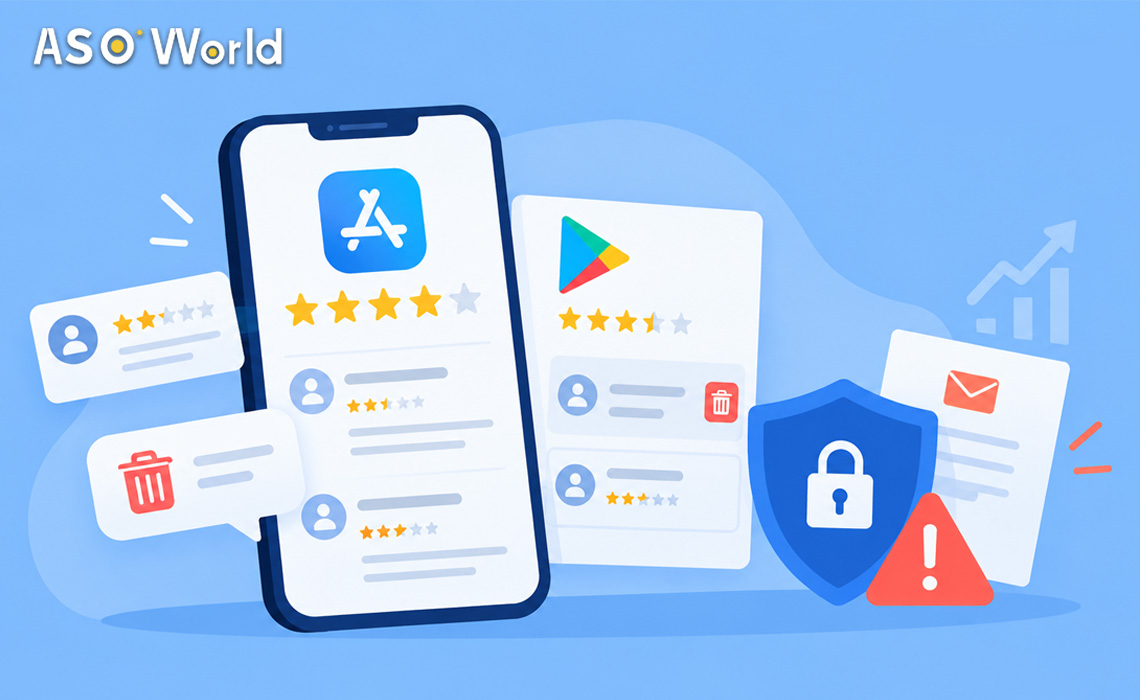
Both the App Store and Google Play run continuous, automated review-integrity systems, and reviews get removed for a handful of well-documented reasons — none of which are mysterious once you know what to look for.
1. Incentivized or policy-violating review patterns. Reviews left in exchange for payment, discounts, or in-app rewards violate both platforms' guidelines outright, and both stores actively detect and strip these — sometimes long after they were posted, which is why a rating can drop unexpectedly weeks after nothing changed on your end.
2. Velocity and pattern anomalies. A sudden, unnatural burst of reviews — especially reviews arriving faster than your install rate would predict, or from device/account patterns that look coordinated rather than organic — is one of the strongest signals the platforms' fraud systems watch for. This is true whether the burst comes from a marketing campaign, a social push, or a third-party service; the trigger is the shape of the pattern, not the source.
3. Content-policy violations within the review text itself. Reviews containing spam, external links, or content that violates community guidelines get filtered independently of who posted them.
4. Genuine user dissatisfaction after an update. Not every disappearing-review story is a policy story. Both platforms weight recent reviews more heavily than historical ones, so a rocky release can visibly drag your average down within days — and it can look, at a glance, like reviews are "vanishing" when what's actually happened is a wave of new 1- and 2-star reviews diluting the average.
The practical takeaway: before assuming you've been targeted by an aggressive filter, separate "reviews are disappearing" from "my average is dropping." They have different causes and different fixes.
What Actually Triggers a Developer Account Warning?
Account-level warnings and, in more serious cases, suspensions, cluster around a small number of well-publicized guideline categories rather than being random or arbitrary:
- Misleading metadata — screenshots, descriptions, or keywords that misrepresent what the app actually does.
- Manipulated ratings and reviews — both platforms explicitly prohibit incentivizing, purchasing in ways that violate their terms, or otherwise artificially inflating ratings; this is the single most common trigger behind the "warning letter" stories developers share in ASO communities.
- Repeated policy violations across multiple apps under one account — the platforms increasingly treat developer accounts, not just individual app listings, as the unit of enforcement, so a violation on one app can put an entire portfolio at risk.
- Sudden, unexplained install or engagement spikes that don't correlate with any marketing event the platform can see (a press mention, an ad campaign, a featuring) — this is a fraud-detection trigger more than a "quality" issue, and it's exactly why gradual, natural-looking delivery patterns matter more than raw volume.
Risk Level by Practice: A Quick Reference
| Practice |
Risk level |
Why |
| Organic reviews from real users, prompted at natural moments (post-positive-interaction, in-app rating prompts) |
Low |
Matches expected, natural patterns |
| Responding professionally to negative reviews |
None |
Explicitly encouraged by both platforms; improves conversion and signals accountability |
| Review or install campaigns with gradual, scheduled delivery that mirrors your app's normal traffic patterns and time zones |
Low–Medium |
Pattern-matching systems are primarily tuned to catch unnatural velocity, not the existence of promotion itself |
| Sudden, large one-day spikes in installs or reviews with no corresponding marketing event |
High |
The single most common trigger for automated fraud flags |
| Incentivizing users (payment, discounts, in-app currency) in exchange for reviews |
High — explicit policy violation |
Directly prohibited by both App Store and Google Play guidelines |
| Working with providers who make no retention guarantee or refuse to explain their delivery methodology |
High (indirect) |
A lack of guarantee is often a signal the provider isn't managing pacing or pattern risk carefully |
How to read this table: the risk isn't really about "am I using outside help or not" — it's about pacing and pattern. Gradual, natural-looking delivery sits in the low-to-medium band regardless of source; sudden, concentrated spikes sit in the high band regardless of source.
A 9-Point Account Health Self-Check
Run through this before you assume the worst — or before you spend budget chasing a problem that isn't actually a policy issue:
- Pull your rating history for the last 90 days. Is the drop gradual (points to a real quality issue) or a sudden cliff (points to either a bad release or a filtering event)?
- Cross-check your review count against your install count for the same window. A review velocity that outpaces your install velocity is the single clearest self-diagnosable red flag.
- Check whether the missing reviews cluster around a specific date. A cluster usually means a platform-side filtering pass, not gradual organic attrition.
- Re-read your last three app descriptions and screenshots against what the app currently does. Metadata drift after feature changes is a common, easily-missed trigger.
- Check your Developer Program / Play Console messages tab, not just your email — many policy notices land there first and get missed.
- Look at whether the issue is app-specific or account-wide. If multiple apps under your account are affected simultaneously, treat it as an account-level compliance review, not a single-listing issue.
- Audit any third-party review or install provider's delivery pattern, not just their headline promise — ask specifically how they pace delivery and whether they guarantee retention (see below).
- Confirm you're not running an in-app incentive tied to leaving a review, even indirectly (a "rate us and unlock this feature" prompt is a policy violation on both platforms).
- If none of the above explains it, run a structured ASO budget diagnostic before spending further budget — a ranking drop and an account-health issue can look similar from the outside but need completely different fixes.
If Your Rating Has Already Taken a Hit
A rating that's dropped from filtering, a rough release, or accumulated unanswered negative reviews doesn't recover passively — and the cost compounds the longer it sits. Research consistently shows apps above a 4-star average convert meaningfully better than apps sitting at 3 stars or below, which means every week a low rating sits on your page, you're paying for traffic that converts worse than it should.
Recovery generally follows a three-part sequence: diagnose the actual root cause (a filtering event, a bad release, or an unmanaged feedback backlog each need a different response), rebuild review volume and quality with genuine, well-timed prompts, and then put a monitoring routine in place so the next dip gets caught in days, not months. One documented recovery case moved a rating from 3.5 to 4.2 stars within three months, alongside a 340% increase in positive review volume and a 46.4% lift in download conversion — the full approach is outlined in ASOWorld's app reputation and negative review management solution.
Where "Guaranteed" Review Services Actually Reduce Risk
The instinct after a bad filtering experience is often to swear off any outside help entirely — but the more useful lens is the one from the risk table above: pacing and pattern matter more than source. A provider that's willing to put a specific, measurable retention guarantee in writing (rather than a vague promise of "quality reviews") is implicitly telling you something about how carefully they manage delivery pacing, because they're the ones on the hook if the pattern trips a filter and the reviews get pulled.
ASOWorld's Guaranteed Reviews service, for example, commits to more than 80% of ordered reviews staying live for 30 days or longer, with a refund if that threshold isn't met — which is a meaningfully different commercial arrangement than a flat per-review sale with no accountability for what happens after delivery. When you're evaluating any provider, ask the same two questions this article has focused on throughout: how do they pace delivery, and what happens if the reviews don't stick.
Common Misconceptions About Account Risk
- "Any third-party review or install help is automatically risky." The evidence points to pacing and pattern as the actual risk driver, not the mere existence of outside help.
- "A warning letter means my account is about to be terminated." Most warnings are exactly that — a warning, with a path to remediation. Escalation to suspension typically follows repeated or unaddressed violations, not a single flagged event.
- "If my reviews disappeared, it must have been an attack from a competitor or a targeted filter." It's far more often a pattern-detection event tied to velocity or incentive-policy violations than a targeted action — and the self-check above will usually tell you which.
Frequently Asked Questions
How long does it typically take for a filtered review to be removed after it's posted?
It varies — some are caught near-instantly, others surface in a review-integrity pass weeks later, which is why a rating can shift without any recent change on your end.
Does responding to negative reviews affect my ranking?
It doesn't directly move your position, but it improves conversion on the traffic you already have, and both platforms treat active review management as a positive engagement signal.
Is it against the rules to ask users to leave a review at all?
No — in-app rating prompts triggered at natural moments (after a positive interaction, a completed task) are standard practice and explicitly supported by both platforms' native prompt APIs. The line is incentivizing the review, not asking for one.
If I get a warning letter, should I stop all promotion immediately?
Pause anything with an unclear delivery pattern while you investigate, but don't panic-stop everything — sudden, complete changes in your app's activity pattern are themselves a signal fraud-detection systems notice.
Can one app's violation affect my other apps under the same developer account?
Increasingly, yes. Both platforms have moved toward account-level enforcement in many cases, which is exactly why a portfolio-wide compliance audit matters more than a single-listing fix.
What's the single best early-warning signal to monitor?
Review velocity relative to install velocity, checked weekly. It's the fastest self-diagnosable signal of an emerging pattern issue, well before a warning letter would ever arrive.
If your self-check above points to something you can't fully diagnose on your own — or if you want a second read on whether a rating dip is a policy issue, a release issue, or a ranking issue — ASOWorld's ASO service can review your account and listing history and help you separate the noise from a real risk before it becomes a bigger problem.
 COVID-19 UPDATE