TL;DR
- Generic head terms like "ai", "ai assistant" and "chatbot" are owned by ChatGPT, Gemini, Grok, Meta's apps and Muse from Meta. New apps rarely win them in Q4.
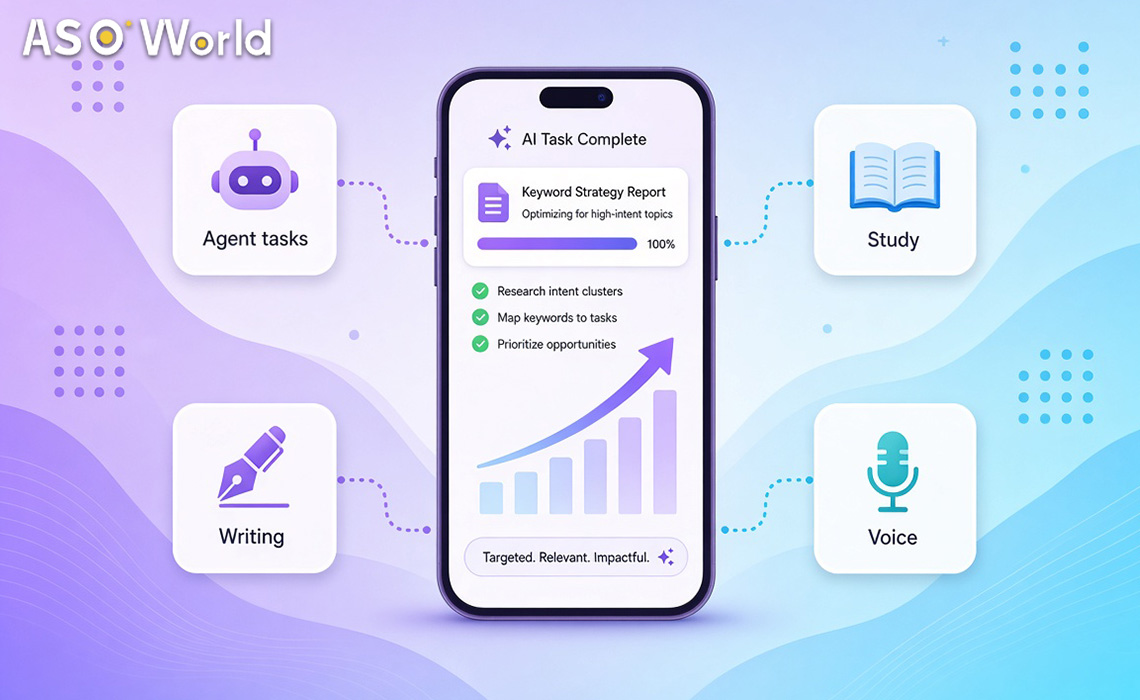
- The winnable ground is intent clusters: what the app does (study, write, edit photos, transcribe, plan money) plus who it's for.
- A new search intent is forming around "agent" apps that complete tasks, separate from "assistant" apps that answer questions. Meta's Muse launched with the subtitle "Your personal AI agent", while ChatGPT's reads "Your everyday AI assistant".
- Put the job-to-be-done in the title or subtitle, the long-tail variants in the keyword field (iOS) or short and full description (Google Play), and keep competitor brand names out of your metadata.
- Validate every cluster with popularity and difficulty data before you build creative around it.
AI apps are the busiest category on both stores this quarter. Our October scoreboard found that at least five of the top ten free Productivity apps on the US App Store were AI-native or AI-branded, and that the Google Play entry band around ranks 24–27 in US Productivity ran roughly 35,000–40,000 weekly downloads (FoxData estimates). If you're launching or relaunching an AI app before the holidays, keyword choice decides whether you compete with the giants or beside them.
Why "AI assistant" is the wrong head term for most apps
The top of the AI market is a contest between companies that can promote an app to hundreds of millions of existing users. Meta launched Muse on September 8, 2026, in the US only, and could reach Facebook, Instagram and WhatsApp audiences on day one. ChatGPT, Gemini and Grok have similar brand gravity. For a head term like "ai assistant", ranking position follows install velocity and brand searches you can't match.
That doesn't mean AI apps can't grow through search. It means the search demand worth chasing sits one level down, where users describe a task or a situation instead of a category.
What this means for your app: stop trying to rank for what your app is. Rank for what it does, for whom, and in which language.
The Q4 2026 AI keyword map: eight intent clusters
| Cluster |
Example seed terms (validate before use) |
User intent |
Who owns the head terms |
Winnable angle for a new app |
| General assistant / chat |
ai chat, ai assistant, chatbot |
Ask anything |
ChatGPT, Gemini, Grok, Meta AI |
Rarely winnable; use only in the description for relevance |
| Agent / task completion |
ai agent, ai that books, ai to do list, ai errands |
Get something done |
Muse, Grok Bot, assistant giants |
Niche tasks: "ai agent for email", "ai meal planner agent" |
| Study / exam |
ai homework helper, ai flashcards, lecture notes ai, ai tutor |
Learn faster |
Gauth, large edtech brands |
Subject + format: "ai flashcards for med school", "lecture transcription" |
| Writing / productivity |
ai writer, ai email writer, summarize pdf |
Produce text |
Big assistants, writing tools |
Document type + use: "cover letter ai", "meeting notes summary" |
| Voice / dictation |
voice to text ai, ai dictation, transcribe |
Speak instead of type |
Dictation apps (e.g., Wispr Flow climbing in October) |
Language + context: "dictation for doctors", "transcribe spanish" |
| Photo / video / art |
ai photo editor, ai video generator, ai headshot |
Create or fix visuals |
Canva AI and creative suites |
Specific output: "ai passport photo", "old photo restore" |
| Money / budget |
ai budget, ai expense tracker, receipt scanner ai |
Manage money |
Fintech brands |
Situation: "ai budget for couples", "freelancer expense ai" |
| Companion / character |
ai friend, ai character chat |
Conversation for fun |
Character platforms |
Higher review risk; check store policy carefully |
Source: ASOWorld keyword framework; app examples from FoxData US Productivity rankings, week ending Oct 29, 2026 | seed terms are starting points, not measured volumes
Two clusters deserve extra attention this quarter. Agent terms are new enough that few apps target them deliberately, and the launches of Muse and xAI's Grok Bot have made "agent" a word users now recognise. Study terms peak around exam periods and the January term start, so metadata shipped in November has time to settle before demand rises.
What this means for your app: pick one primary cluster and one secondary cluster. Apps that try to rank for every AI cluster end up ranking for none.
Agent vs assistant: a metadata decision, not just branding
The difference between "assistant" and "agent" is turning into two search behaviours. People searching "assistant" or "chat" want answers. People searching "agent", or typing a task ("ai that books flights"), want an outcome.
| If your app mainly... |
Lead with |
Example subtitle pattern (iOS, 30 characters) |
| Answers questions and chats |
Assistant / chat + topic |
"AI Chat for Spanish Learners" |
| Completes tasks in other apps or accounts |
Agent + task |
"AI Agent for Your Inbox" |
| Produces a specific output |
The output + AI |
"AI Flashcards From Notes" |
| Works by voice |
Voice / dictation + context |
"Voice Notes to Text, Any Language" |
Source: ASOWorld metadata patterns; Muse and ChatGPT subtitles as reported October 2026
Before you rename anything, check that your product actually does what the word implies. Store reviewers and users judge "agent" claims quickly, and a mismatch shows up in ratings within days.
What this means for your app: use the word that matches the job your best users hire the app for. If your retention data shows people use it to complete one task, put that task in the subtitle.
Where each keyword goes: the metadata layout
| Field |
App Store (iOS) |
Google Play |
What to put there |
| Title |
30 characters |
30 characters |
Brand + primary cluster term ("Lumo: AI Flashcards") |
| Subtitle / short description |
30 characters (subtitle) |
80 characters (short description) |
Job-to-be-done + audience |
| Keyword field |
100 characters, comma-separated, not visible |
No keyword field |
Long-tail variants, plurals, secondary cluster terms |
| Description |
Not used for search ranking on iOS |
Up to 4,000 characters, indexed |
Natural sentences using cluster terms 2–4 times each |
| Localized metadata |
Separate per locale |
Separate per language |
Translate the task, not the English keyword |
Source: Apple App Store Connect and Google Play Console field limits | checked November 3, 2026
Keep competitor names out of every field. Apple's App Review Guideline 2.3.7 tells developers not to pack metadata with trademarked terms or popular app names, and Google Play's metadata policy similarly prohibits misleading references to other apps. "ChatGPT alternative" in your keyword field is a review risk, not a growth hack.
For a step-by-step way to score candidate terms by popularity, difficulty and relevance, use ASOWorld's guide on how to pick the right keywords.
How to validate a cluster in one afternoon
- List 20–30 seed terms for your primary and secondary clusters, including local-language versions for your top two non-English markets.
- Pull popularity and difficulty for each term per country (Apple Search Ads popularity or your ASO tool). Drop anything at the index floor unless it's highly relevant and you expect seasonal growth.
- Check who ranks top 10. If all ten are household brands, move one level more specific.
- Check relevance honestly. Would a user who typed this term be happy with your app? If not, the install won't convert or retain.
- Shortlist 8–12 terms: 2–3 for title and subtitle, the rest for the keyword field or description.
What this means for your app: this shortlist is your Q4 keyword plan. Everything else, including screenshots, In-App Events and campaigns, should reinforce the same 8–12 terms.
A 30-day plan for a new or relaunched AI app
| Week |
Focus |
Actions |
| Week 1 |
Positioning |
Choose primary and secondary clusters; write title and subtitle; shortlist 8–12 terms |
| Week 2 |
Conversion |
First two screenshots show the task being done, not the chat interface; add a short preview video |
| Week 3 |
Ranking |
Support 3–5 terms where you already appear in the top 250 with keyword installs (from $0.20 per install on Android and $0.30 on iOS, verified Nov 3, 2026), at volumes in proportion to your organic baseline |
| Week 4 |
Review and adjust |
Keep terms that moved; swap terms that stalled for more specific variants; check ratings for complaints about accuracy |
Source: ASOWorld planning framework; pricing from ASOWorld's Keyword Installs page
Conversion matters more for AI apps than most categories, because users have many free alternatives a tap away. Screenshots that show a finished result ("Your week planned in 10 seconds") convert better than screenshots of an empty chat box. ASOWorld's work on improving organic conversions and user experience covers the product page side.
If you're launching from zero, a dedicated mobile app launch marketing plan sequences metadata, creative, ratings and campaigns so they reinforce each other in the first weeks, when store algorithms are deciding where your app belongs.
Common mistakes AI apps make in app store search
- Leading with the model name. Users search for outcomes, not model versions.
- Using "ChatGPT" or other brand names in metadata. It invites rejection and rarely ranks.
- Targeting every AI cluster at once. Relevance dilutes and none of the terms rank.
- Screenshots of a blank chat box. Show the result the user will get.
- Ignoring localization. Many AI tasks are searched in local languages where competition is lighter.
- Over-claiming "agent" features. If the app can't complete the task reliably, reviews will say so.
FAQ
What keywords should a new AI app target in 2026?
Task-specific and audience-specific terms in one primary cluster, such as "ai flashcards from notes" or "ai email agent", rather than "ai assistant" or "chatbot", which are dominated by the largest AI brands.
Should I call my app an AI agent or an AI assistant?
Use "agent" only if the app completes tasks on the user's behalf; use "assistant" or "chat" if it mainly answers questions. Muse launched as "Your personal AI agent", while ChatGPT's subtitle reads "Your everyday AI assistant".
Can I use "ChatGPT" as a keyword?
No. Apple's App Review Guideline 2.3.7 warns against packing metadata with trademarked terms and popular app names, and Google Play's metadata policy prohibits misleading references to other apps.
How many keywords should an AI app target at launch?
A shortlist of about 8–12 validated terms: 2–3 in the title and subtitle, the rest in the iOS keyword field or Google Play description.
What download level does an AI app need to chart in Productivity?
In our October scoreboard, the US Google Play Productivity band around ranks 24–27 ran roughly 35,000–40,000 weekly downloads (FoxData estimates). Keyword rankings are usually a more realistic first target than category charts.
Do AI apps need a different ASO strategy on iOS and Google Play?
Yes. iOS relies on the title, subtitle and hidden keyword field; Google Play indexes the description. In October, Muse led US iOS Productivity while ChatGPT led Google Play, a reminder that the two stores rank differently.
For hands-on help with AI-specific positioning and campaigns, see ASOWorld's AI app marketing practice.
 COVID-19 UPDATE