COVID-19 UPDATE


Important Notice:Beware of scams using ASOWorld's name for part-time recruitment or ASO earning app activities. ASOWorld is not hiring any part-time staff. Trust only official information posted by ASOWorld.

Discover which long-tail keywords are rising in summer 2026, how AI search is reshaping app discovery, and the exact ASO tactics to capture the seasonal surge.


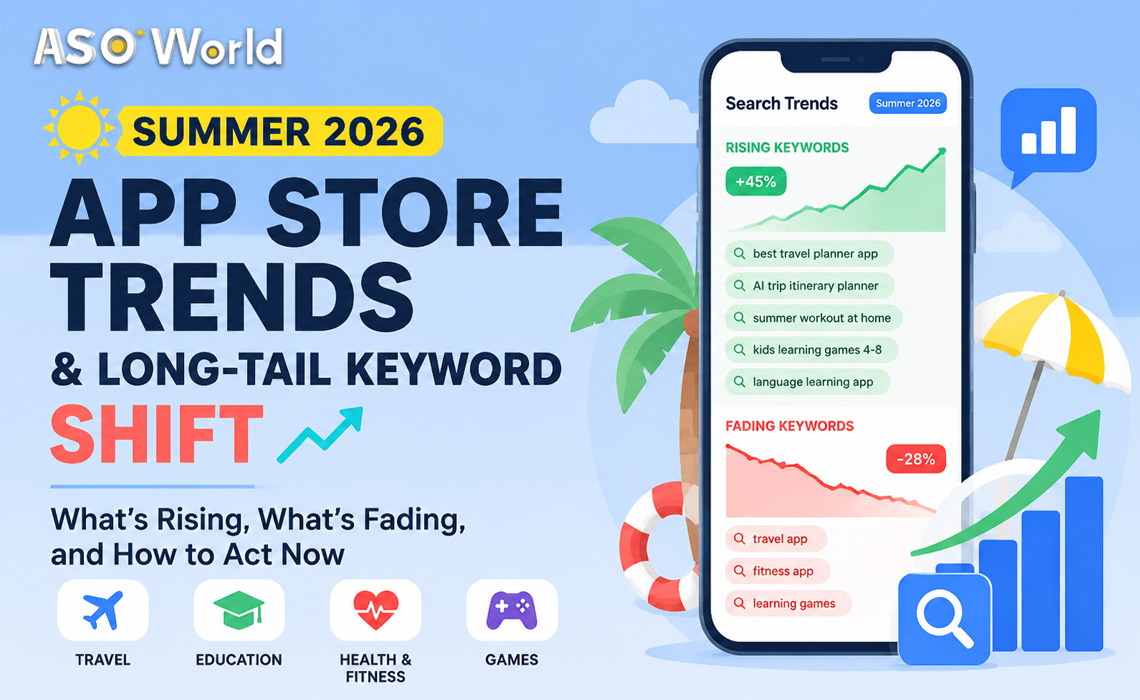
Summer (June–August) is the third-largest app store traffic window of the year, trailing only the Christmas–New Year peak (new device activations + holiday leisure) and Black Friday–Cyber Monday (shopping app surge). But unlike those holiday windows, summer drives sustained demand across multiple categories simultaneously—travel, education, health & fitness, and gaming all see meaningful uplift.
The macro numbers confirm the opportunity. According to Apple's June 2026 newsroom disclosure, the App Store ecosystem facilitated $1.4 trillion in developer billings in 2025. Globally, mobile app install spend in 2026 has reached $940 billion, up 16% year-over-year. Within that growth, the summer quarter carries disproportionate weight for categories tied to seasonal behavior.
⚡ Expert Tips
Don't wait until late June to adjust your metadata. Major seasonal updates should be submitted 2–3 weeks before your target date—algorithm indexing and ranking reactions aren't instant. If your summer push starts July 1, your metadata changes should be live by mid-June at the latest.
But 2026 introduces a structural shift that most ASO teams are underestimating: AI-powered discovery is creating a "pre-store" layer that intercepts traditional keyword search traffic.
Users increasingly ask ChatGPT, Gemini, or Perplexity for app recommendations before opening the App Store or Google Play.
This means:
Google's own data bears this out: the average query length triggering AI Overview grew from 3.1 words (June 2024) to 4.2 words (December 2024), and queries of 8+ words triggering AI Overview have grown 700% since May 2024.
📖 Related reading: For a comprehensive breakdown of how AI is reshaping app store discovery, see our guide on Beyond ASO: How to Get Your App Recommended by AI.
The practical implication: your ASO strategy can no longer focus solely on head-term rankings. You need to build visibility across a wide portfolio of specific, scenario-based long-tail keywords that match how real users describe their needs—and how AI models summarize solutions.
📖 Related reading: If you're new to building a keyword strategy from the ground up, our Seasonal App Marketing Strategy guide walks through how to map seasonal trends to keyword calendars.
Not all categories benefit equally from the summer window. Below is a breakdown of the four categories experiencing the most significant seasonal uplift—and the specific 2026 dynamics reshaping each one.
| Category | Peak Months | Primary Driver | Key 2026 Trend | Critical Data Point |
|---|---|---|---|---|
| Travel | Jun–Aug | Family vacations, graduation trips, international bookings | Offline features become high-conversion selling points; GP Guided Search pushes intent-based discovery | D30 retention only 4.6%—first-screen conversion is everything |
| Education | Jul–Sep (dual peak: summer learning + back-to-school) | Parents preventing "Summer Slide"; K-12 supplemental learning | AI-powered adaptive learning apps driving "adaptive learning" long-tail growth | 72% of parents say kids use educational apps in summer (up from 66% in 2024) |
| Health & Fitness | Jun–Jul (secondary peak after January) | Summer body goals, outdoor sports (running, cycling, hiking) | Niche vertical apps (e.g., AllTrails for hiking) proving focused beats broad | D30 retention 12.1%—nearly 3× higher than Travel |
| Games | Jun–Aug (second only to December) | Student summer break, schedule changes, indoor leisure | LiveOps + seasonal content updates drive +21% DAU; cross-platform sync extends sessions by 31% | Casual games = 62% of all global game downloads |
Summer is the most certain incremental window for travel apps. But the economics tell a cautionary tale: Travel iOS CPI is relatively affordable at $3.92 (far below Fintech's $11.62 or Dating's $9.84), yet D30 retention sits at just 4.6%, dropping to 2.1% by day 90.
This means summer travel users are highly situational and low-loyalty "one-and-done" users. Your ASO must prioritize immediate conversion—your first three screenshots must communicate "I can book your trip or plan your route right now" in under three seconds.
⚡ Expert Tips — Travel Apps
Regional players consistently beat global giants in local markets during summer (Grab in Southeast Asia, Rapido in India, Bolt in Europe). Your ASO localization must go beyond language translation—incorporate local transportation modes, payment methods, and holiday naming conventions for each target market.
The summer education surge has shifted from "classroom extension" to "parent-driven anti-Summer-Slide". The timeline is clear: early June ramp-up, mid-July peak, late August back-to-school second wave. Critically, parent subscription conversion rates spike during summer because the "don't let my child fall behind" anxiety is at its highest.
Emerging sub-categories with the fastest growth: STEM coding apps, AI tutors, and social-emotional learning (SEL) tools. Traditional flashcard-based apps are hitting a growth ceiling.
⚡ Expert Tips — Education Apps
Update your metadata 2–3 weeks before June, not in August. Embed phrases like summer learning loss, back to school prep, and grade X math in your title, subtitle, and keyword field before the search volume peaks. Waiting until the surge hits means you're already behind the algorithm's indexing cycle.
While January remains fitness's biggest month (New Year's resolutions), the summer months represent a meaningful secondary peak driven by outdoor activities. The breakout story of 2026 is niche vertical fitness apps—AllTrails for hiking, Strava for running/cycling—proving that focused category positioning can scale.
Fitness apps also enjoy significantly better retention than travel: D30 retention of 12.1%, which creates a more sustainable growth flywheel during the summer window.
Gaming sees its second-largest download window in summer (after December holiday). The 2026 differentiator is LiveOps: seasonal content updates and time-limited events drive a +21% increase in DAU. Cross-platform sync games see session lengths extend by 31% as users switch between phone and tablet during summer downtime.
📖 Related reading: For a deep dive into how summer CPI dynamics affect gaming specifically, see The Summer 2026 ASO Playbook: How to Capture App Store Growth During Gaming's Biggest Season.
This is the core strategic shift of summer 2026. The data is unambiguous: the vast majority of real search behavior happens in the long-tail zone—keywords so specific that most tools can't reliably show search volume for them.
According to Ahrefs' US keyword database, only 31,000 keywords have monthly search volume above 100,000. Meanwhile, 3.8 billion keywords have volume below 10—and those account for roughly 95% of the entire database. During summer, this distribution skews even further toward specific, scenario-driven phrases.
⚡ Pro Tip — Discover Before You Target
The keywords rising fastest are often ones no competitor is actively optimizing yet. Use ASOWorld's competitor keyword analysis tool to see which keywords rival apps are ranking for, then identify the long-tail gaps where you can move first. The tool surfaces keywords based on search volume, difficulty, and competition—so you can prioritize the highest-opportunity terms before investing in campaigns.
These are keywords where the user describes a complete task rather than a category. They signal high purchase intent and lower competition.
| Rising Long-Tail Keyword | Replacing This Head Term | Why It's Rising |
|---|---|---|
road trip planner with gas stops |
"travel app" | Users want to solve a specific task (route planning with fuel stops), not browse a category |
offline map for hiking trails |
"map app" | "Offline" is a hard filter in outdoor scenarios with unreliable connectivity |
summer body workout at home no equipment |
"fitness app" | Home + zero equipment = lowered barrier to entry, matching hesitant users |
math game for 4th graders fractions |
"kids education" | Parents search with extreme specificity, directly mapping to curriculum pain points |
These queries rarely appear in any keyword tool's "search volume" column because they're personalized and one-off. But they're proliferating rapidly in AI search layers (ChatGPT, Gemini, Perplexity) and indirectly shaping in-store search behavior.
| Typical AI Query Pattern | Resulting In-Store Search Migration |
|---|---|
| "What's the best app to track my kid's screen time during summer break?" | → screen time parental control summer |
| "I need a workout plan for losing belly fat in 6 weeks before my beach trip" | → 6 week ab challenge home workout |
| "Which language learning app is best for conversational Spanish before my Mexico vacation?" | → learn Spanish conversation travel |
⚡ Expert Tips — AI Query Fan-Out
AI platforms use query fan-out—breaking one long query into multiple sub-questions—to find answers. Your metadata doesn't need to match the entire long sentence. Instead, ensure it covers the sub-intent fragments: the specific feature, audience, and scenario embedded within the query. Think modular, not monolithic.
As Apple and Google ship new discovery mechanisms in 2025–2026, keywords that reference specific platform features are gaining search volume:
| Emerging Modifier | Platform Mechanism | ASO Implication |
|---|---|---|
widget / lock screen widget |
iOS 16+ Lock Screen / StandBy | Your screenshots must explicitly showcase the widget form factor |
live activity |
iOS Live Activities | Live Activities are a differentiator for food delivery, fitness, and travel apps |
app clip / instant app |
iOS App Clip / Android Instant Apps | No-download trial experiences lower the activation barrier |
watch companion |
Apple Watch / Wear OS | Summer outdoor scenarios (running, hiking) make the watch experience a decision driver |
| ❌ Fading Head Term | Why It's Declining | ✅ Rising Long-Tail Replacement | Why It's Ascending |
|---|---|---|---|
| "best travel app" | Too broad, low conversion, AI intercepts traffic | family road trip itinerary maker USA |
High intent, low competition, matches specific scenario |
| "fitness tracker" | Saturated; Apple/Google native tools squeeze the middle | outdoor HIIT workout no gym summer |
Scenario + constraints filter for high-motivation users |
| "kids games" | Parents worry about "pure entertainment" apps; poor post-download retention | educational scavenger hunt outdoor kids |
Combines learning + outdoors, aligns with parent values |
| "photo editor" | Red ocean; CapCut/Canva dominate head positions | remove background from photo batch |
Hyper-specific function avoids head-on competition with incumbents |
📖 Related reading: Want a systematic approach to finding these long-tail opportunities? Our guide on Keyword Research & Keyword Optimization breaks down the exact process for uncovering high-intent, low-competition terms.
The gap between iOS and Android ASO strategy is widening, not narrowing. Summer amplifies these differences because the stakes for conversion optimization are higher during seasonal surges.
Custom Product Pages (CPPs) now feed into organic search (since July 2025), with the cap raised to 70 variants. Your summer strategy should create dedicated CPPs for distinct user scenarios:
Separately, Apple's June 2025 algorithm update now indexes screenshot caption text as a ranking factor. This means blurry marketing copy like "All-in-One Solution" is actively wasting ranking potential. Use the language your users actually search: "Track Your Run," "Edit 4K Video," "Plan Road Trips Offline."
📖 Related reading: For a complete walkthrough on building and deploying CPPs for different user segments, see How to Leverage Custom Product Pages to Increase Conversion Rates.
Guided Search means users increasingly type goals rather than keywords ("find a cheap flight for my summer trip"), and the algorithm auto-categorizes. This requires embedding scenario-based phrases naturally within your long description—not keyword-stuffing, but writing the way your users talk.
Two additional Android-specific dynamics for summer 2026:
⚡ Expert Tips — Android Keyword Strategy
📖 Related reading: For a deep dive into Google Play's unique keyword mechanics, see Google Play Store ASO & Keyword Optimization.
Traditional ASO follows a linear path: user searches keyword → app appears in results → user downloads.
The 2026 reality has an extra step upstream:
This creates two strategic imperatives:
The shift from "search optimization" to "answer optimization" means your app's metadata, reviews, and even your website's FAQ content all function as potential "answers" that AI models can surface. This is a fundamentally different game from traditional keyword ranking.
📖 Related reading: We explored the mechanics of AI-driven store recommendations in depth in Apple App Store AI Personalized Recommendations: Everything Developers Must Know.
⚡ Expert Tips — AI-Proof Your ASO
Audit your app description against the "three questions" test: Can a chatbot reading your metadata accurately describe what your app does, who it's for, and when someone should use it? If your description is full of vague superlatives ("the ultimate all-in-one solution"), AI models can't extract clear signals. Replace with concrete, scenario-specific language that directly mirrors the queries users are asking AI assistants.
Even with the right strategy, execution mistakes can sink your summer campaign. Here are the four traps we see teams fall into every year:
| Pitfall | Why It Hurts | How to Avoid It |
|---|---|---|
| Starting too late | Algorithm indexing and ranking reactions take time. By the time your metadata changes propagate, the surge has already peaked. | Submit major seasonal metadata updates 2–3 weeks before your target date. If your campaign starts July 1, changes go in by June 10. |
| Promising what the app doesn't deliver | Screenshots showing "Summer Sale" or "Free Premium" with no corresponding in-app activity → high uninstall rates and negative reviews. | Ensure every visual promise has a matching in-app experience. Coordinate ASO creatives with your product team's actual summer feature roadmap. |
| Ignoring retention signals | Summer "one-and-done" users who churn within day 1 damage the algorithm's quality score, suppressing your ranking for all users. | Your first-launch experience must deliver instant value: auto-generate the first travel plan, the first workout routine, the first lesson. Give users a reason to come back before they close the app. |
| Treating iOS and Android identically | iOS descriptions aren't indexed (rankings come from Title, Subtitle, Keywords field, and CPPs). Google Play indexes the full long description and weighs engagement signals. Same strategy = losing on both platforms. | Maintain separate metadata strategies per platform. iOS: optimize Title + Subtitle + 100-char keyword field + CPP variants. Android: optimize Title + Short Description + Long Description natural language + engagement loops. |
📖 Related reading: Summer CPI surges can erode your ROI fast. See CPI Spiking This Summer? How to Protect ROI When User Acquisition Costs Surge for strategies to maintain efficiency during the peak.
The summer surge is real—but it's also compressing. With AI intercepting head-term traffic and long-tail queries fragmenting across millions of specific phrases, the teams that win in Q3 2026 won't be the ones chasing generic keywords. They'll be the ones who:
The long-tail keyword shift isn't a trend—it's the new baseline. The 95% of search queries that live in the long-tail zone are where your next growth cycle is hiding. The question isn't whether to chase them, but how fast you can get there before your competitors do.
📖 Keep reading: See how keyword optimization delivered measurable results in our case study: How a Puzzle Game Reduced CPI by 41% with Keyword Optimization.
Submit metadata changes 2–3 weeks before your target surge date. If your summer campaign starts July 1, your updated screenshots, keywords, and descriptions should be live by mid-June. Algorithm indexing isn't instant—the earlier your changes are submitted, the more ranking momentum you'll have when traffic peaks.
The highest-opportunity long-tail keywords are scenario-specific (e.g., "road trip planner with gas stops" instead of "travel app"), conversational (e.g., "summer workout plan at home no equipment"), and platform-feature-specific (e.g., "lock screen widget" or "live activity"). The key shift is away from broad head terms toward keywords that describe a complete user task.
AI search creates a "pre-store" discovery layer that intercepts head-term traffic. Users arrive at the App Store with brand names or very specific feature phrases they got from AI recommendations. To adapt: (1) ensure your brand term ranks #1, (2) write metadata that clearly answers "what does this app do, for whom, in what scenario," and (3) target long-tail keywords that match the sub-intent fragments AI models extract from queries.
Absolutely. On iOS, rankings come from Title, Subtitle, 100-character keyword field, and Custom Product Pages—descriptions aren't indexed. On Google Play, the full long description is indexed and engagement signals weigh heavily. Running the same strategy on both platforms means underperforming on both.
Monitor three signals: (1) keyword ranking movement for your target long-tail terms (daily tracking recommended during surge windows), (2) organic download trends correlated with ranking changes, and (3) retention metrics (D1, D7, D30) for summer-acquired users. If rankings improve but retention drops, the algorithm will eventually penalize you—balance acquisition with engagement.
Get FREE Optimization Consultation
Let's Grow Your App & Get Massive Traffic!
All content, layout and frame code of all ASOWorld blog sections belong to the original content and technical team, all reproduction and references need to indicate the source and link in the obvious position, otherwise legal responsibility will be pursued.