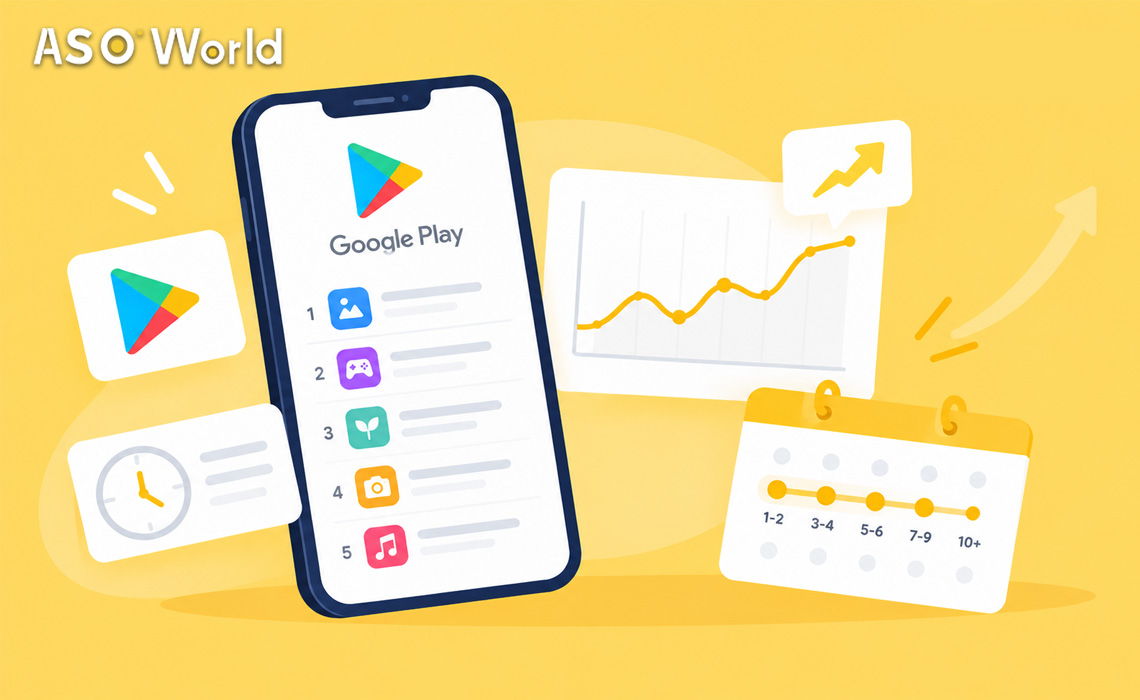
TL;DR: Google Play updates keyword rankings on a slower, noisier cycle than the App Store — expect the first readable signal around day 3–4 and a stable read by day 7–9. Checking daily and reacting to every dip is the single biggest reason developers misjudge a working campaign as a failed one. Below is the realistic day-by-day timeline, plus a 5-point check for telling normal volatility apart from an actual problem.
Why does Google Play ranking move slower than the App Store?
Google Play's ranking algorithm weighs a broader set of signals — install velocity, retention, uninstall rate, and engagement over a rolling window — rather than reacting to a single day's activity. That's structurally different from how Apple's Search Ads and organic algorithm process updates. It's also why a Google Play campaign that "isn't working" on day 2 is one of the most common false alarms we see. For the mechanics of how Google weighs these signals, see Google Play Keyword Ranking Algorithm.
The realistic timeline, day by day
| Day |
What's actually happening |
What you'll typically see |
| Day 1–2 |
Google is still collecting fresh signal; nothing has been re-weighted yet |
No visible change, or minor noise in either direction |
| Day 3–4 |
First re-indexing pass begins to reflect new install velocity |
Early, sometimes unstable movement — can bounce up then back down |
| Day 5–6 |
Signal starts stabilizing if volume has stayed consistent |
Position starts trending in one direction more reliably |
| Day 7–9 |
A full cycle has completed |
This is the earliest point where the result is a fair read of whether the campaign is working |
| Day 10+ |
Position should be holding within a band, not still trending |
If it's still moving significantly, something in the setup needs adjusting |
This is also why ASOWorld configures Google Play keyword campaigns in 7–9 day cycles by default rather than daily one-off orders — judging a Google Play keyword before day 7 is judging an incomplete cycle.
Is it normal volatility or a real problem? A 5-point check
Run through these before concluding the campaign isn't working:
- Has a full 7–9 day cycle actually completed? If not, you don't have a reading yet — you have a partial one.
- Did daily volume stay consistent, or was there a gap? Even a one-day interruption resets part of the momentum Google needs to keep re-weighting your position. A stop-start pattern looks identical to "not working" but is actually a pacing issue.
- Is the whole category moving, not just your app? Seasonal spikes, algorithm updates, and back-to-school-style traffic shifts move entire categories at once. Check 2–3 competitor apps on the same keyword — if they moved too, it's market noise, not your campaign. This recent example walks through exactly that pattern.
- Is the keyword itself too competitive for the current volume? A keyword with several established Top 10 competitors needs materially more volume than a low-competition one to move at all — this isn't a timeline issue, it's a configuration issue. See the next section's diagnostic in Wrong Keyword Promotion Is Harming Your App.
- Has the app's own listing changed recently? A metadata edit, new screenshots, or a policy flag can all interact with ranking independently of the ASO campaign itself.
If you answered "yes, full cycle, consistent volume, category is stable, keyword is right-sized, no listing changes" and the position still hasn't moved — that's the point where it's a genuine problem, not noise.
What to do at each stage
If you're inside the first cycle (day 1–6): Hold the course. Keep daily volume consistent and avoid the temptation to increase or pause based on a single day's snapshot.
If a full cycle completed and nothing moved: The most common fix isn't more of the same volume — it's re-matching volume to the keyword's actual competition level. Keyword Installs lets you configure day-by-day volume per keyword and preview a multi-day plan before committing, so you can scale a specific keyword up without guessing.
If the position moved and then reversed after you stopped ordering: that's expected behavior, not a bug — see Keywords Ranking Drop for why rankings aren't permanent once volume support ends.
If your ranking swings hard in either direction with no campaign change at all: that's more likely a platform-side algorithm shift than anything on your end. Google Play Ranking Drop: Why It Happens & How to Recover covers recovery steps for that specific case.
FAQ
Why did my Google Play ranking jump on day 2, then fall back by day 5?
Early movement before a full cycle completes is often provisional — Google hasn't finished re-weighting the position based on sustained signal yet. A jump followed by a partial pullback inside the first week is common and doesn't necessarily mean the campaign failed; the day 7–9 reading is the one that matters.
Does Google Play ranking move faster for branded / low-competition keywords?
Yes. Low-competition and branded terms typically show movement earlier because there's less established signal to outweigh. High-competition generic terms need a full cycle, and often more than one, before the position stabilizes.
Should I increase volume if I don't see movement by day 3?
No — day 3 is too early to judge. Increasing volume mid-cycle based on an incomplete read is one of the more common ways campaigns end up misconfigured. Wait for the full 7–9 day cycle, then adjust based on that result.
How is Google Play different from iOS in this respect?
iOS keyword ranking typically shows a usable signal within about 3 days per cycle, faster than Google Play's 7–9 day window. If you run campaigns on both platforms, judging them on the same timeline is a common mistake.
 COVID-19 UPDATE