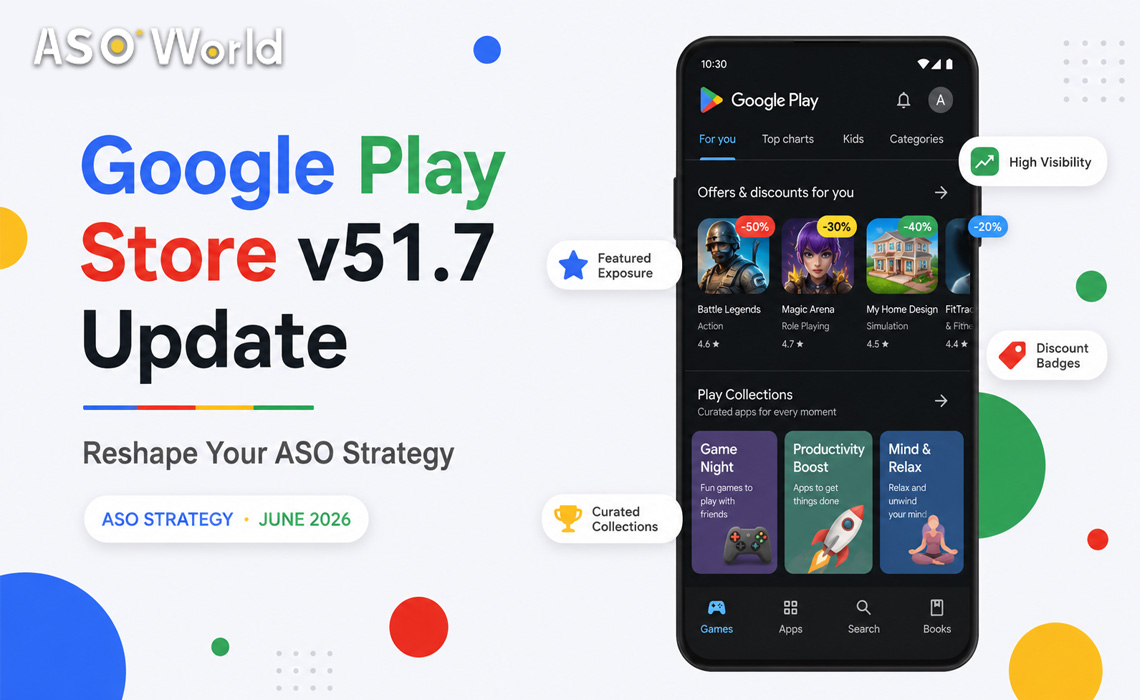
Google Play Store v51.7, released on June 1, 2026, introduces six changes that directly affect how users discover, evaluate, and purchase apps. For app developers and marketers, this is not a routine maintenance update — it expands the store listing from a static download page into an active content discovery and re-engagement surface. Here is what changed, what it means for your ASO strategy, and what you should do right now.
What Changed in Google Play Store v51.7?
Google's official system services release notes list six updates in Play Store v51.7. Each one carries distinct implications for app visibility and conversion optimization. Let's break them down.
| Feature |
Platforms |
What It Means for Developers |
| Sales prices and discount details are clearer and more visible across the Play Store |
Phone |
Pricing promotions now get stronger visual emphasis, increasing their impact on conversion rates |
| Refreshed design in Play Store dialogs when you get or buy an app |
Auto, Phone, TV |
Updated purchase flow UI across three platforms — test your in-app purchase and install flows |
| Pre-registration and auto-install use a single flow |
Phone |
Fewer friction steps from pre-registration to install — expect higher pre-reg conversion rates |
| Notifications for monthly challenges via pop-up banners |
Phone |
Google Play gamification features gain a new push channel for re-engagement |
| Notifications for Loyalty MAX challenges via pop-up banners |
Phone |
Loyalty programs now have stronger notification visibility inside the Play Store |
| App content on installed app store listing pages + Play Collections for similar content |
Phone |
Installed apps' store pages become content discovery surfaces; Play Collections expands browse-based visibility |
This update builds directly on the foundation laid by Play Store v51.5 in May 2026, which first introduced Play Collections and in-app content search. The v51.7 release deepens both features and adds commercial tools that reward developers who actively manage their store presence.
In-App Content on Store Listings: The Biggest Shift in App Visibility
The headline change in v51.7 is the expansion of in-app content surfacing on installed app store listing pages, combined with Play Collections for browsing similar content. This is the second iteration of a feature introduced in v51.5, and its significance for ASO cannot be overstated.
Traditionally, a store listing served one purpose: convince a new user to install. Once installed, the listing became irrelevant — users had no reason to return. With this update, Google transforms the store listing into a content hub for existing users. When a user visits the store page of an app they already have installed, they can now see that app's in-app content — articles, products, videos, levels, or features — directly within the Play Store.
This creates two new visibility channels:
- Re-engagement through content discovery: Dormant users who encounter your app's content on its store page may be prompted to re-open the app. This addresses the critical challenge of user retention and reactivation that most developers struggle with.
- Cross-app discovery via Play Collections: When users browse "similar content" through Collections, your app can appear alongside competitors — or more importantly, alongside complementary apps whose users match your target audience. This is algorithmically driven, meaning your keyword and metadata optimization directly influences whether you appear in relevant Collections.
For content-heavy apps — media, e-commerce, education, news, and social platforms — this is a fundamental change in how the Play Store distributes attention. Your in-app content quality now directly affects your store-level visibility.
⚡ Expert Tips
- Implement App Indexing and deep links immediately. Google can only surface your in-app content on store listing pages if it can crawl and index that content. Configure deep links through Google Play Console and verify they work with the App Indexing API.
- Treat in-app content as an ASO asset. The titles, descriptions, and metadata of your in-app content (articles, products, courses, videos) should be keyword-optimized just like your store listing. This content now feeds Play Store discovery surfaces.
- Audit your category and tag alignment. Play Collections groups apps by thematic relevance. Review whether your app's category, tags, and description accurately reflect your core value proposition. Misaligned metadata means missing Collections placements. Consider running an A/B test on your listing metadata to identify which positioning earns more browse traffic.
- Update content regularly. A store listing showing stale in-app content signals abandonment. Establish a content refresh cadence — weekly for media/news apps, bi-weekly for e-commerce, monthly for utility apps.
Pricing and Discount Visibility: A Conversion Rate Lever
The v51.7 update makes sales prices and discount details — including offer terms and dates — clearer and more visible across the Play Store. For paid apps, subscription-based apps, and apps with in-app purchases, this is a direct conversion rate optimization opportunity.
When discount information is visually prominent, time-limited offers become more effective. Users who might have scrolled past a price tag will now see the discount context — original price, sale price, and expiration date — with greater clarity. This reduces purchase hesitation and creates urgency.
⚡ Expert Tips
- Run strategic promotional pricing campaigns. With enhanced discount visibility, well-timed sales events will deliver stronger conversion lifts than before. Plan promotions around seasonal events, app milestones, or competitive windows.
- Use Google Play Console's pricing experiments. Test different discount levels and durations. The improved visibility means even small price adjustments will be noticed by more users.
- Coordinate pricing with ASO metadata. Update your "What's New" section and short description to reference active promotions. Users who see a discount badge and a matching description are more likely to convert.
Streamlined Pre-Registration: Lower Friction, Higher Launch Impact
Merging pre-registration and auto-install into a single flow removes a step that previously caused drop-off. Users who pre-register now automatically get the app installed when it launches, without needing to return to the store or manually initiate the download.
For developers planning a new app or game launch, this means pre-registration campaigns will deliver higher install conversion rates. Every pre-registered user becomes a guaranteed Day 1 install, improving your launch metrics — which in turn influence your initial ranking position in the Play Store.
⚡ Expert Tips
- Invest more aggressively in pre-registration campaigns. The reduced friction means your cost-per-install from pre-registration will decrease. Allocate budget toward pre-launch user acquisition via social media, influencer partnerships, and cross-promotion.
- Prepare your Day 1 experience. With auto-install, users will open your app immediately after launch with no warm-up period. Ensure your onboarding flow is polished, server capacity is ready, and first-session content is compelling.
Play Store Gamification: Monthly Challenges and Loyalty MAX
The addition of pop-up banner notifications for monthly challenges and Loyalty MAX challenges shows Google's continued investment in gamification as a retention mechanism within the Play Store itself. While these features are Play Store-level rather than app-level, they create indirect benefits for developers.
Users who engage with Play Store challenges are more active app explorers. They browse more, install more, and spend more time evaluating listings. If your app appears in a challenge-related Collection or recommendation, you benefit from a more engaged audience. Maintaining high review quality and ratings ensures your app stands out when these highly active users encounter it.
Refreshed Purchase Dialogs Across Auto, Phone, and TV
The updated purchase and install dialog design across three platforms — Auto, Phone, and TV — is a UI change that most users won't consciously notice, but developers should test against. Any change to the purchase flow can affect conversion behavior, especially on less-tested platforms like Android Auto and Android TV.
If your app is distributed across multiple form factors, run a regression test on your purchase and install flows after this update rolls out. Broken or unexpected dialog behavior on Automotive or TV could silently suppress installs on platforms where you have less visibility into performance data.
Google Play Store v51.7 marks a strategic shift: the store listing is no longer just a download page — it is becoming a content and commerce surface. Developers who optimize their in-app content for Play Store discovery, leverage enhanced pricing visibility, and capitalize on streamlined pre-registration will gain measurable advantages in both new user acquisition and existing user re-engagement.
Frequently Asked Questions
What is the most important change in Google Play Store v51.7 for ASO?
The expansion of in-app content on installed app store listing pages, combined with Play Collections, is the most significant change. It transforms store listings from static download pages into dynamic content discovery surfaces, creating new visibility channels for both new and existing users. Developers should prioritize keyword optimization and deep link implementation to take advantage of this feature.
How do the new pricing visibility features affect my app's conversion rate?
Sales prices and discount details are now displayed more prominently across the Play Store, including offer terms and expiration dates. This increased visibility makes promotional pricing campaigns more effective at driving conversions. To maximize impact, coordinate your pricing promotions with A/B testing on your store listing to identify the optimal combination of pricing and messaging.
What should I do to prepare my app for Play Collections?
Ensure your app's category, tags, short description, and long description accurately reflect your core value proposition and target use cases. Play Collections groups apps by thematic relevance, so misaligned metadata can cause your app to be excluded from relevant collections. Review your on-metadata optimization strategy and consider updating it to align with Collection themes.
Does the pre-registration change affect apps that are already live?
The streamlined pre-registration and auto-install flow primarily benefits apps and games planning future launches. However, if you are releasing a major new version as a separate listing or launching a companion app, the improved pre-registration conversion will apply. For live apps, focus on the in-app content and pricing features instead.
How does this update relate to the May 2026 Play Store changes?
Google Play Store v51.7 builds directly on v51.5 (May 2026), which first introduced Play Collections and in-app content search. The June update expands these features to installed app store listing pages and adds commercial tools like enhanced discount visibility. Read our full analysis of the May 2026 Google Play system updates for the complete context on how these features evolved.
 COVID-19 UPDATE