Same budget. Fewer installs. Sound familiar? You're not alone — and the answer isn't just "spend more."
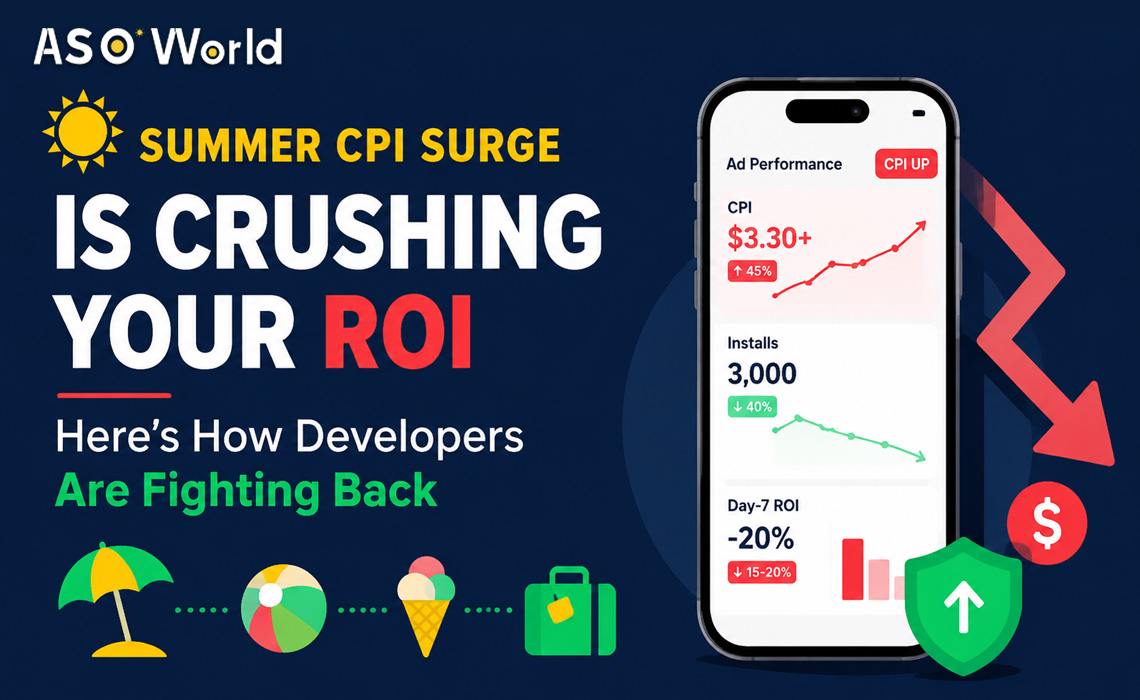
Picture this: in March, your $10,000 monthly ad budget pulled in 5,000 installs at a $2 CPI. Fast-forward to July — that same $10,000 buys you barely 3,000 installs. CPI has jumped to $3.30+, and your Day-7 ROI has slipped another 15–20% on top of that.
If you're a mobile app developer, this is the summer reality. Budgets haven't changed, but the market has. CPI is up, ROI is down, and every team is stuck debating the same question: do we pour more money in, or pull back and wait it out?
Neither extreme is the right answer. Let's break down what's actually happening — and what you can do about it. (For a deeper look at the seasonal dynamics at play, read our Summer 2026 ASO Playbook.)
📊 The Summer Squeeze
During Q3 peak season, average CPIs across gaming and utility categories rise 30–50% compared to Q1–Q2 baselines — while organic discovery traffic drops as store algorithms favor established, high-spending apps.
Why Does CPI Explode During Summer?
Three forces converge every Q3 to push acquisition costs through the roof:
- Every category bids at once. Gaming, edtech, travel, social — they all ramp spend simultaneously during the summer window. Auction-based ad platforms respond exactly as expected: more bidders, higher prices. (For a category-specific breakdown, see our analysis of Mobile Games CPI Trends in 2026.)
- Inventory doesn't scale with demand. The total pool of ad impressions stays roughly fixed. When spend surges but supply doesn't, cost-per-impression and cost-per-click rise mechanically.
- Platform algorithms penalize new and weak creatives. Both Apple Search Ads and Google UAC tighten quality thresholds during high-competition periods. Low-relevance ads and new accounts with thin history get deprioritized — meaning you pay more just to enter the auction.
None of this is new. But most teams still react to it the wrong way.
The Real Reasons Your ROI Is Dropping (It's Not Just CPI)
Here's the uncomfortable truth: blaming CPI alone lets you off the hook. The developers who maintain healthy ROI during summer share a common trait — their acquisition structure doesn't depend entirely on paid traffic. (Read more on attracting high-quality users when ROI is declining.)
If your ROI is cratering, look at three structural issues first:
- You have no organic baseline. If 90%+ of your installs come from paid channels, every CPI increase hits your P&L directly. Apps with strong ASO and organic discovery absorb paid cost spikes far better because their blended CPI stays manageable.
- Your keyword coverage has gaps. Paid and organic traffic should reinforce each other. If you're bidding on the same 20 head terms but ignoring hundreds of long-tail keywords with lower competition and higher intent, you're leaving cheap installs on the table.
- Your conversion funnel isn't summer-optimized. Landing pages, creative assets, and app store listings designed in Q1 lose relevance by Q3. Lower conversion rates per click mean you need more clicks per install — which silently destroys ROI even if CPI looks stable.
💡 Expert Tip
Before increasing your summer budget by a single dollar, run an acquisition structure audit. Calculate the ratio of paid-to-organic installs, review your keyword coverage breadth, and measure your store listing conversion rate for the past 30 days. If any of those three metrics is weak, fixing it will do more for your ROI than adding spend.
Three Moves That Actually Work During Peak Season
1. Build an ASO Keyword Net That Captures Organic Traffic Year-Round
The most reliable way to blunt CPI spikes is to reduce how many installs you need to buy in the first place. During summer, search volume in app stores surges — users are actively looking for new apps. If your keyword strategy only covers a handful of head terms, you're missing the long-tail queries that drive high-intent organic installs at zero marginal cost.
A systematic keyword expansion — covering feature-based terms, problem-solution phrases, and seasonal modifiers — builds a persistent organic traffic layer. Over time, this layer absorbs a meaningful share of your total installs, lowering your blended acquisition cost regardless of what paid CPI does. (For a full walkthrough, see our guide to lowering CPI with ASO best practices.)
And it's not theoretical: one puzzle game title reduced its CPI by 41% purely through keyword optimization — without increasing its paid budget.
→ How ASOWorld helps: Our keyword optimization and ranking service identifies high-opportunity keywords across your category, maps competitive density, and executes a sustained ranking strategy — so your app captures organic search traffic precisely when paid costs peak.
2. Protect Your Ratings Before the Summer Rush — Not After
This is the single most under-invested lever in summer acquisition. When download volume spikes, so does the volume of ratings and reviews. A handful of negative reviews during a traffic surge can pull your average rating down by 0.2–0.3 points — and that directly increases your ad conversion cost.
Why? Because both Apple and Google factor ratings into ad relevance scores. Lower ratings mean lower conversion rates on your ad impressions, which means you pay more per install. The damage compounds: worse rating → lower organic ranking → more dependence on paid → higher blended CPI.
The fix is simple in theory: front-load your reputation management before summer traffic hits. Address existing negative reviews, implement in-app review prompts at high-satisfaction moments, and monitor rating trends daily during peak periods.
→ How ASOWorld helps: Our ratings and reviews management service helps you proactively maintain a strong store reputation — from review response strategies to reputation monitoring — so your conversion rates stay high when it matters most.
3. Allocate Budget Dynamically — Don't Just Add More
The instinctive reaction to rising CPI is to increase budget to maintain volume. That's a trap. The smarter approach is to continuously shift budget toward the channels, keywords, and creatives that deliver the best conversion efficiency — and cut the ones that don't. (We broke down the full methodology in our step-by-step guide to boosting installs withoutbreaking your budget.)
This requires two things: reliable, real-time data on channel-level performance, and the discipline to reallocate weekly (or even daily) based on what's actually converting. Most teams set budgets monthly and leave them. During summer, that cadence is far too slow.
Track cost-per-install, cost-per-activated-user, and Day-7 retention by channel. Move money from underperformers to top performers on a rolling basis. The total budget might not need to increase at all — it just needs to move faster.
→ How ASOWorld helps: Our data analytics and diagnostic tools give you clear visibility into which keywords, channels, and campaigns are driving efficient growth — so you can make reallocation decisions based on evidence, not gut feeling.
Stop Bracing for Summer CPI. Start Optimizing Your Growth Structure.
The developers who win in Q3 aren't the ones with the biggest budgets — they're the ones who've built resilient acquisition funnels that don't collapse when auction prices spike. Before you approve that budget increase, take 30 minutes to diagnose your current structure.
Use ASOWorld's free ASO tools to see where your organic gaps are, or book a 1-on-1 consultation with our growth team to build a summer acquisition plan tailored to your app's category and competitive position.
Get Your Free Summer Growth Audit →
 COVID-19 UPDATE