noticeCOVID-19 UPDATE ASO World entire team is working remotely. we expect no disruptions in our ASO services.
Browser close
50% OFF FIRST ORDER
Referral Program
bonusprogram
50% OFF FIRST ORDER
Referral Program
bonusprogram
logo
  • アプリプロモーションサービス
    キーワードインストール
    パッケージ名によるインストール
    評価とコメント
    良質なコメントサービス
    キーワードを保証するランキングサービス
    ASO仕える
    カスタマイズソリューション
    その他のサービス
  • ASO ツール
    無料ASOツール
    キーワードリサーチツール
  • ソリューション
    By vertical
    スポーツ
    HOT
    人工知能アプリケーション
    健康と運動
    eコマース
    フィンテック
    HOT
    ゲーム
    教育
    デート
    エンターテイメント
    トラベル
    ソーシャルメディア
    レストランとフードテック
    生産性
    Lifestyle
    音楽
    効用
    写真とビデオ
    Casino
    Business
    ニュース
    NEW
    By Performance
    App Reputation & Negative Reviews Management
    NEW
    アプリのランキングとユーザー獲得を向上
    NEW
    オーガニックコンバージョンとユーザーエクスペリエンスの向上
    NEW
    モバイルアプリのローンチマーケティング
    NEW
    キーワードランキングとオーガニックダウンロードを増やす
    NEW
    solution-suffix
    お客様の事例
    感動的な顧客事例を調べて、貴社のような企業がどのように ASO World を活用して強力なモバイル アプリを作成することに成功したかを確認してください。
  • ASOナレッジカレッジ
    ブログ
    ケーススタディ
    ガイドと洞察
    一般的な問題
    用語集
  • 価格
ログインする 登録
logo
  • アプリプロモーションサービス
    キーワードインストール
    パッケージ名によるインストール
    評価とコメント
    良質なコメントサービス
    キーワードを保証するランキングサービス
    ASO仕える
    カスタマイズソリューション
    その他のサービス
  • ASO ツール
  • ソリューション
    By vertical
    スポーツ
    人工知能アプリケーション
    健康と運動
    eコマース
    フィンテック
    ゲーム
    教育
    デート
    エンターテイメント
    トラベル
    ソーシャルメディア
    レストランとフードテック
    生産性
    Lifestyle
    音楽
    効用
    写真とビデオ
    Casino
    Business
    ニュース
    By Performance
    App Reputation & Negative Reviews Management
    アプリのランキングとユーザー獲得を向上
    オーガニックコンバージョンとユーザーエクスペリエンスの向上
    モバイルアプリのローンチマーケティング
    キーワードランキングとオーガニックダウンロードを増やす
  • ASOナレッジカレッジ
    ブログ
    ケーススタディ
    ガイドと洞察
    一般的な問題
    用語集
  • 価格
Important Notice
重要なお知らせ:ASOWorld の名前を騙ってパートタイムの採用や ASO 収入アプリ活動を行う詐欺にご注意ください。ASOWorld はパートタイムのスタッフを募集していません。ASOWorld が投稿した公式情報のみを信頼してください。
Close the Important Notice

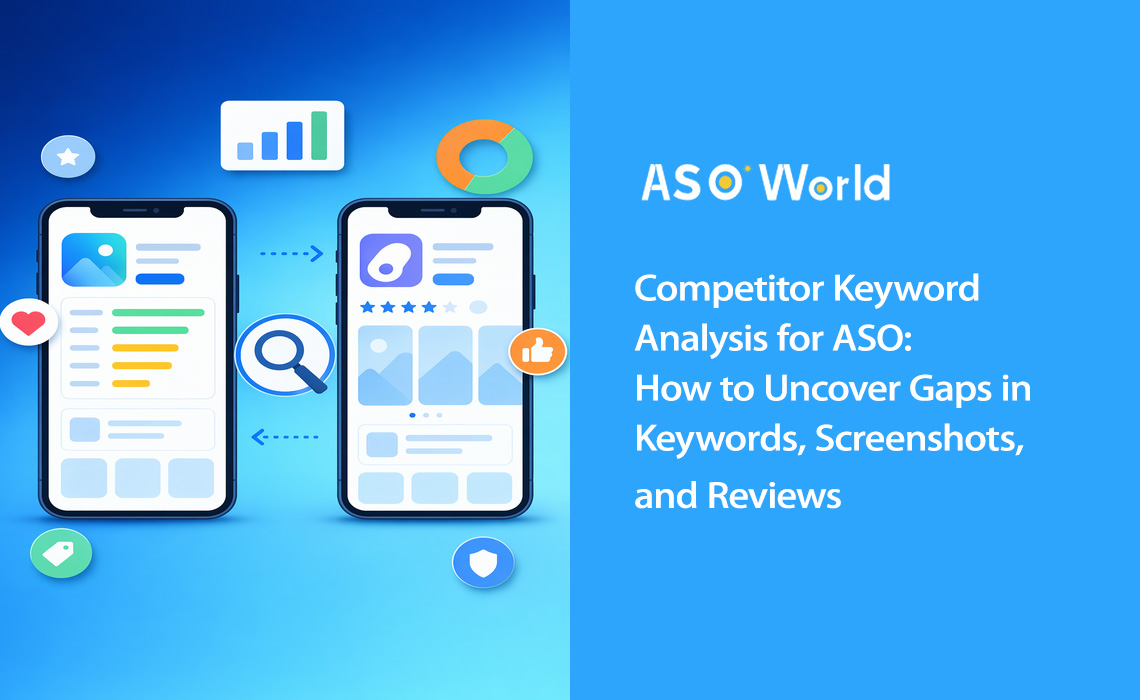
Competitor Keyword Analysis for ASO: How to Uncover Gaps in Keywords, Screenshots, and Reviews

Learn how to analyze competitor keyword coverage, screenshot positioning, and user reviews to find ASO gaps and drive more organic app installs.

公開日: Today
更新日: Today
ホームページ ガイドと洞察 Competitor Keyword Analysis for ASO: How to Uncover Gaps in Keywords, Screenshots, and Reviews

Competitor Keyword Analysis for ASO


Key Takeaways

  • Competitor keyword analysis goes far beyond copying rivals' metadata — it reveals gaps in your own strategy that you cannot find through internal data alone.
  • Studying competitor screenshots and store listing creatives helps you identify which value propositions resonate most with your shared audience.
  • Mining competitor user reviews uncovers recurring pain points that become your positioning advantage when addressed in both product and metadata.
  • Combining keyword gap analysis, creative benchmarking, and review mining into a single competitive intelligence workflow produces compounding ASO results.
  • Tools like ASOWorld's competitor keyword features and keyword ranking tools make this process systematic rather than guesswork.


Most app developers start their ASO journey by optimizing their own metadata — refining titles, testing subtitles, and adjusting keyword fields based on internal performance data. That approach works up to a point. But it leaves a critical blind spot: you only see the keywords, creatives, and messaging that you have tested. You have no visibility into the strategies driving installs for the apps that compete directly for your users' attention.


This is where competitor keyword analysis becomes essential. It is not about copying what rivals do. It is about understanding the full landscape of search demand in your category, identifying where competitors have invested and succeeded, and finding the gaps where you can win. When done properly, competitive keyword analysis becomes the foundation for every metadata update, screenshot redesign, and feature prioritization decision your team makes.


Why Does Competitor Keyword Coverage Analysis Matter More Than You Think?

The App Store and Google Play are search-driven ecosystems. Over 65% of app installs originate from a store search, which means keyword visibility determines whether your app gets discovered or gets buried. When you only analyze your own keyword performance, you are working within a bubble — optimizing for terms you already know, while competitors may be capturing traffic from hundreds of keywords you have never considered.


Competitor keyword coverage analysis solves this by mapping the full keyword footprint of your top rivals. The goal is to answer a precise set of questions: Which keywords do competitors rank in the top 10 for? Which of those keywords are missing from your own metadata entirely? Where do competitors rank higher than you for the same term — and why?


This analysis is not a one-time exercise. App store algorithms continuously re-evaluate keyword relevance based on download velocity, retention signals, and metadata freshness. A competitor that did not rank for a keyword three months ago may now dominate it after a metadata update or a successful keyword ranking campaign. Regular competitive audits — ideally monthly — ensure you catch these shifts early enough to respond.


The methodology itself is straightforward but requires discipline. Start by identifying your true keyword competitors: the apps that appear in search results for your core terms, not necessarily the apps you consider business competitors. An app in a different subcategory may still compete with you for the same search queries. Once you have a list of five to eight keyword competitors, pull their full keyword sets and compare them against your own. The keywords where competitors rank and you do not represent your keyword gap — and closing that gap is often the fastest path to incremental organic installs.


ASOWorld's keyword ranking tools are built specifically for this workflow. They allow you to track competitor keyword positions across countries and stores, identify unique keywords that only specific competitors rank for, and monitor ranking changes over time. Instead of guessing which keywords matter, you can see exactly where the traffic is going — and redirect your strategy accordingly.


⚡ Expert Tips

  1. Do not limit your competitor set to direct business rivals. Search your top 20 keywords in the store and note which apps appear repeatedly — those are your keyword competitors, regardless of category.
  2. Prioritize "exclusive" competitor keywords — terms where a rival ranks in the top 5 but you rank nowhere. These represent untapped demand that your metadata is currently invisible to.
  3. After identifying keyword gaps, check the search volume and difficulty score before adding them to metadata. A gap keyword with zero search volume is not a gap worth closing.


What Can Competitor Screenshots and Store Creatives Tell You About Winning Positioning?

Keywords get your app found. Screenshots get your app installed. Yet most competitive analysis workflows stop at metadata and never examine the creative assets that competitors use to convert impressions into downloads. This is a missed opportunity, because competitor screenshots are a direct window into how rivals position their product to the same audience you are trying to reach.


When you study a competitor's screenshot sequence, you are not just looking at design quality. You are reading a prioritized list of value propositions. The first screenshot in the carousel receives the most views by a wide margin — whatever message a competitor places there is what they believe converts best. The second and third screenshots typically reinforce the primary claim or address secondary use cases. By the fourth or fifth frame, competitors often address objections (security, pricing, ease of use) or showcase social proof.


The analytical framework is simple: across your top five competitors, document the primary headline message in screenshot one. Look for patterns. If three out of five competitors lead with "AI-powered" as their primary claim, that tells you the market has anchored on AI as the expected baseline. Leading with the same message will not differentiate you. Instead, you need to find the value proposition that competitors are not leading with — speed, privacy, offline capability, pricing — and test whether leading with that message improves your conversion rate.


This approach also applies to app preview videos, feature graphics on Google Play, and promotional text on iOS. Every creative element on a competitor's product page is a data point about what they have tested and chosen to keep. For a detailed methodology on optimizing your own screenshots based on competitive insights, ASOWorld's guide on optimizing iOS app screenshots provides a step-by-step framework that complements the competitive analysis described here.


Beyond individual creative elements, pay attention to how competitors structure their product page as a whole. The combination of icon style, screenshot sequence, description structure, and rating display creates a conversion environment. Competitors with consistently high conversion rates have usually optimized these elements as a system, not in isolation. Understanding that system — through regular competitive audits — gives you the intelligence to outperform it.


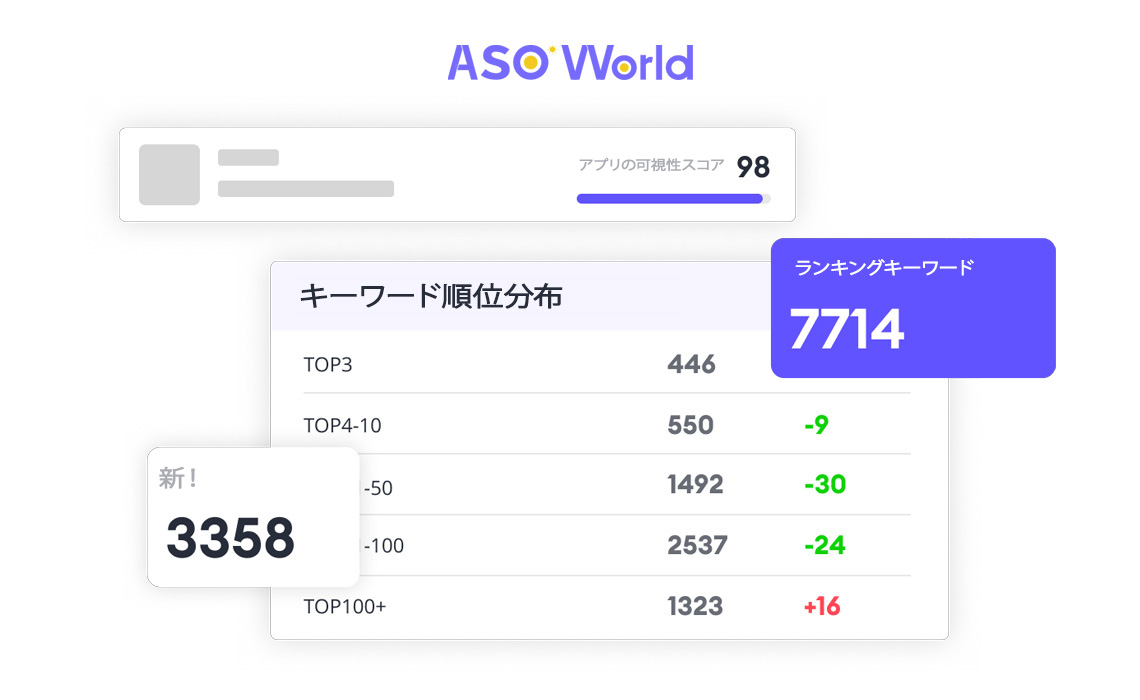
ASO World キーワード最適化
App StoreとGoogle Playの検索結果でアプリの可視性を向上させましょう!
adImg


How Do Competitor User Reviews Reveal the Keywords and Positioning You Are Missing?

User reviews are the most underutilized data source in competitive ASO. While most teams monitor their own reviews for bug reports and feature requests, very few systematically mine competitor reviews for strategic insight. This is a significant oversight, because competitor reviews contain three categories of information that directly improve your keyword strategy, creative messaging, and product roadmap.


The first category is natural language keyword discovery. When users describe what they love or hate about a competitor's app, they use the exact vocabulary that other users type into the search bar. A fitness app's reviews might repeatedly mention "home workout," "no equipment," or "quick routine" — these are not just feedback; they are high-intent search terms that belong in your metadata if your app serves the same need. This organic keyword mining often surfaces long-tail phrases that no keyword research tool would suggest, because they emerge from authentic user language rather than algorithmic volume estimates.


The second category is pain point identification. Negative reviews cluster around specific failure points: crashes after updates, confusing navigation, aggressive monetization, missing features. When you map these pain points across multiple competitors, you build a prioritized list of problems that the market wants solved. If three competing apps all receive complaints about a forced subscription model, and your app offers a generous free tier, that insight belongs in your screenshot headlines and description — not buried in a feature list.


The third category is feature validation. Positive reviews that mention specific features repeatedly — "love the dark mode," "the widget is so useful," "the export to PDF feature saved me" — are user-generated proof of what the market values. These validated features should influence both your product development priorities and your keyword targeting. If users consistently praise a feature that your app also has (but you have not highlighted), you are leaving conversion value on the table.


ASOWorld's insight on app review analysis for competitor insights details a structured four-step process for turning review data into actionable decisions — from identifying the right competitors to translating review patterns into metadata changes and campaign timing.


⚡ Expert Tips

  1. Focus on competitor reviews from the last 6 months. Older reviews often reflect previous app versions and outdated user sentiment.
  2. Pay special attention to reviews that mention switching behavior — "I switched from [Competitor] because..." — these reveal the exact triggers that make users open to alternatives.
  3. Extract the specific adjectives and phrases users repeat across reviews. Use these exact words in your metadata and screenshot copy — they match user search intent more naturally than marketing language.


How Should You Combine These Three Pillars into a Single Competitive Intelligence Workflow?

Keyword gap analysis, creative benchmarking, and review mining are most powerful when integrated into a unified competitive intelligence cycle rather than treated as separate activities. The insights from each pillar reinforce and validate the others. A keyword you discover through gap analysis becomes more actionable when competitor reviews confirm that users actively search for that feature. A positioning angle you identify from competitor screenshots becomes more compelling when negative reviews reveal that competitors fail to deliver on that exact promise.


The practical workflow operates on a monthly cadence. In the first week, pull updated keyword rankings for your competitor set and identify any new gaps or ranking shifts. In the second week, audit competitor store listings for creative changes — new screenshots, updated descriptions, changed icons. In the third week, review the latest competitor reviews, filtering for sentiment shifts and recurring themes. In the fourth week, synthesize these three data streams into specific metadata updates, creative briefs, or product feature requests.


Analysis Pillar Primary Data Source Key Output Update Frequency
Keyword Gap Analysis Competitor keyword rankings Metadata update priorities Monthly
Creative Benchmarking Competitor screenshots, videos, descriptions Positioning & conversion hypotheses Monthly / per competitor update
Review Mining Competitor 1–2 star and 4–5 star reviews Keyword ideas, pain points, feature validation Bi-weekly to monthly


This integrated approach ensures that your ASO strategy is never operating on assumptions. Every metadata change, every screenshot redesign, and every keyword targeting decision is grounded in observable competitor behavior and validated user demand. For teams ready to move beyond basic keyword research, ASOWorld's guide on Google Play keyword research provides the detailed checklist for executing the keyword pillar of this workflow, while the App Store search algorithm guide explains the ranking factors that determine whether your metadata changes actually move the needle.


When you are ready to accelerate keyword ranking improvements beyond what organic metadata optimization alone can achieve, ASOWorld's guaranteed keyword ranking service provides a direct path to top positions for your highest-priority competitive keywords.


Competitor analysis is not a one-time project — it is a recurring intelligence cycle. The teams that build this into their monthly workflow consistently outperform those that treat it as an occasional exercise.


Frequently Asked Questions

Q: How many competitors should I track for keyword analysis?

Five to eight keyword competitors is the practical range. Fewer than five gives you an incomplete picture of your category's keyword landscape. More than eight introduces noise and makes it harder to identify meaningful patterns. Remember that keyword competitors are defined by search overlap, not business similarity — any app that consistently appears in search results for your core terms qualifies.


Q: How often should I update my competitor keyword analysis?

Monthly is the recommended cadence for most apps. The app store algorithms re-evaluate keyword relevance frequently, and competitors update their metadata in response to performance data. A quarterly audit is the absolute minimum; anything less frequent means you are likely reacting to competitor moves months after they happen.


Q: Can competitor review analysis actually improve my keyword rankings?

Yes, through two mechanisms. First, review mining surfaces natural-language keywords that users actually search for, which you can incorporate into your metadata. Second, identifying competitor pain points allows you to position your app as the solution — both in metadata and in screenshots — which improves click-through and conversion rates. Higher conversion rates send positive signals to the app store algorithm, which in turn improves your keyword rankings.


Q: What tools do I need for competitor screenshot analysis?

At minimum, you need a way to systematically capture and compare competitor store listings across time. ASO platforms that archive historical screenshots are ideal, but even a manual process — taking screenshots of competitor pages monthly and storing them in a shared folder — works for smaller teams. The key is consistency: you need to see changes over time to understand what competitors are testing and keeping.


Q: How do I prioritize which competitor keyword gaps to close first?

Rank gap keywords by three criteria: search volume (is this keyword worth pursuing?), difficulty score (can you realistically rank for it?), and relevance to your app's core use case (will users who find you through this keyword actually convert?). Start with high-volume, medium-difficulty keywords that closely match your app's functionality. Avoid chasing high-difficulty keywords early — choosing the right keywords strategically is more important than targeting the highest-volume terms.

目次
    ストアランキング取得能力の検出を開始します。
    当社のASOツールを使用して、段階的にすべてのアプリストア最適化の取り組みを測定します。

    Get a good start for your app optimization with practical ASO guideline!

    Want to get the latest Guides & Insights from ASOWorld?

    関連するマーケティング ガイドライン
    cardImg

    App Store検索アルゴリズム2026:キーワード順位を実際に決定する要因とは

    tag
    ASO 初心者向けガイドライン

    Apr 24, 2026

    cardImg

    究極のアプリ新バージョンリリースASOチェックリスト2026:可視性とダウンロード数を最大化する30以上のステップ

    tag
    ASO 初心者向けガイドライン

    Apr 9, 2026

    cardImg

    App Store vs Google Play:各プラットフォームは評価とレビューをどう重視するか

    tag
    ASO 初心者向けガイドライン

    Apr 1, 2026

    cardImg

    アプリローカライゼーションガイド:限られた予算で2026年にインドでアプリを成長させる方法は?

    tag
    ASO 初心者向けガイドライン

    Mar 11, 2026

    今すぐプロモーションを開始し、アプリの探索ツアーを開始しましょう!
    大手、小規模のスタートアップを問わず、 Google Play, App Store, Galaxy Store や RuStore でアプリを低価格でプロモーションできるよう支援しています.
    今すぐプロモーションを開始し、アプリの探索ツアーを開始しましょう!
    • ASO
    • Email [email protected]
    • Contact Contact Us
    • twitter facebook linkedin instagram
    • 仕える
    • キーワードインストール
    • パッケージ名によるインストール
    • 評価とコメント
    • 良質なコメントサービス
    • キーワードを保証するランキングサービス
    • ASO仕える
    • その他のサービス
    • ASOナレッジカレッジ
    • ブログ
    • ケーススタディ
    • ガイドと洞察
    • 一般的な問題
    • 用語集
    • モバイルニュース
    • 会社
    • なぜASO World
    • 当社について
    • お問い合わせ
    • リセラープログラム
    ASO World © 2020-2026 all rights reserved
    プライバシーポリシー サービス条項

    当社のウェブサイトでは Cookie を使用して、お客様の好みや繰り返しのアクセスを記憶することで、最も適切なエクスペリエンスを提供します。 「同意する」をクリックすると、すべての Cookie の使用に同意したことになります。