COVID-19 UPDATE


Important Notice:Beware of scams using ASOWorld's name for part-time recruitment or ASO earning app activities. ASOWorld is not hiring any part-time staff. Trust only official information posted by ASOWorld.

💡 Did You Know?
Apps that move from a 3.5-star to a 4.0-star average on Google Play see, on average, a 25–40% increase in organic installs — and the effect compounds as improved ratings feed back into higher search rankings.
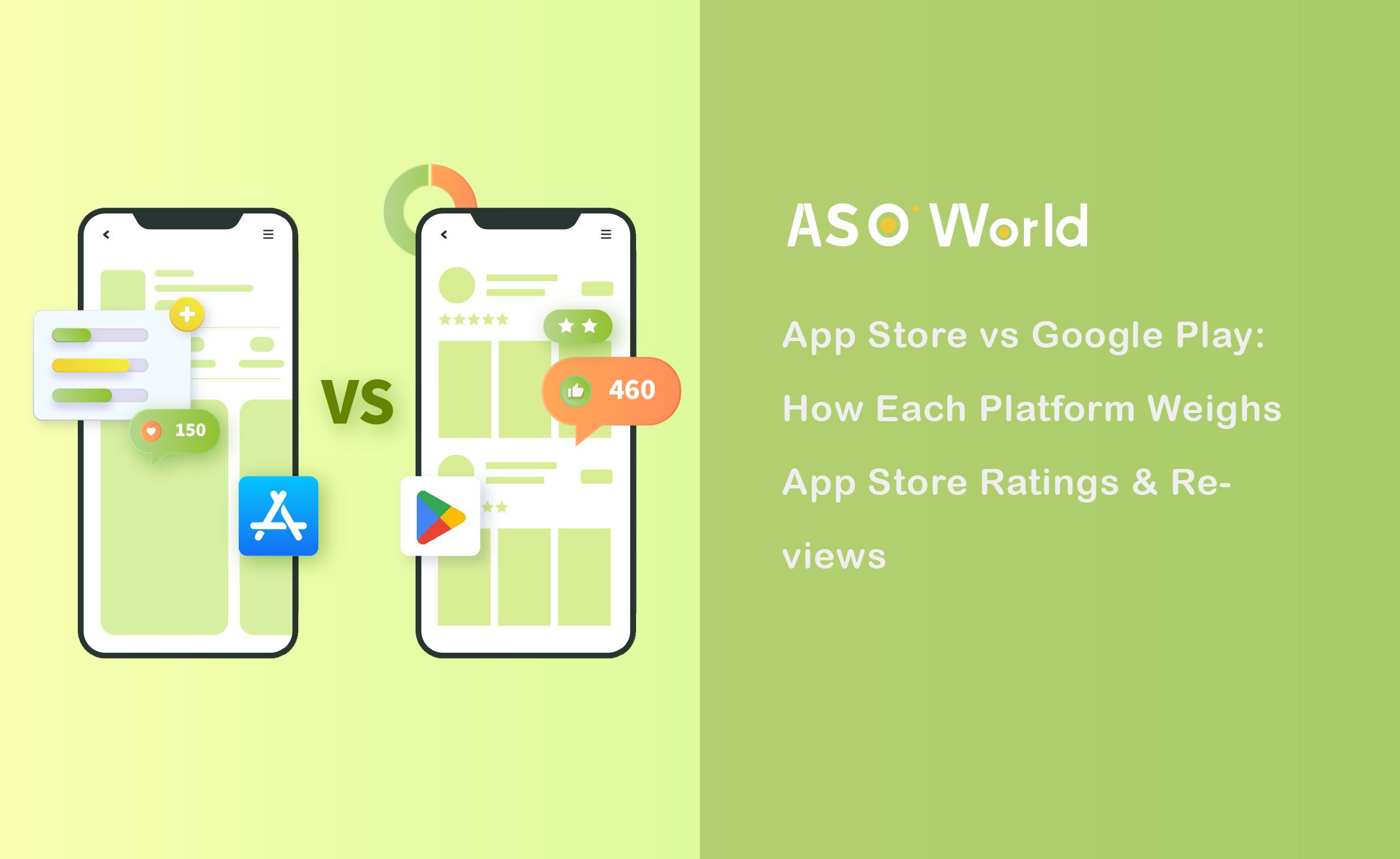
Ratings and reviews are the most visible trust signals on both stores — but each platform's algorithm interprets them in fundamentally different ways. This guide unpacks the mechanics so you can build an ASO strategy that actually matches how each store works.
Apple takes a straightforward approach to rating aggregation: every rating receives equal weight, regardless of when it was submitted or which version of the app it was left for. A one-star rating from three years ago carries the same mathematical influence on your average as a five-star rating posted this morning.
This has a critical practical implication: legacy problems can haunt your average for years. If your app had a rocky v1.0 launch that generated a wave of negative ratings, those scores remain in the denominator — permanently diluting the improvements you've made since. Developers can reset their visible rating when releasing a new version, but the cumulative average that Apple's algorithm references still factors in the full history.
The silver lining is that every new positive rating you earn contributes lasting value. There's no decay curve. Unlike Google Play (which we'll cover next), your efforts to accumulate high ratings compound over time rather than fading.
The biggest evolution in Apple's approach to reviews is the shift from quantitative signals (star count, volume) to qualitative analysis (what the reviews actually say). In 2026, Apple's algorithm performs semantic analysis on review text. Apps whose reviews contain detailed, positive commentary about specific features — "the sleep tracking accuracy is impressive" or "budget categorization saved me hours" — rank higher than apps with the same star average but vague reviews.
This is a meaningful change for ASO practitioners. It means that the quality of the reviews you attract matters as much as the quantity. Generic five-star ratings ("Love it!") are still helpful, but they're no longer sufficient to maximize your ranking potential.
Additionally, Apple now actively indexes screenshot caption text, expanding the surface area for keyword discoverability beyond traditional metadata fields. This means your visual assets are doing double duty — converting browsers and signaling relevance to the algorithm.
Ratings don't operate in isolation. Apple's search algorithm synthesizes text relevance with a suite of behavioral signals:
➡ Download velocity — how quickly your install rate is growing
➡ Ratings & reviews — volume, recency, and now content quality
➡ Retention & engagement — how often users return after installing
➡ Performance & stability — crash rates and responsiveness
The takeaway: you can't game your way to the top with reviews alone. But a strong review profile acts as a multiplier on all these other signals. When your conversion rate is high (driven partly by good reviews), your download velocity increases, which feeds back into higher rankings — a virtuous cycle. Learn more about improving organic conversions and user experience to fully leverage this loop.
🌠Expert Tip: Since Apple weights all ratings equally, your most impactful move during a re-launch or major update is to reset your visible rating while simultaneously deploying an in-app review prompt at a moment of user delight. This gives you a clean slate on the listing page while you rebuild momentum with the new version's quality.
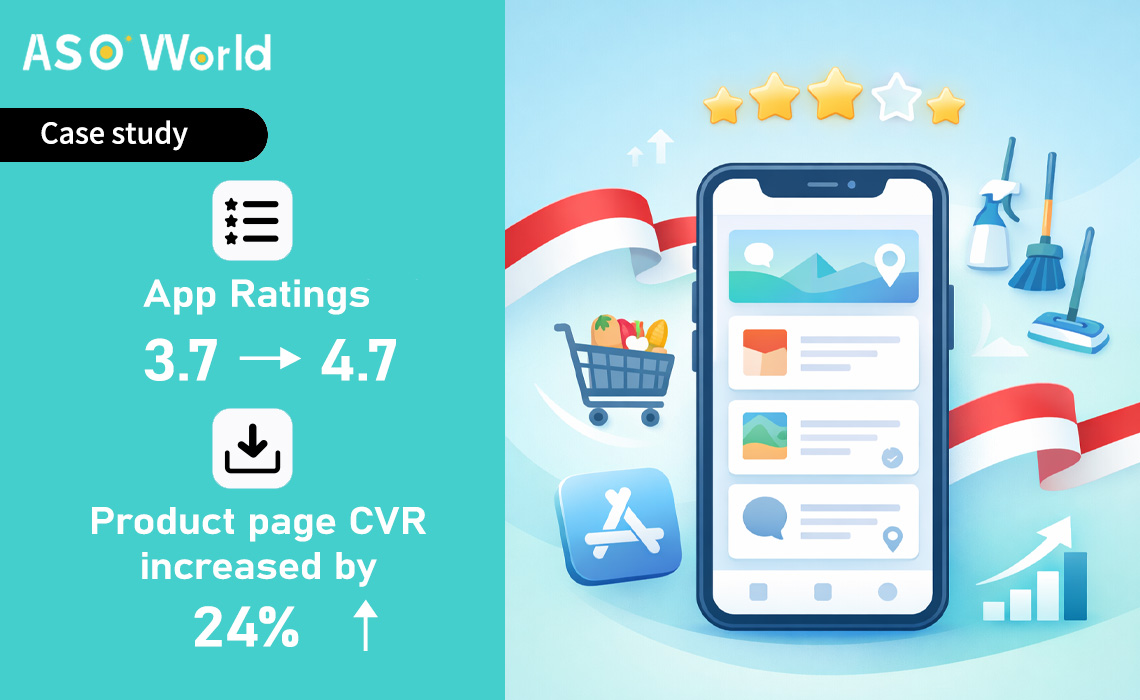
👉 Case Study: If you want to see how this strategy works in practice, check out this real-world example where a local service app improved conversion by 24% through rating reset and structured review optimization.
This case breaks down how resetting ratings, timing review prompts, and managing post-update feedback can significantly boost both user trust and install conversion.
Google Play takes the opposite approach to Apple. Rather than treating every rating as equal, Google applies a time-decay weighting model that gives significantly more influence to recent ratings. Older reviews gradually lose their impact on your displayed average.
This design philosophy reflects Google's belief that an app's current quality matters more than its historical track record. The practical consequence is double-edged: if your app has improved dramatically since launch, your average will climb faster than it would on Apple. But if you ship a buggy update and trigger a spike in negative reviews, your rating will drop faster too — and recover more slowly than you might expect.
The recency model also means that sustained review generation matters more than one-time campaigns. A burst of positive ratings will boost your score temporarily, but without ongoing flow, the effect decays. Consistent quality and consistent prompting are the winning strategy here.
Google Play's algorithm doesn't just read star ratings — it reads your reviews and extracts keywords from user-generated text to determine ranking relevance. This means your app can rank for search terms that aren't even in your metadata, simply because users mention those terms in their reviews.
For example, if dozens of users write reviews mentioning "meal planning" in a general fitness app, Google may start surfacing that app for "meal planning" searches — even if the developer never included that phrase in the title, description, or tags.
In 2026, Google has further elevated review sentiment to a direct ranking factor. It's not enough for users to leave stars; the emotional tone and specificity of their feedback now influence how the algorithm scores your app. Understanding what users say about your competitors' apps can reveal keyword opportunities you're missing — our piece on using review analysis to gain competitor insights walks through this process.
Google Play uniquely ties technical performance metrics directly to store visibility. If at least 0.47% of daily active users experience a user-perceived ANR (Application Not Responding) event across all device models, your app may become less discoverable — on all devices, not just the ones experiencing crashes.
This is a blunt instrument. It means that a performance issue affecting only low-end devices can tank your discoverability across your entire user base. Google also surfaces user-facing warnings on your store listing when technical quality metrics exceed their thresholds — a conversion killer that sits right next to your carefully optimized screenshots and description.
🌠Expert Tip: Because Google Play weights recent ratings more heavily, your post-update window is the highest-leverage period for review generation. Deploy your in-app review prompt immediately after a well-received update to lock in a wave of positive ratings while the recency boost is strongest. For a deeper dive into review strategies, check out our complete guide to boosting your app reviews.
The following table distills the key differences into a quick reference. Bookmark this — you'll come back to it.
|
Feature |
App Store |
Google Play |
|
Rating Weight |
Equal weight for all ratings — lifetime average |
Recent ratings weighted more heavily — time-decay model |
|
Review Content Indexed |
Yes — sentiment analyzed, feature mentions detected |
Yes — keywords extracted and used for search ranking |
|
Sentiment as Ranking Factor |
Yes (introduced 2025–2026) |
Yes — direct ranking signal in 2026 |
|
Developer Responses |
Rewarded indirectly (improved user perception) |
Explicitly rewarded by algorithm; triggers re-rating prompts |
|
Technical Health Impact |
Stability affects ranking as one of many signals |
Crash/ANR rates directly impact discoverability + trigger warnings |
|
Rating Prompt Tool |
SKStoreReviewController (In-App Review API) |
Google Play In-App Review API |
|
Incentivized Reviews |
Strictly prohibited |
Strictly prohibited |
|
Screenshot Text Indexed |
Yes — caption text is searchable |
Not confirmed as of 2026 |
|
Rating Reset Option |
Available on new version release |
Not available — recency weighting serves similar purpose |
The most significant algorithmic shift in 2026 is the promotion of review sentiment from a secondary signal to a primary ranking factor on both platforms. This chart illustrates the growing weight each store places on different review components:
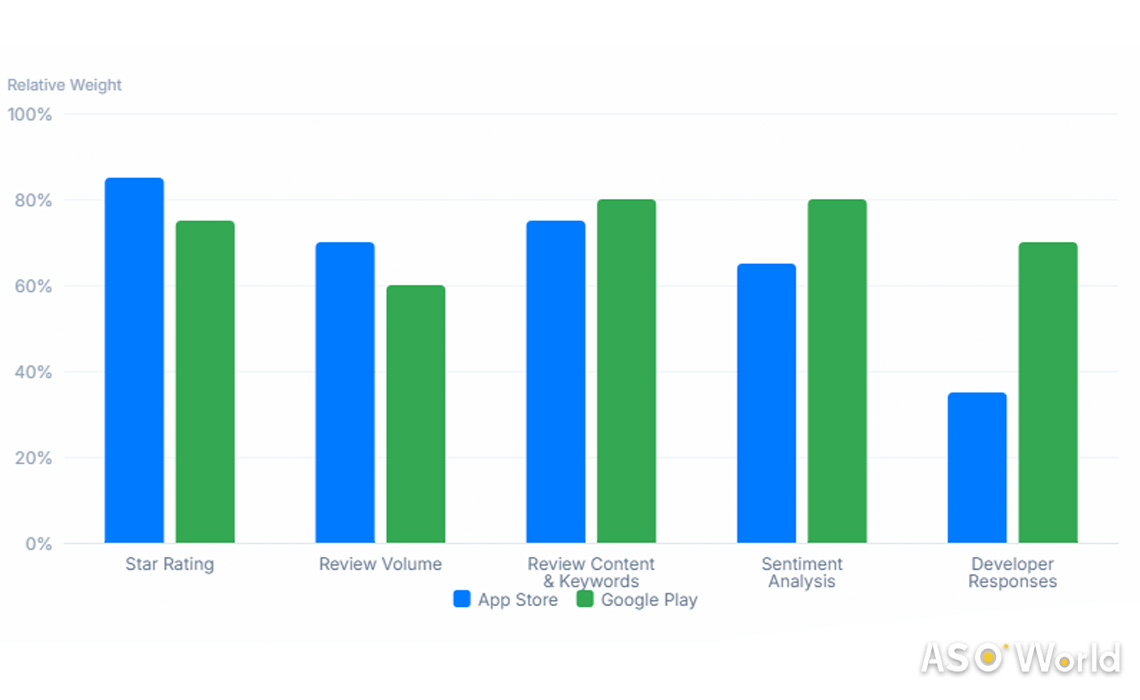
The implication is clear: generic star-stuffing is a dead strategy. Both platforms now reward apps whose users write substantive, positive reviews. This makes it essential to design your in-app experience around moments that naturally inspire detailed feedback — and to understand exactly what users are saying. For a systematic approach, explore our breakdown of review sentiment analysis for ASO.
One of the most underutilized tools in the ASO toolkit is the developer response to reviews. On Google Play, the impact is explicit and algorithmic: Google has publicly stated that developers who respond to reviews build better user sentiment — and the algorithm rewards this behavior.
The mechanism is powerful. When a developer replies to a one-star review and addresses the user's complaint, Google sends a notification to the original reviewer, prompting them to consider updating their rating. This creates a direct pipeline from customer service to rating improvement — one that costs nothing but time and attention.
On the App Store, the effect is less direct but still significant. While Apple hasn't confirmed that developer responses are an explicit ranking factor, the conversion impact is real: potential users who see thoughtful developer responses to criticism are more likely to trust the app and convert. It signals that there's an active team behind the product.
🌠Expert Tip: Set up a weekly review triage workflow. Categorize incoming reviews by sentiment and topic, prioritize responses to negative reviews that mention fixable issues, and track your "response → rating update" conversion rate. On Google Play, a well-run response program can shift your average by 0.1–0.3 stars over a quarter — a meaningful ranking difference.
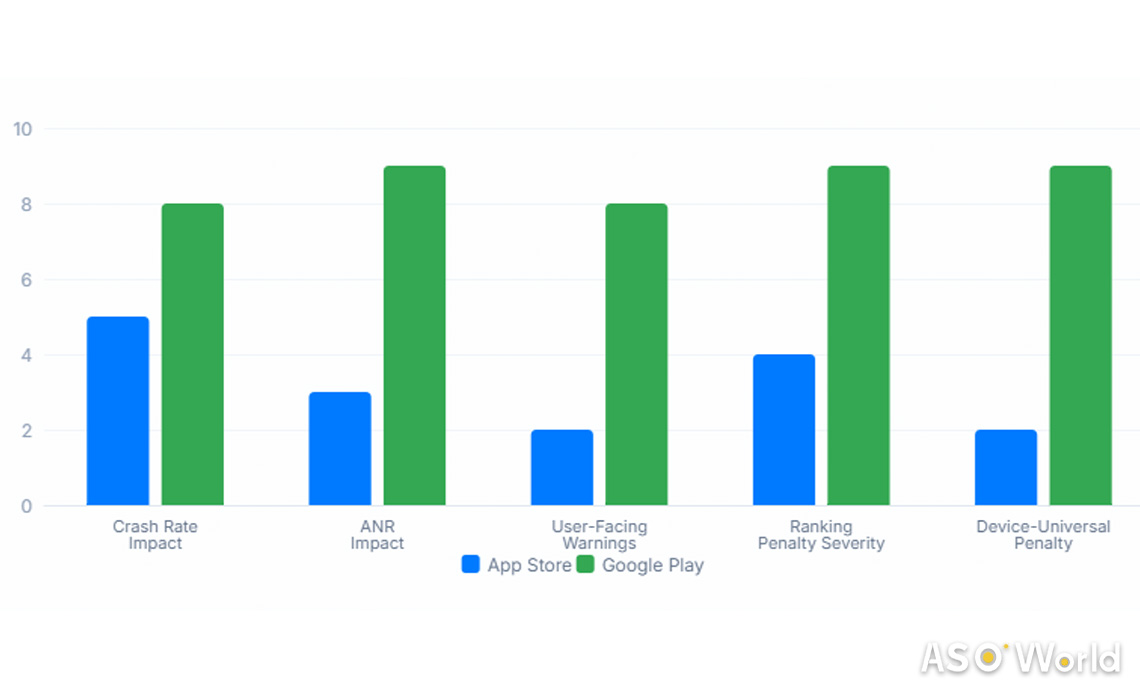
Both platforms factor technical quality into their ranking algorithms, but Google Play is far more aggressive about it.
On Google Play, the relationship between app stability and store visibility is direct and punitive. Apps that exceed Google's bad behavior thresholds — defined primarily by crash rates and ANR (Application Not Responding) events — face ranking penalties that apply regardless of your review quality. You could have a 4.8-star average and still lose discoverability if your ANR rate exceeds 0.47% of daily active users.
Worse, Google surfaces user-facing warnings directly on your store listing when these thresholds are breached. A yellow warning banner about app stability sitting above your first screenshot is a conversion disaster that no amount of ASO optimization can overcome.
On the App Store, Apple factors stability into its ranking algorithm as one component among many. It's less transparently punitive than Google's approach, but apps with high crash rates will see diminished search visibility over time — particularly as Apple's behavioral signals (retention, engagement) are negatively impacted by poor performance.
Both Apple and Google provide native In-App Review APIs — and both strictly prohibit incentivizing reviews in any form. No rewards, no discounts, no gated features. Violations can result in app removal or account suspension.
The art of review prompting is entirely about timing and context. The goal is to surface the rating prompt at a moment when the user has just experienced genuine value — what the industry calls a "moment of delight."
🌠 Expert Tip: Apple limits the system rating prompt to 3 times per year per user (365-day rolling window). Google is less restrictive but throttles prompt frequency automatically. In both cases, you need to make each prompt count. Use analytics to identify your highest-sentiment moments and trigger exclusively there. For strategies that stay within platform guidelines, see our detailed walkthrough on improving ratings without risking penalties.
Ready to optimize your ratings & reviews strategy?
Explore ASOWorld's services and insights to build an ASO pipeline that turns user sentiment into organic growth.
1.The platforms are converging on sentiment, but diverge on mechanics. Both now analyze review text and reward positive sentiment — but Apple treats all ratings as permanent and equal, while Google prioritizes recency. Your strategy must account for this fundamental difference.
2.On the App Store, play the long game. Every rating is forever. Focus on generating consistently high-quality, detailed reviews across all versions. Encourage users to describe specific features they value — this directly impacts your keyword rankings.
3.On Google Play, prioritize velocity and stability. Recent positive ratings matter most, and technical issues can override even excellent reviews. Maintain a continuous flow of fresh ratings and keep your ANR rate below the 0.47% threshold.
4.Developer responses are an asymmetric advantage. Most developers ignore reviews. On Google Play, responding to negative reviews can directly recover lost stars. On both platforms, it signals quality and care to potential users browsing your listing.
5.In 2026, review quality beats review quantity. The era of star-stuffing is over. Both platforms reward authentic, detailed, positive feedback. Design your product experience to create genuine moments of delight, prompt at the right time, and let the quality of your app speak through your users' words.
Get a good start for your app optimization with practical ASO guideline!
Want to get the latest Guides & Insights from ASOWorld?
Related posts