COVID-19 UPDATE


Important Notice:Beware of scams using ASOWorld's name for part-time recruitment or ASO earning app activities. ASOWorld is not hiring any part-time staff. Trust only official information posted by ASOWorld.


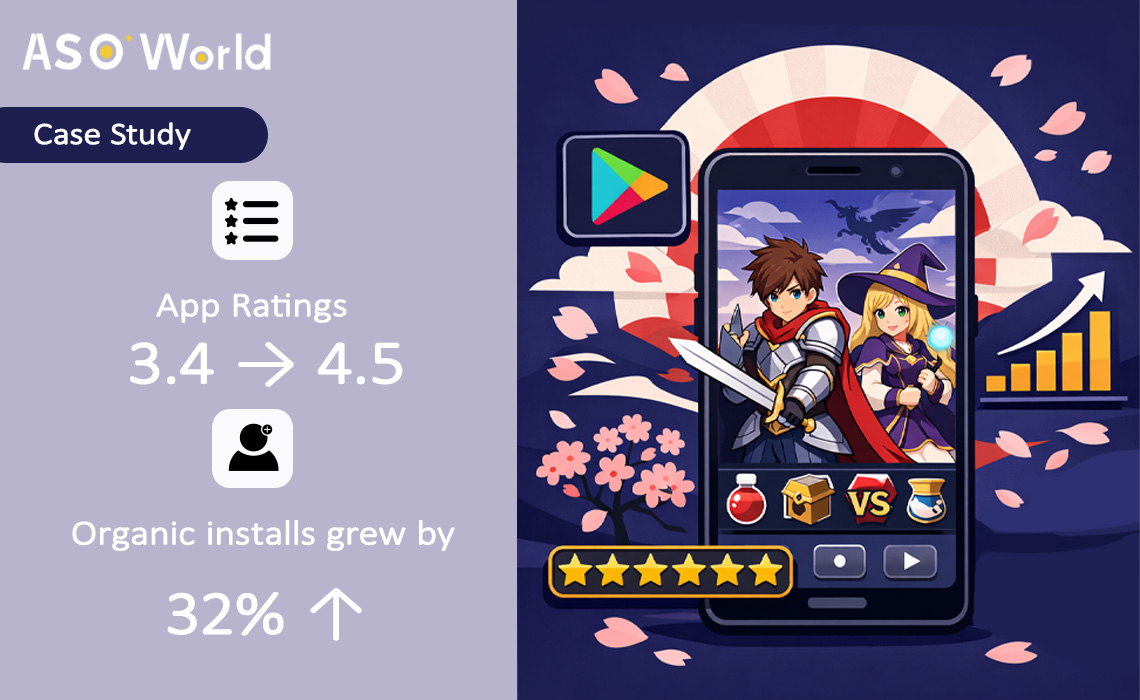
Japan is the third-largest mobile gaming market globally — and one of the hardest to crack. Japanese players are loyal, quality-driven, and deeply influenced by peer reviews before downloading a game. For RPG titles especially, a low star rating is a dealbreaker.
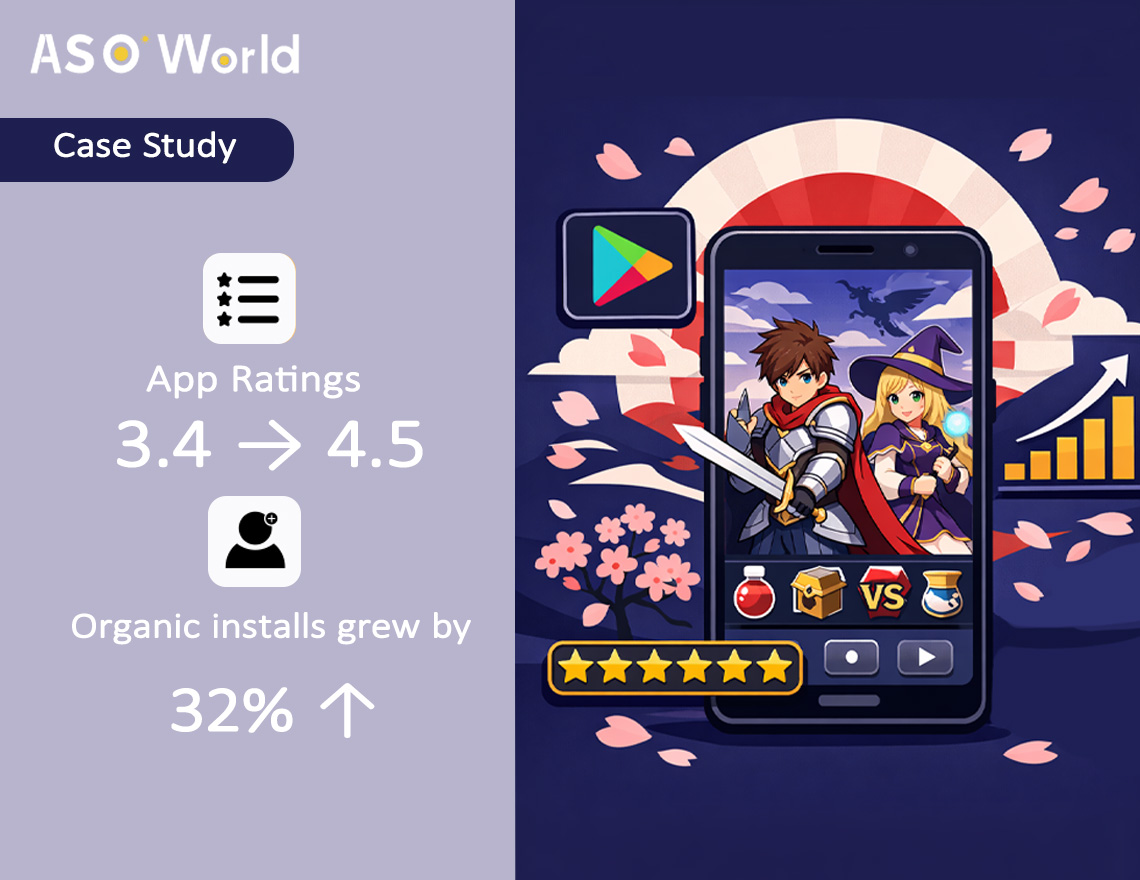
This case study walks through how ASOWorld helped a mid-tier RPG publisher turn a declining rating into a growth engine — without changing the product itself.
Japan
Google Play
Before diving into the optimization, it's worth understanding why Japan demands a different ASO approach than most markets.
| Factor | Japan Market Reality |
|---|---|
| iOS vs. Android revenue split | ~55% iOS / ~45% Google Play (source: data.ai) |
| Average RPG player spending | 2–3x higher than global average |
| Review reading behavior | 87% of Japanese users read reviews before download (vs. 79% global average) |
| Language sensitivity | Users strongly prefer native Japanese reviews; English reviews are ignored or seen as suspicious |
| Rating threshold for conversion | Below 4.0 stars = significant conversion drop; below 3.5 = near-invisible in Browse/Recommended |
Japanese mobile gamers treat reviews like product research. They don't just glance at the star count — they read review text, check for recent feedback, and look for specific gameplay details. This makes review quality and recency equally important as the rating number itself.
👉 How Each Platform Weighs Ratings & Reviews Differently
Our client is a mid-sized game studio based in Tokyo, publishing an anime-style RPG with turn-based combat and gacha mechanics. The game had been live on Google Play Japan for 18 months with a stable but unspectacular install base of roughly 15,000–20,000 monthly organic installs.
The core product metrics were solid:
But the Google Play rating told a different story: 3.4 stars from ~4,800 reviews.
The client had already completed solid keyword optimization and creative asset optimization (localized screenshots, promotional video, optimized short description in Japanese). Metadata was not the bottleneck — the rating was.
💡 Expert Tips: Why Ratings Matter More in Japan Than Most Markets
Google Play made ratings country-specific in 2021. This means your Japan rating is calculated only from Japanese users' reviews — you can't dilute bad Japan reviews with good reviews from other countries. For games targeting Japan specifically, every single Japanese review carries outsized weight.
Additionally, Japanese users tend to leave more detailed, longer reviews than users in Western markets. This means negative reviews are more visible and persuasive to potential downloaders browsing the store page.
The client's metadata optimization was already strong. The remaining lever was review and rating optimization — the area with the largest gap between product quality and store perception.
We designed a 45-day plan with four phases.
Before taking action, we analyzed the full review corpus (4,800+ reviews) to understand:
Key findings:
| Review Topic | % of 1-2 Star Reviews | % of 4-5 Star Reviews |
|---|---|---|
| Gacha rates / luck | 64% | 3% |
| Bugs / crashes | 18% | 2% |
| Story / characters | 4% | 41% |
| Combat system | 5% | 28% |
| Events / updates | 9% | 26% |
The data was clear: the negative reviews were about one feature (gacha), while positive sentiment centered on core gameplay — story, combat, and events. The problem wasn't the game. It was which players were motivated to leave reviews.
The existing review prompt appeared after 7 days of gameplay, regardless of what the player had just done. This meant players who just failed a gacha pull or lost a difficult battle were equally likely to see the prompt.
We worked with the client's dev team to redesign the trigger logic:
New prompt conditions (all must be true):
This targeted the prompt at moments of genuine satisfaction — right after a narrative payoff or a successful pull.
The result: prompt-to-review conversion improved by an estimated 35%, and the average star value of organically prompted reviews rose from 3.1 to 4.2.
Even with improved prompt logic, the math was against organic-only recovery. With 4,800 existing reviews averaging 3.4 stars, reaching 4.0+ through organic reviews alone would require approximately 2,000+ new 5-star reviews — which at the app's organic review velocity (~80/month) would take over two years.
The client needed to accelerate. That's where ASOWorld's Ratings & Reviews service came in.
Service configuration for this campaign:
Why this works safely:
ASOWorld's review service uses real users — not bots, not incentivized review farms. Each reviewer has an authentic Google Play account with purchase history. Reviews are staggered naturally over time with varied lengths and detail levels. This approach aligns with Google Play's guidelines for authentic user feedback.
👉 A Complete Guide to Buying App Store and Google Play Reviews Safely
💡 Expert Tips: Review Language Matters in Japan
In the Japanese Google Play market, reviews written in English, Chinese, or other non-Japanese languages are almost universally ignored by local users — and can actually raise suspicion. When optimizing reviews for Japan, every review must:
ASOWorld's Japan review team consists of native Japanese speakers who are active mobile gamers themselves — ensuring review authenticity at the language, cultural, and gaming context level.
Ready to optimize your ratings & reviews strategy?
Explore ASOWorld's services and insights to build an ASO pipeline that turns user sentiment into organic growth.
Alongside adding positive reviews, we helped the client build a system for managing existing and incoming negative reviews:
Developer reply framework:
Results of the response strategy:
If you're running a game in the Japanese market and your rating is stuck below 4.0, you're leaving organic installs and revenue on the table. ASOWorld's review optimization service is built for exactly this scenario — real users, native Japanese, safe delivery, measurable results.
Ready to fix your Japan rating?
👉 Register now for a free ASO consultation and 50% off your first order
Categories