COVID-19 UPDATE


Important Notice:Beware of scams using ASOWorld's name for part-time recruitment or ASO earning app activities. ASOWorld is not hiring any part-time staff. Trust only official information posted by ASOWorld.

Fortnite is back on iOS globally. Explore what Epic's worldwide App Store return means for ASO strategy, keyword competition, and mobile game marketing in 2026.


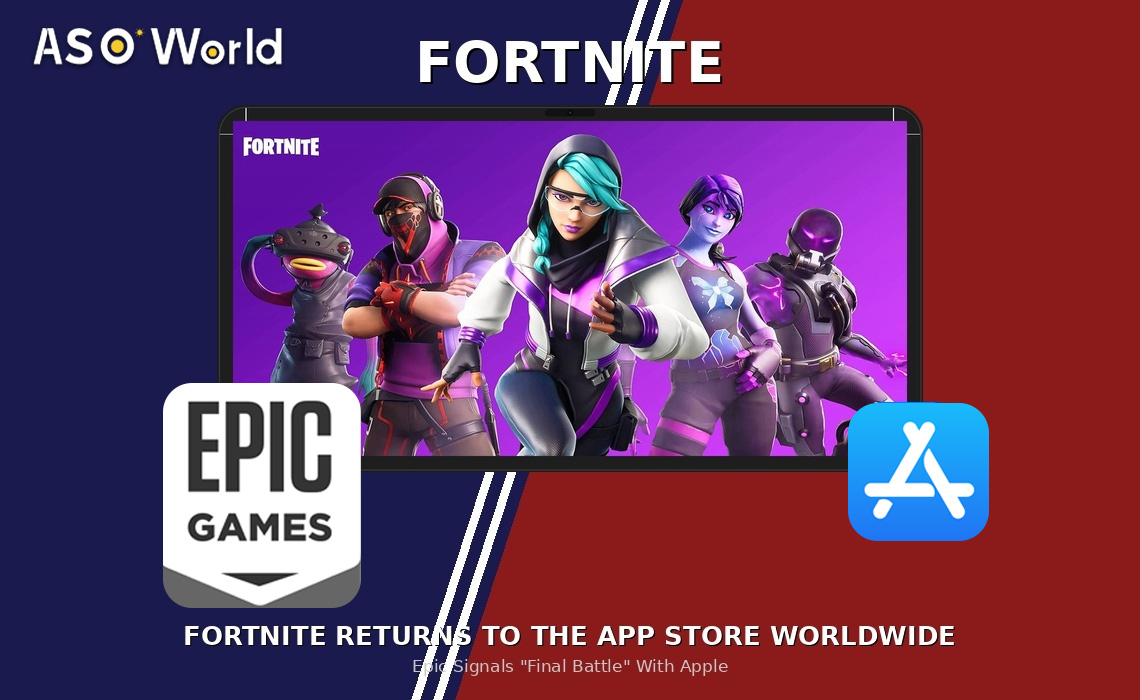
On May 19, 2026, Epic Games announced that Fortnite is back on the App Store in every country except Australia. CEO Tim Sweeney framed it as "the beginning of the end of the Apple Tax worldwide," directly tying the rollout to Apple's own Supreme Court admission that global regulators are watching the case to decide permissible commission rates.
This is the third act in a multi-year saga. ASOWorld covered the initial EU policy-driven anticipation in 2024 and the U.S. iOS comeback analysis in May 2025. Now, with Fortnite available globally on iOS once more, app marketers have real-world data on what a mega-title re-entry looks like — and actionable lessons for their own growth playbooks.
Understanding the timeline helps developers contextualize the current opportunity:
| Year | Milestone | Implication for App Marketers |
|---|---|---|
| 2020 | Fortnite removed from App Store & Google Play | Demonstrated platform risk; competitors filled the battle royale vacuum |
| 2024 | EU Digital Markets Act enables third-party stores; Epic announces iOS sideloading in Europe | Opened alternative distribution channels; ASO now spans multiple storefronts |
| May 2025 | Fortnite returns to U.S. App Store after court pressure on Apple | Proved pent-up demand (Day-1 surge); keyword competition for "battle royale" intensified |
| Apr 2026 | Ninth Circuit reverses stay on App Store fee ruling | Signaled lower commissions ahead — impacts pricing & revenue modeling |
| May 2026 | Fortnite returns globally (except Australia) | Full re-entry creates localization & multi-market ASO benchmarks |
The Australian holdout is notable: despite winning its court case, Epic refuses to re-enter under what it calls an "illegal payment arrangement." For marketers, this underscores that regulatory compliance varies market by market — a factor you must build into any global launch or re-launch strategy.
Fortnite's return is the largest App Store re-entry in history. Whether you manage a battle royale title or a productivity SaaS app, the ASO principles at play are universal.
During Fortnite's absence, rivals like Call of Duty: Mobile (ranking for ~39,000 keywords) and PUBG Mobile (~32,500 keywords) absorbed its search visibility. Fortnite's subtitle and metadata strategy upon re-listing will determine how quickly it reclaims high-traffic terms like "battle royale," "multiplayer shooter," and long-tail variants across dozens of locales.
Developers facing similar re-entry scenarios should conduct a full keyword gap analysis before re-listing.
A returning app inherits its historical rating but faces fresh scrutiny from day-one reviewers. Device compatibility issues — Fortnite still excludes iPhones with less than 4 GB RAM — risk triggering a wave of 1-star reviews that can suppress conversion rates. Proactive review management is critical in the first 72 hours of any re-launch.
Going live in nearly every market simultaneously demands localized screenshots, descriptions, and keyword sets. Fortnite's brand recognition provides a head start, but for mid-market developers, this kind of multi-locale launch requires a structured ASO optimization framework that covers metadata, creatives, and cultural nuance for each storefront.
⚡ Expert Tips
Epic's stated goal is to dismantle Apple's 30% commission globally. The Ninth Circuit's April 2026 ruling already reversed a stay that had let Apple pause compliance. If the court ultimately mandates lower — or zero — commissions on purchases made via external links, the downstream effects on app marketing are significant:
Pricing flexibility: Lower platform fees mean developers can either increase margins or reduce user-facing prices, which directly affects conversion rate optimization (CRO) on product pages.
Multi-channel payment funnels: With external payment links becoming legally protected, your ASO strategy must account for users who convert outside the App Store. Attribution, analytics, and funnel design all need updating.
Alternative storefronts: The EU's DMA has already normalized third-party app stores. Japan and the UK are following. Developers who build multi-storefront marketing strategies now will have a structural advantage as distribution fragments further.
Fortnite's global re-entry immediately pressures category rankings. Based on data from its U.S. return in 2025, we can expect:
For developers outside the battle royale genre, the lesson is clear: mega-title movements create ripple effects across the entire Games category. Monitor your own rankings during these disruption windows and be ready to adjust bids, creatives, and keyword targets.
Seeking For An Effective Way to Grow Your Game Downloads?
Try ASO to achieve 3x boost in app downloads & 5x boost in app revenue!
Whether you're a solo developer or a studio marketing team, Fortnite's worldwide comeback offers a real-time masterclass in large-scale ASO execution. Here's how to translate these observations into action:
Benchmark against disruption events. Use Fortnite's re-entry as a natural experiment — track how your own keyword rankings, impressions, and conversion rates shift during the week of May 19. This data informs future contingency plans.
Diversify your distribution. If you're iOS-only, explore listing on alternative stores in DMA-regulated markets. Early movers on the Epic Games Store and AltStore have reported lower competition and higher feature rates.
Invest in guaranteed keyword ranking services to defend or capture high-value terms during periods of category volatility.
Audit your payment and monetization flow. As commission structures evolve, ensure your in-app purchase pricing, external link flows, and attribution are optimized for the emerging multi-rail payment landscape.
Fortnite's worldwide App Store return is more than a gaming headline — it's a structural event for the entire mobile ecosystem. The legal, regulatory, and competitive forces driving this moment will influence how apps are distributed, monetized, and optimized for years to come.
For app marketers and developers, the strategic imperative is to move beyond spectating. Audit your ASO fundamentals, stress-test your growth plans against a lower-commission future, and build distribution flexibility into your roadmap. The tools and frameworks are available — what matters is acting on them now.
Ready to optimize your app's growth strategy in this shifting landscape? Explore ASOWorld's growth plans and start building your competitive edge today.
As of May 19, 2026, Fortnite is available on the iOS App Store in every country except Australia. Epic Games has stated it cannot return to Australia under what it considers an "illegal payment arrangement" and is awaiting a court order to compel Apple's compliance.
A mega-title re-entry creates category-wide ranking displacement. During Fortnite's U.S. return in 2025, competing battle royale titles saw temporary drops in both Free and Grossing subcategory rankings. Developers in adjacent categories should monitor their positions closely during launch week.
The Ninth Circuit's April 2026 reversal sends the case back to a district court to determine what commission Apple can charge on purchases made via external links. If commissions are reduced, developers gain pricing flexibility — you can either improve margins or lower user-facing prices to boost conversion rates.
If you operate in EU, Japan, or UK markets, yes — exploring alternative storefronts is increasingly viable. The regulatory trend favors multi-store distribution. Early adopters benefit from lower competition and potential feature placements on emerging platforms.
ASOWorld provides keyword research tools, guaranteed keyword ranking services, and comprehensive app promotion solutions designed for both stable and volatile market conditions. During disruption events like Fortnite's re-entry, ASOWorld's real-time keyword tracking and optimization services help you defend rankings and capture emerging opportunities.
 Mobile Growth,Mobile Analytics,
Get FREE Optimization Consultation
Let's Grow Your App & Get Massive Traffic!
All content, layout and frame code of all ASOWorld blog sections belong to the original content and technical team, all reproduction and references need to indicate the source and link in the obvious position, otherwise legal responsibility will be pursued.