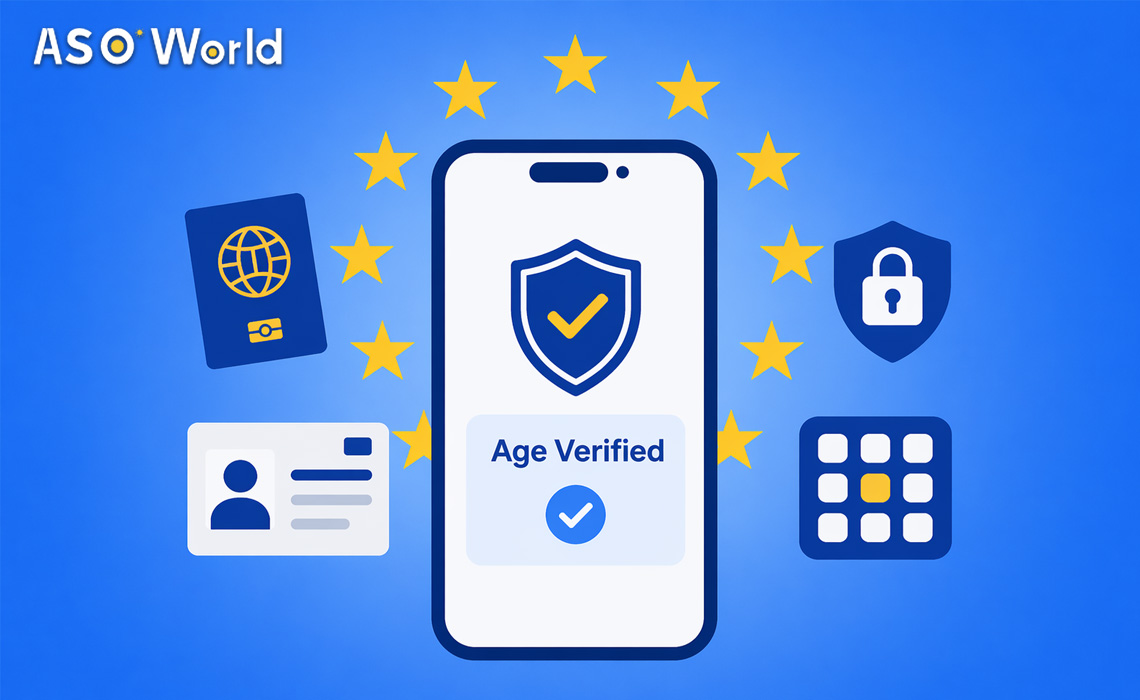
The European Union's upcoming age verification app will reshape how apps handle user access across the bloc. Here's what every app developer and marketer needs to know — and the actionable steps to turn regulatory change into a growth opportunity.
Key Takeaways
-
Is the EU introducing a unified age verification app that allows users to prove their age without sharing personal identity data?
-
Will this new system significantly impact high-risk app categories like social media, dating, gaming, and gambling?
-
Does the Digital Services Act (DSA) use age verification as a technical mechanism to enforce child safety and risk mitigation requirements?
-
Can developers gain a competitive advantage by proactively updating privacy practices, onboarding flows, and app store metadata?
-
Is EU age verification not just a compliance requirement, but also an opportunity to improve ASO performance and user acquisition?
What's Happening: The EU Age Verification App Explained
European Commission President Ursula von der Leyen has confirmed that the EU's age verification app is technically ready and will be introduced in the coming months. The app is designed to let users verify their age across digital platforms without disclosing personal identity — a privacy-first approach built on anonymization and open-source architecture.
Here's how it works:
- One-time setup: Users authenticate their age using official documents (passport, national ID) during initial setup.
- Cross-platform verification: Once verified, users can confirm eligibility to access age-restricted services — social media, gambling, alcohol-related content — without sharing additional personal data each time.
- Multi-device support: The app is built to function across smartphones, tablets, and desktop environments.
Several EU member states — including France, Denmark, and Italy — are already exploring integration of the verification system into their national digital identity frameworks. While no binding EU-wide minimum age has been enacted yet, the European Parliament has previously supported proposals advocating for a minimum age of 16 for social media access.
The initiative is closely tied to the Digital Services Act (DSA), which places greater responsibility on platforms to mitigate risks related to harmful content and user safety. For app developers and marketers, this means the compliance landscape is expanding — and the enforcement infrastructure is becoming more concrete.
Why This Matters for App Developers and Marketers
If your app is available in the EU — or if you plan to expand there — this regulatory shift has direct implications for your product, your store listing, and your growth strategy.
1. Expanded Compliance Requirements Beyond Content Ratings
The age verification app adds a new compliance layer on top of existing content rating systems like IARC. It's no longer sufficient to simply set a "Mature 17+" or "Teen" rating and move on. Platforms operating in the EU will need to support or integrate with a standardized, government-backed verification mechanism.
This is particularly relevant given that Google Play has already tightened its child safety policies. As we covered in our analysis of October 2025 Google Play Policy Updates: Key Changes for Child Safety, Finance & Health Compliance, Google is independently raising the bar for how apps handle minor users. The EU's verification app adds a regulatory mandate on top of platform-level enforcement.
2. Privacy Declarations Under Increased Scrutiny
The EU app's privacy-first design — anonymization, no personal data sharing beyond age confirmation — sets a new standard that regulators will use to evaluate other apps' data practices. If your app collects user data during age verification or onboarding that goes beyond what's necessary, you'll face heightened scrutiny.
This aligns with a broader enforcement trend. Apps that have already faced issues with EU trader status requirements (as covered in Apps Without Trader Status Face Removal from EU App Store) know that the EU is willing to enforce removal at scale. Data safety declarations that don't match actual behavior are a primary removal trigger.
3. Store Listing and Metadata Implications
Age-gated content categories will face new store listing requirements. Your app description, screenshots, and content ratings must accurately reflect how your app handles age-restricted content and user verification. Misleading metadata — even unintentionally — could lead to listing suppression or removal.
Which App Categories Will Be Most Affected?
Not all apps face equal exposure. Here's a breakdown of risk levels by category:
| Category |
Impact Level |
Key Concern |
| Social Media |
Very High |
Core target of EU minimum age proposals (13–16 threshold) |
| Dating Apps |
Very High |
Age verification is already a legal requirement in some EU markets |
| Gambling & Betting |
Very High |
Existing age restrictions will be enforced through the new app |
| Gaming (with chat/UGC) |
High |
User-generated content and social features trigger child safety requirements |
| Streaming & Content |
High |
Alcohol, violence, and mature content categories affected |
| Health & Fitness |
Medium |
Health data handling intersects with minor protection rules |
| E-commerce |
Medium |
Age-restricted product categories (alcohol, tobacco) |
| Utilities & Productivity |
Low |
Minimal age-sensitive content, but data collection still applies |
Expert Tip: Conduct an EU Compliance Audit Now
Don't wait for the app to officially launch. Map every feature in your app that could be considered age-sensitive — social features, UGC, in-app purchases, content feeds, messaging — and document how each one handles (or should handle) minor users. This audit will form the foundation of your compliance response and dramatically accelerate your reaction time when specific requirements are published.
5 Actionable Strategies to Prepare Your App for EU Age Verification
Strategy 1: Update Your Content Ratings and Age Classification
Re-submit your IARC content rating questionnaire with the EU's emerging requirements in mind. If your app contains any features that could be accessed by minors — even if it's not designed for them — err on the side of higher ratings.
Common Mistake
Assuming that a correct content rating exempts you from age verification requirements. The EU's verification app operates as a separate layer — your content rating tells the store who your app is for, but the verification app will control who can actually access it. Both must be aligned.
Strategy 2: Redesign Your Onboarding Flow for Verification Compatibility
Start thinking about how your app's onboarding flow will integrate with external age verification. The EU app is designed to be cross-platform and service-agnostic, meaning your app will likely need to accept a verification token or signal from the EU system rather than running its own age check.
Expert Tip: Build a Modular Verification Layer
Design your age-gating logic as a modular component that can accept verification signals from multiple sources — the EU app, platform-native controls (like Apple's Screen Time or Google's Family Link), and your own in-app system. This gives you maximum flexibility as regulations evolve across different markets.
Strategy 3: Strengthen Your Privacy Declarations and Data Safety Section
Audit every SDK in your app for data collection behavior. Third-party analytics, ad networks, and crash reporters often collect data you haven't declared. With the EU's emphasis on privacy-first age verification, any discrepancy between your data safety section and actual app behavior becomes a higher-risk compliance gap.
Your privacy policy must be GDPR-compliant, accessible from both the store listing and within the app, and specifically address how your app handles data from users who may be minors.
Strategy 4: Optimize Your Store Listing to Signal Compliance and Trust
This is where compliance meets ASO. Apps that visibly signal their commitment to user safety and regulatory compliance in their store listings will benefit from both user trust and algorithmic favor.
Practical steps:
- Add safety-related keywords to your metadata where relevant — terms like "age verification," "child safety," "GDPR compliant," and "parental controls" are gaining search volume in EU markets.
- Update screenshots and feature graphics to highlight safety features, parental controls, or privacy protections if your app includes them.
- Craft your app description to explicitly address how your app handles age-appropriate content and user data protection.
For a comprehensive approach to keyword optimization, refer to How To Enlarge Your App Store Searching Traffic With Keyword Research & Keyword Optimization.
Expert Tip: Localize Your Compliance Messaging
The EU has 24 official languages, and compliance messaging that resonates in English may not translate effectively. With Apple's recent expansion to 50 supported localizations (covered in App Store Now Supports 11 New Languages: Your Complete Localization Action Plan for 2026), you now have the infrastructure to deliver localized compliance messaging across all major EU markets. This is both a compliance best practice and an ASO opportunity — localized listings consistently outperform English-only listings in non-English markets.
Strategy 5: Diversify Your Distribution and Build Platform Resilience
The EU's regulatory framework applies to all platforms operating in the region, but enforcement timelines and interpretations may vary between Apple's App Store, Google Play, and alternative stores. Apps that maintain a multi-platform presence are better positioned to absorb regulatory disruptions on any single platform.
The Bigger Picture: Regulatory Compliance as a Competitive Advantage
EU regulators acknowledge that the age verification system will not fully prevent circumvention — VPN usage, for example, has already been observed in markets like Australia that have implemented similar restrictions. The app is designed as a "protective barrier" rather than a comprehensive enforcement mechanism.
But here's what matters for app marketers: the regulatory direction is clear, and it's accelerating. Multiple EU member states are independently pursuing minimum age thresholds between 13 and 16. A coordinated EU-level approach is under discussion. The Digital Services Act is being actively enforced, with platforms like Meta and X already facing probes and penalties.
Developers who treat these regulatory changes as a competitive opportunity — by building compliance into their product, signaling it in their store listings, and using it as a differentiation lever — will outperform those who react only when enforcement arrives.
This mirrors a pattern we've seen repeatedly in app store compliance. As we documented in How to Avoid Getting Your App Removed from Google Play, the developers who survive enforcement waves are those who build proactive compliance into their operational workflow — with quarterly audits, monitoring tools, and documented processes.
Expert Tip: Monitor Policy Changes Across Both Stores and Regulators
Set up a monitoring pipeline that tracks not just App Store and Google Play policy updates, but also EU regulatory developments. The European Commission's announcements, DSA enforcement actions, and member state-level legislation all provide early signals of what platform-level requirements will follow. Our coverage of App Store News shows how platform changes often follow regulatory pressure — tracking both gives you the earliest possible warning.
What Comes Next: Timeline and Preparation Checklist
| Timeline |
Expected Development |
Your Action |
| Q2 2026 |
EU age verification app official launch |
Complete your compliance audit; update content ratings |
| Q2–Q3 2026 |
Member state integration begins (France, Denmark, Italy first) |
Localize compliance messaging for priority EU markets |
| Q3–Q4 2026 |
Policy panel recommendations on EU-wide minimum age |
Prepare onboarding flow modifications for age-gating |
| 2027 |
Potential binding EU-wide age legislation |
Full integration with EU verification infrastructure |
FAQs
Will the EU age verification app affect apps outside the EU?
Directly, no — the app is designed for the EU market. However, if your app is available on the App Store or Google Play in any EU member state, you'll need to comply with the regulations it enforces. Additionally, regulatory trends in the EU often influence policy in other markets (Australia, the UK, and parts of Asia have pursued similar measures), so preparing now has global relevance.
Does my app need to integrate directly with the EU verification app?
The specific integration requirements have not been fully published yet. The app is designed to provide a cross-platform verification signal, which suggests that platforms (Apple, Google) may handle the integration layer, with apps receiving a verified/unverified user status. However, apps in high-risk categories (gambling, dating, social media) should prepare for the possibility of direct integration requirements.
What if my app already has its own age verification system?
Your existing system may still be useful as a supplementary measure, but it likely won't replace the EU's standardized verification. The EU app is specifically designed to provide a uniform, privacy-preserving alternative to the fragmented age-gating methods currently used by individual apps. Plan for both systems to coexist during the transition period.
How does this relate to the Digital Services Act (DSA)?
The age verification app is a technical enforcement tool for the DSA's requirements around child safety and platform responsibility. The DSA already requires platforms to mitigate risks related to harmful content and user safety — the verification app provides the infrastructure to enforce age-based access restrictions specifically.
Will this impact my app's ASO performance?
Yes, in two ways. First, apps that fail to comply may face listing suppression or removal in EU markets, directly impacting visibility. Second, apps that proactively signal compliance — through updated metadata, safety-related keywords, and trust-building store listing elements — can capture increased search traffic as users and regulators alike prioritize safe, compliant apps.
What's the penalty for non-compliance?
Under the DSA, platforms can face fines of up to 6% of global annual turnover for systemic non-compliance. For individual app developers, the more immediate risk is listing removal or geo-restriction in EU markets. Given that the EU has already enforced trader status requirements with app removals, developers should take compliance deadlines seriously.
Looking for expert help preparing your app for the EU's changing regulatory landscape? ASOWorld provides end-to-end App Store Optimization services — from compliance-aligned metadata optimization and localization to keyword strategy and creative optimization — across both iOS and Google Play.
 COVID-19 UPDATE