TL;DR
- December is the best month of the year to audit keywords: holiday data is fresh, seasonal terms have to come out anyway, and January brings new search intent.
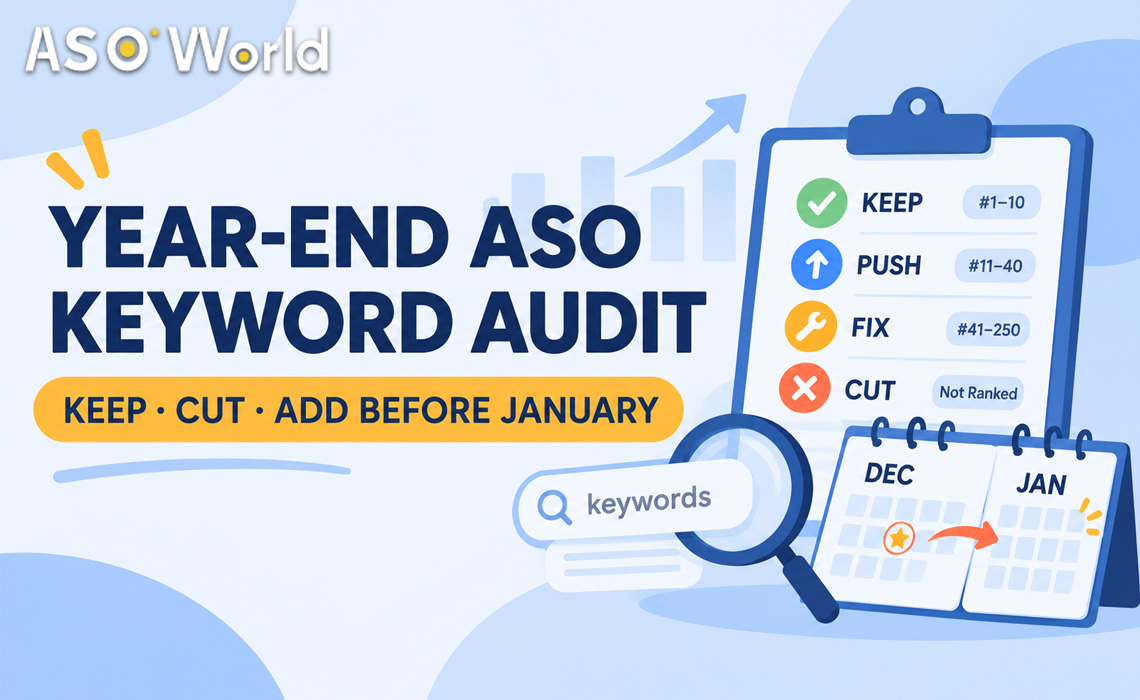
- Sort every tracked keyword into four ranking buckets (1-10, 11-40, 41-250, not ranked), then apply one rule per bucket: keep and defend, push, fix relevance or replace, cut.
- Rebuild the list so 10-30% are core terms and 70–90% are long-tail, starting from 2-4 core terms and 10 or more long-tail terms.
- Only keywords that already rank inside the top 250, match what your app does and convert visitors are worth spending on in January.
Most keyword lists grow by addition. Terms get added for a launch, a feature, a competitor or a holiday, and almost nothing is removed. By December, the list is long, the metadata is crowded, and nobody is sure which keywords bring installs. A year-end audit fixes that in one afternoon, and it gives you a short, defensible plan for January.
Why should you audit keywords in December?
Three things line up at the end of the year.
- Holiday data is fresh. You can see which seasonal terms brought real traffic and which only brought impressions.
- Seasonal terms have to come out. Words such as “black friday”, “christmas” or “gift” lose search volume in January. Left in place, they take characters away from terms people will search next month.
- January intent is different. New phones, New Year goals and new budgets shift what people search for, especially in health, finance, productivity and education.
What data do you need before you start?
| Data |
Where to get it |
What it tells you |
| Rank per keyword and country |
Your keyword tracking tool |
Which bucket each term sits in |
| Search volume (popularity) |
Keyword tool or Apple Ads popularity |
Whether a term is worth the characters |
| Downloads by source (search vs browse) |
App Store Connect, Google Play Console |
Whether search traffic grew or fell this quarter |
| Search terms that brought visitors |
Google Play Console store analysis |
Real queries on Android, including ones you never targeted |
| Product page conversion rate |
App Store Connect, Google Play Console |
Whether ranking turns into installs |
| Competitor ranked keywords |
Keyword tool |
Terms you are missing |
Rankings you see on your own phone will often differ from a tracking tool because of location, device and personal history. If that difference confuses your team, read Why is my app’s ranking different on my phone than in my ASO tool? before you start.
You can pull rankings, competitor keywords and a diagnosis of your listing from ASOWorld’s free tools (Keyword Monitor, Competitor’s Keywords and App Intelligent Diagnosis) with a free account.
How do you run the audit? A 7-step process
Step 1: Export every tracked keyword and sort it into four buckets
Use the same buckets as our badly ranked or not ranked diagnostic: positions 1 - 10, 11 - 40, 41 - 250 and not ranked. Do it per country. A keyword can be in the top 10 in Canada and not ranked in the US, and those are two different decisions.
Step 2: Apply the keep, push, fix or cut rule
| Bucket |
Typical situation |
Decision |
What to do in January |
| 1-10 |
Brings visible traffic |
Keep and defend |
Keep it in title or subtitle; watch conversion; maintain, don’t push hard |
| 11-40 |
Close to page one, some traffic |
Push |
Strengthen metadata placement; consider a small, paced campaign |
| 41-250 |
Indexed but rarely seen |
Fix relevance or replace |
Push only if relevant and with real volume; otherwise swap for a long-tail variant |
| Not ranked |
Not indexed or far away |
Cut or rebuild |
Remove from fields; re-add only with a clear relevance case |
Two filters apply in every bucket. First, relevance: if users who search this term would not want your app, cut it, whatever the rank. Second, conversion: a term that ranks well but brings visitors who don’t install is costing you, because a low conversion rate weakens the page’s overall signal.
Low volume alone is not a reason to cut. A popularity score of 5 can still send steady installs in a niche, as we explain in Low-popularity keywords: why a popularity of 5 can still drive installs.
Step 3: Clear seasonal terms on a fixed date
Make a list of every holiday term in your metadata, in-app event names and screenshots. Put a removal date next to each one, usually the first week of January. If you sell into Japan, Korea or Vietnam, leave room for New Year (January 1-3) and Lunar New Year (February 2027) terms instead of deleting the seasonal slot entirely.
Step 4: Rebalance core and long-tail terms
ASOWorld’s How to Pick the Right Keywords guide recommends a portfolio of 10–30% core terms and 70-90% long-tail terms, starting with 2-4 core terms and 10 or more long-tail terms, then reviewing every few weeks. Score each candidate on volume (5-100), difficulty and chance, and balance the three rather than maximizing any one.
If most of your list is high-difficulty head terms, you are probably spending characters on keywords you cannot win this quarter. Your target ASO keyword is too competitive shows how to find winnable alternatives.
Step 5: Rewrite metadata store by store
The two stores read different fields, so a single keyword list rarely fits both.
| Field |
App Store |
Google Play |
| Title |
30 characters, strongest signal |
30 characters, strongest signal |
| Subtitle / short description |
Subtitle, 30 characters, indexed |
Short description, 80 characters, indexed |
| Keyword field |
100 characters, hidden, comma-separated |
None |
| Long description |
Not indexed for search |
Up to 4,000 characters, indexed |
| Repetition |
No benefit from repeating a word across fields |
Priority terms 3-5 times in the description, without stuffing |
On iOS, don’t repeat words that already appear in the title or subtitle inside the keyword field. On Google Play, write the description for people first and place priority terms naturally.
Step 6: Pick a short January push list
Only some keywords deserve paid visibility. Put a keyword on the January list when all four are true:
- It ranks inside the top 250 in the target country.
- It matches a feature people can use on the first screen.
- Visitors from it convert at least as well as your page average.
- It sits in the 11-40 or 41-250 bucket, where a move up changes traffic.
For those terms, a small, paced campaign is the efficient option. On ASOWorld, keyword installs start at $0.20 per install on Google Play and $0.30 on iOS (checked November 27, 2026), and the app must already rank in the first 250 results for each keyword and country. ASOWorld’s own guidance is to keep keyword installs below 30% of your total daily installs and to increase volume gradually. Keep in mind that any paid activity around store search carries platform policy risk; our guide How to choose a keyword installs provider lists the questions to ask before spending.
If you plan to fund January keyword work, ASOWorld’s Black Friday recharge bonus closes tonight, November 27, at 23:59 (UTC+8), and the bonus credit does not expire. A 4-week plan to spend your credit shows how to split it across December and January.
Step 7: Set your tracking cadence for the new year
Check impressions, conversion and rank movement monthly, and run a full refresh every quarter, or sooner after a major update, a seasonal shift or a competitor change. Decide in advance what “working” means for each keyword: a top-1 position for a few terms, or top-10 coverage across many. Rank #1 or rank wide? helps you set that goal, and our weekly ASO report template turns it into a one-page update for your team.
What does an audit look like in practice? A worked example
Illustrative example, not a client case. A budgeting app tracks 42 keywords in the US on iOS.
| Bucket |
Keywords |
Decision |
| 1-10 |
5 (brand, “expense tracker”, 3 long-tail) |
Keep and defend; no paid push |
| 11-40 |
9 |
Push 4 relevant, converting terms in January |
| 41-250 |
16 |
Keep 6 with real volume; replace 10 with long-tail variants |
| Not ranked |
12 (incl. “black friday budget”, “christmas gifts”) |
Cut all seasonal terms on January 4; drop 4 off-topic terms |
The result: 31 keywords instead of 42, a keyword field with room for “new year budget” and “savings goal” variants, and a January push list of four terms instead of twenty.
Should your audit include AI assistants?
Yes, briefly. People now ask ChatGPT, Gemini and Perplexity which app to use, and those answers draw on how your app is described across the web, not only in the store. Search your app name together with your core use case in two or three assistants. If the description they give differs from your listing (different category, missing core feature), align your website, store listing and press descriptions so every source says the same thing.
Which keyword audit mistakes are most common?
- Cutting low-volume terms that convert. A small, high-intent term often beats a large, vague one.
- Keeping seasonal words into February. They waste characters for weeks after demand disappears.
- Auditing only one country. Each storefront ranks independently; audit the markets that bring installs.
- Judging after two days. Rankings refresh slowly. If a term has not moved, use a switch, scale or wait framework before you replace it.
- Pushing terms that don’t convert. More visibility on a term with a weak page only multiplies the leak. Fix the page first.
Frequently asked questions
How often should I audit my app store keywords?
Check performance monthly and run a full audit every quarter. A year-end audit in December is a good fourth-quarter refresh because seasonal terms come out anyway.
How many keywords should an app track?
There is no fixed number. A practical starting point is 2-4 core terms plus 10 or more long-tail terms per market, with 10–30% core and 70-90% long-tail.
Should I delete keywords that are not ranked?
Remove them from your metadata unless you have a clear relevance case and plan to rebuild them. Unranked terms in your fields take space from terms that can rank.
Can I audit keywords without paid tools?
Yes. App Store Connect and Google Play Console show downloads by source and conversion rates, Google Play shows search terms, and ASOWorld’s free tools show rankings and competitor keywords with a free account.
When should I push a keyword with paid installs?
Only when it already ranks in the top 250, is relevant to a feature users see immediately, and converts at least as well as your page average. Keep paid volume small relative to organic installs and increase it gradually.
What should I do with Christmas and Black Friday keywords in January?
Remove them on a fixed date in the first week of January and reuse the characters for January intent, such as New Year goals or new-device searches.
What else is in the 2027 planning series?
This audit is the first step of our 2027 planning series. One more page worth reading before January:
Where should you go from here?
- No ASOWorld account yet? Create a free account and run App Intelligent Diagnosis on your app; it gives you the ranking buckets for Step 1 in a few minutes.
- Account ready, list too long? Run Steps 1–4 for your top two countries today, then cut every seasonal term on a set date in January.
- Already running campaigns? Move budget from terms in the 1-10 bucket to relevant, converting terms in the 11-40 bucket, and keep paid volume proportional to organic installs.
 COVID-19 UPDATE