COVID-19 UPDATE


중요 공지:파트타임 채용이나 ASO 수익 앱 활동을 위해 ASOWorld의 이름을 사용하는 사기에 주의하세요. ASOWorld는 파트타임 직원을 채용하지 않습니다. ASOWorld가 게시한 공식 정보만 신뢰하세요.


The client is a small independent team behind an AI-powered expense tracker. The app scans receipts, sorts spending into categories automatically, and builds simple monthly reports. Its users fall into two groups: individuals planning a personal budget, and freelancers or small-team employees who need clean records for reimbursement and tax filing.
The product was well received, with a 4.7-star rating from early users. Even so, the app was stuck at roughly 45 organic downloads per day. Although it is really a productivity tool for organizing receipts and records, its store listing leaned on the broad “finance” label, a term shared with thousands of banking, investing and budgeting products. The features that set it apart, receipt recognition and automatic categorization, were invisible in search. With the November–December budgeting season approaching, the team wanted qualified search traffic in place before demand peaked.
The expense and budgeting space is crowded. Budgeting apps, workplace expense and receipt tools, and banking apps all compete for the same searches, and the broad finance terms are dominated by the largest names. That makes it hard for a newer, feature-focused productivity app to be seen.
The team faced three specific challenges:
The objective was clear: replace the generic finance keyword set with one built around year-end budgeting and expense scenarios, and turn that visibility into steady organic downloads.
The client knew its listing was not working, but it had never bought ASO or keyword services before and was not sure where to start. It came to ASOWorld with a goal and kept the decisions in its own hands. The client edited its own listing and placed its own Keyword Installs orders on the self-service platform. ASOWorld’s consultants supplied what a first-time buyer usually lacks: keyword suggestions, a recommended order volume and pacing, and a weekly check-in to review the numbers. FoxData provided the ranking and competitor data behind each discussion.
The client exported its search reports and shared them with ASOWorld’s consultants, who compared them with FoxData keyword data. (How to Conduct Competitive ASO Keyword Optimization Analysis)
The consultants laid out the options. The client decided to drop the broad finance label and compete on year-end budgeting and receipt scenarios instead.
ASOWorld proposed a candidate list of about 100 keywords, grouped by what the user is trying to do. The client then trimmed it to a fixed library of 60, using its own knowledge of the product. For example, it dropped mileage-related terms because the app does not track mileage. ASOWorld’s advice was to keep only terms that match a feature the app really has, so visitors who install do not leave disappointed.
The final library had about 20 keywords for each job:
The generic finance terms left the core library and were only monitored on the side.
The client’s marketer wrote the new title, subtitle, keyword field and screenshot captions. ASOWorld shared guidance on character limits, on not repeating a keyword across fields, and on wording that US users actually search, such as “tax season”, “reimbursement” and “write-offs”. The consultants reviewed the draft and suggested moving “receipt scanner” into the title, where it carried the most weight. The client made the final call and submitted the update itself.
Screenshot captions followed the same order as the jobs: scan a receipt in seconds, see where your year went, export a report for reimbursement.
After comparing the options, the client chose Keyword Installs to support its priority terms. This was its first time buying the service, so ASOWorld gave a starting plan:
The client placed every order itself on the self-service platform, within what store rules and the market allowed. No other paid acquisition was used.
Every week the client and ASOWorld looked at the same 60 keywords in the same country and store. ASOWorld pointed out which terms to keep, which deserved more volume and which to drop, and the client made the call. After week 4, the client swapped nine terms that were still outside the Top 50 for better ones found in its search-term data, and chose to raise volume on its budgeting keywords. A fixed basket kept the results comparable and stopped the library from drifting back toward broad finance terms.
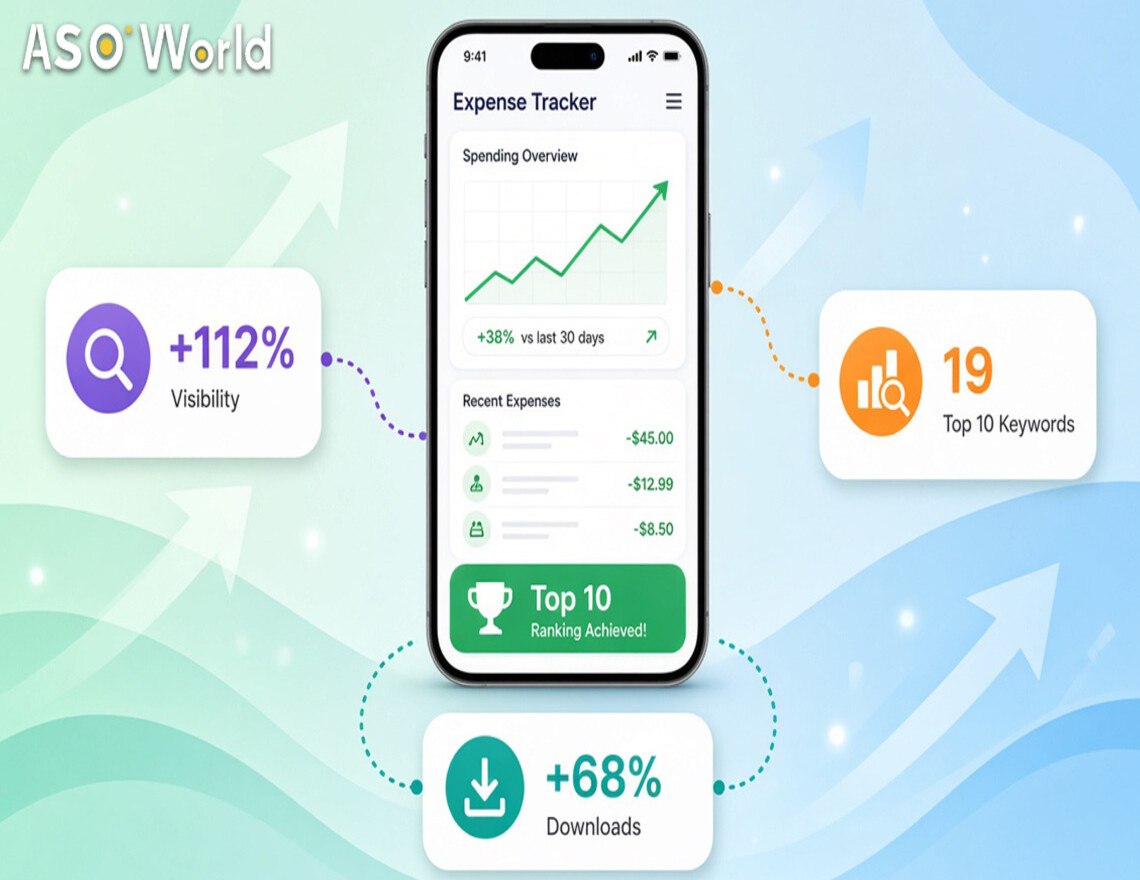
By the end of the 8 weeks, the app ranked in the Top 10 for 19 keywords and the Top 50 for 41. Gains were strongest in the budgeting and receipt jobs, where the listing and the keywords matched most closely.
| Job | Top 10 keywords before | Top 10 keywords after |
|---|---|---|
| Tidy up the year | 1 | 7 |
| Plan next year | 2 | 8 |
| Reimbursement and taxes | 1 | 4 |
| Total | 4 | 19 |
Search visibility across the fixed library rose 112%, and weekly impressions grew 97%. The share of impressions coming from broad finance terms fell from about 72% to about 35%. Organic downloads stabilized at about 75 per day, a 68% increase, and product page conversion improved from 31.2% to 33.1%.
Planning for a seasonal peak in your own category? Start with ASOWorld’s ASO Service or explore Keyword Installs to support your priority keywords.