COVID-19 UPDATE


Important Notice:Beware of scams using ASOWorld's name for part-time recruitment or ASO earning app activities. ASOWorld is not hiring any part-time staff. Trust only official information posted by ASOWorld.


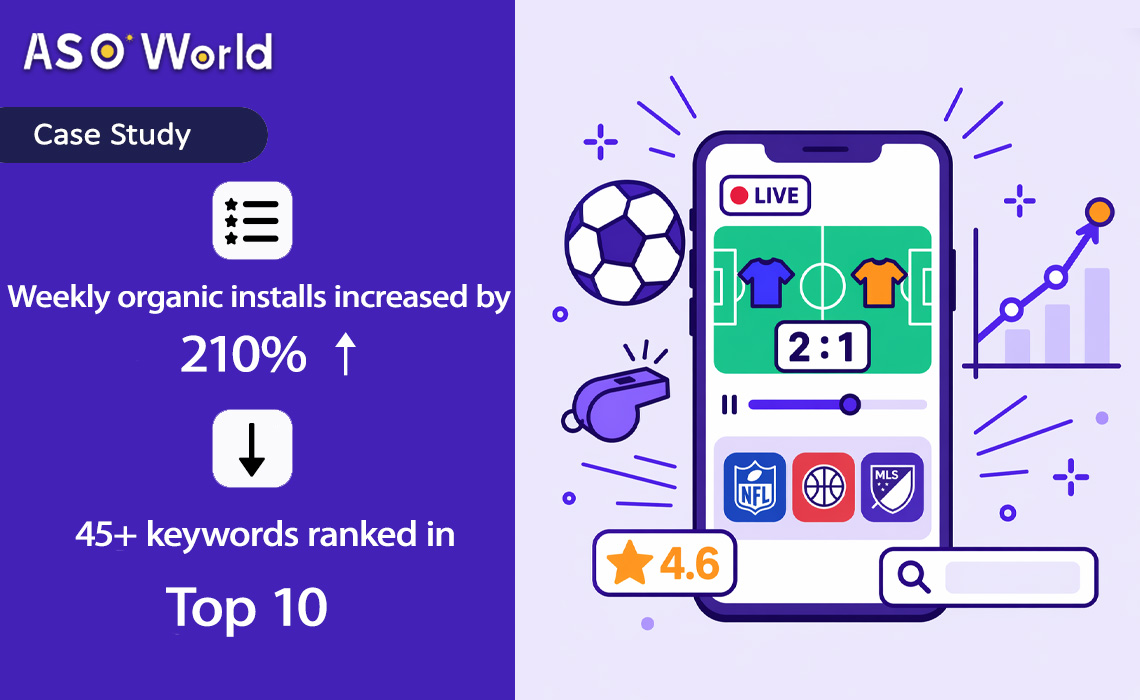
The client operates a sports live streaming app covering NFL, NBA, MLS, and Premier League with a freemium model — free highlights and scores, paid subscription for full streams.
At the start of Q1 2026, the app ranked in the Top 10 for only 3 keywords — all branded. Core discovery terms like "live sports streaming," "NFL live," and "watch basketball" were dominated by ESPN+, DAZN, FuboTV, and Paramount+. The client's app appeared nowhere on the first page.
The result: over 90% of installs came from paid UA or direct brand searches. Organic discovery was nearly non-existent.
United States, Canada
iOS App Store
The Q1 2026 sports calendar created a compressed window of opportunity — NFL Playoffs, Super Bowl, and NBA mid-season all overlapping — with the 2026 FIFA World Cup already driving early search interest.
The client identified three problems blocking them from capturing this demand:
No keyword positions for non-branded terms. The app was indexed for 87 keywords total — less than a third of the top-10 category average (320+). Users searching by league name, event, or feature never saw the app.
Late to every seasonal window. In past seasons, the team started ASO work during the event itself. By then, keyword positions were locked and paid CPIs had spiked 3-4x. The traffic surge came and went without lasting ranking gains.
No system for compounding. Each season reset to zero. Rankings built during NFL season decayed during the off-season because there was no ongoing keyword maintenance.
The client's goal: build durable keyword positions before the Q1 peak — and keep them.
The client ran a competitive scan using ASOWorld's free ASO diagnostic tool, benchmarking against the top 10 sports streaming apps in the US.
The scan surfaced over 200 relevant keywords where the app had zero visibility. More importantly, it revealed that incumbents like ESPN+ and FuboTV concentrated on head terms ("sports streaming," "live TV") but left significant gaps in:
These weren't low-value scraps. They were high-intent keywords with meaningful search volume that large players simply hadn't optimized for.
👉 How to conduct keyword research and increase app visibility
With the keyword gap mapped, the client restructured metadata across title, subtitle, and keyword field to maximize indexing coverage.
Before → After:
|
Element |
Before |
After |
|
Title |
[Brand] - Live Sports |
[Brand]: Live Sports Streaming & Scores |
|
Subtitle |
Watch live sports, highlights & more |
NFL, NBA, MLS & Premier League — Stream Live |
|
Keyword field |
Repeated title terms + generic sports words |
League names, event terms, feature terms, competitor-adjacent terms |
The shift was deliberate: move from generic benefit language ("watch live sports") to specific intent signals ("NFL," "NBA," "Premier League") that match how users actually search. As covered in leveraging App Store seasonality for sports apps, sports users search by league and event — not by category.
Result: Indexed keywords expanded from 87 to 310+ within 3 weeks. But indexing alone doesn't mean ranking. Most new keywords sat at positions #80-200 — visible to the algorithm, invisible to users.
This was the core growth lever.
Metadata got the app indexed. Keyword installs through ASOWorld's platform moved it up the rankings. The client ran targeted install campaigns for priority keywords, structured in three tiers:
|
Tier |
Target |
Approach |
|
Quick wins |
15 keywords already at #20-50 |
Moderate daily volume → push into Top 10 first |
|
Seasonal pre-position |
20 event-driven keywords (Super Bowl, NBA Playoffs) |
Front-loaded volume 4 weeks before peak demand |
|
Long-tail build |
30+ league-specific and feature terms |
Steady volume to establish and maintain positions |
During Super Bowl week, paid CPI for "super bowl streaming" spiked 4x across the industry. But the client had already reached position #4 organically three weeks earlier — capturing the traffic surge at zero incremental cost while competitors scrambled to bid up paid placements.
This is the same timing principle that drives World Cup ASO strategy: rank before the window opens, not during it.
ASOWorld First Order Discount
Get 50% off on your first order to start your app growth!
Past seasons had taught the client a painful lesson: rankings built during a spike decay without maintenance. This time, the approach was different.
The client established an ongoing keyword maintenance rhythm:
The 2026 sports marketing trends confirm this pattern across the industry: apps that treat ASO as a continuous process retain 60-70% of seasonal ranking gains, while one-time optimizers lose most positions within 4-6 weeks.
ESPN+ and DAZN will always own "sports streaming." They can't own every league-specific, event-driven, and feature-specific long-tail keyword. For mid-size streaming apps, the real opportunity isn't competing for 5 head terms — it's systematically ranking for 50+ long-tail terms that collectively drive more organic traffic than any single head term.
This case study shows a repeatable framework:
Map the gap → Restructure metadata → Push rankings with keyword installs → Maintain with ongoing campaigns.
If your sports streaming app is invisible in App Store search while incumbents capture your potential users, start with a free diagnostic to see exactly where you stand:
👉 Run a Free ASO Diagnosis — instant keyword gap analysis vs. your top 10 competitors.
👉 Explore Sports App Marketing Solutions — 50% off your first campaign.
The 2026 World Cup kicks off June 11. NFL preseason starts in August. The best time to build keyword positions is before the season — not during it.
Categories