COVID-19 UPDATE


Important Notice:Beware of scams using ASOWorld's name for part-time recruitment or ASO earning app activities. ASOWorld is not hiring any part-time staff. Trust only official information posted by ASOWorld.


| Industry | Mobile Games — Puzzle / Casual |
| Platforms | App Store (iOS) & Google Play |
| Target Markets | United States, United Kingdom, Germany |
| Team Size | Small studio (~15 people) |
| ASO Service Used | Keyword Installs |
The client is a small overseas game studio that had built a well-designed match-style puzzle game with strong retention mechanics. After a soft launch in Q3, the game showed promising Day-7 retention (around 28%) and solid in-app purchase conversion among engaged players.
However, the studio's growth was almost entirely dependent on paid user acquisition through ad networks. With rising competition in the casual and puzzle game market, CPI had climbed steadily over successive campaigns, compressing margins and making it difficult to scale profitably.
The team recognized that building an organic acquisition channel was no longer optional — it was essential for long-term survival.
Before partnering with ASOWorld, the puzzle game studio faced three interconnected problems that are common across the puzzle and casual game category:
Approximately 85% of all installs came from paid channels (primarily Facebook Ads, Google UAC, and ironSource). As more developers entered the casual game marketing space, CPIs in puzzle-related campaigns had increased by roughly 30% year-over-year. The studio's blended CPI was $2.80 — well above the category benchmark and approaching the break-even threshold for their LTV model.
Despite having a quality product, the game ranked outside the Top 50 for nearly all relevant puzzle keywords. Core terms like "puzzle game," "brain puzzle," and "match 3" were dominated by established titles with millions of installs. The studio had not invested in keyword research or metadata optimization, leaving organic search — the single largest discovery channel in both stores — essentially untapped.
Even when users did land on the product page, the install conversion rate was below category average. Without strong keyword-driven traffic sending high-intent users to the listing, the page attracted mostly broad, low-intent visitors from paid ads — resulting in a CVR of just 31% on Google Play.
Expert Tip
If your puzzle game's organic download share is below 20%, it's a signal that your app store presence needs immediate attention. Games with healthy growth typically maintain at least 35–45% organic installs. Start by auditing your keyword coverage — ASOWorld's free ASO tools can help identify gaps in minutes.
After evaluating the studio's situation, the team chose to focus on keyword installs as the primary growth lever — the most direct way to improve search rankings and build organic visibility in the puzzle game category.
Here is how the studio executed the strategy with support from ASOWorld:
The studio began by using ASOWorld's keyword research tools to map the competitive landscape across the puzzle game category. The goal was to identify keywords where ranking improvement was both feasible and high-impact.
The team categorized target keywords into three tiers:
| Tier | Example Keywords | Search Volume | Strategy |
|---|---|---|---|
| Long-tail | "relaxing puzzle game," "brain puzzle free" | Low–Mid | Attack first for quick wins |
| Mid-competition | "match puzzle," "block puzzle game" | Mid | Scale after initial momentum |
| Head terms | "puzzle game," "brain games" | High | Target after building authority |
This tiered approach avoided the common mistake of spending budget on ultra-competitive head terms too early — where ranking improvement is slow and expensive.
Expert Tip
For puzzle games, don't just target generic terms. Keywords tied to specific mechanics — "match 3," "block puzzle," "word search" — attract players who already know what they want, leading to higher install rates. Learn more about ASO insights for match-3 games and how sub-genre targeting works.
With the keyword list finalized, the studio launched keyword install campaigns through ASOWorld. The process worked as follows:
The campaign started with 8 long-tail keywords at conservative daily volumes (50–100 installs per keyword). Within the first two weeks, 6 of those keywords moved into the Top 10. The studio then expanded to 15 total keywords, including mid-competition terms.
In parallel with the keyword install campaigns, the studio optimized its app store metadata to maximize the organic lift from improved rankings:
This metadata work ensured that ranking gains from keyword installs were reinforced by on-page relevance signals — creating a compounding effect.
Once core keywords stabilized in the Top 10, the studio reduced daily keyword install volumes to maintenance levels (20–30 per keyword) to sustain rankings while minimizing cost. The saved budget was reallocated to test additional long-tail keywords and expand into the German market.
Expert Tip
Keyword installs are most effective when paired with metadata optimization. Ranking alone is not enough — your title and screenshots must convert the visitor once they find you. For a step-by-step guide, see: How to Buy Keyword Installs Safely — A Case Study That Worked.
While keyword installs drove the primary results, two additional optimizations contributed to the overall outcome:
The studio used ASOWorld's ratings and reviews service to accelerate positive rating accumulation. The game's average rating improved from 3.6 to 4.4 stars over the same period, which increased click-through rates in search results and improved the listing's visual competitiveness against established puzzle titles.
The studio updated its screenshots and preview video to highlight the game's most engaging puzzle mechanics — focusing on the "satisfying moment" that puzzle players seek. This contributed to the +22% CVR improvement observed during the campaign period.
| Metric | Before | After (60 Days) | Change |
|---|---|---|---|
| Core Keyword Rankings | 50+ | Top 10 (12 keywords) | Significant improvement |
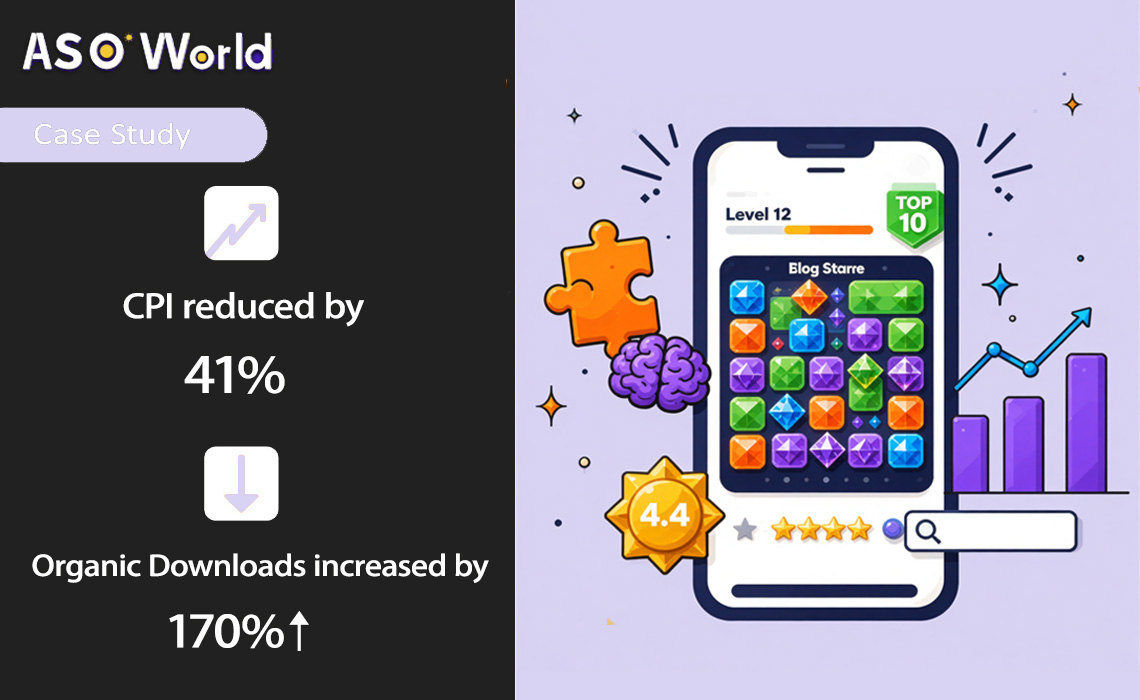
| Organic Downloads (Monthly) | ~3,200 | ~8,640 | +170% |
| Organic Download Share | 15% | 45% | +30 pts |
| Blended CPI | $2.80 | $1.65 | –41% |
| Install Conversion Rate (Google Play) | 31% | 38% | +22% |
| App Rating | 3.6 ⭐ | 4.4 ⭐ | +0.8 |
With a stable organic acquisition channel in place, the studio plans to:
Whether you're an indie developer or a publishing team, ASOWorld's keyword install service can help you build sustainable organic traffic — without inflating your UA budget.
Most puzzle game developers see measurable ranking movement within 5–10 days for long-tail keywords. Mid-competition keywords typically require 2–3 weeks of consistent keyword install volume. Head terms like "puzzle game" may take 4–6 weeks depending on the competitive landscape. A phased approach — starting with easier keywords — is recommended for budget efficiency.
Budget depends on the number of keywords targeted and the competition level. A focused campaign targeting 8–12 keywords on a single platform (iOS or Android) can be executed effectively as a starting investment. ASOWorld's keyword install pricing scales based on daily volume, so you can start small and increase spend as you see results.
Yes — and they often perform better together. Keyword installs improve your organic ranking, which increases overall store visibility. When combined with paid campaigns (especially Apple Search Ads), the improved organic presence can lower your blended CPI significantly. The studio in this case study reduced blended CPI by 41% by running both channels in parallel.
Absolutely. The keyword install approach is genre-agnostic — it works across all puzzle sub-genres including match-3, word puzzles, block puzzles, and brain training games. The key difference is keyword selection: each sub-genre has its own set of high-intent search terms that need to be researched and prioritized individually.
Once a keyword reaches the Top 10, you can reduce daily install volume to a maintenance level (typically 20–40% of the initial volume). As your organic downloads grow naturally from the improved ranking, the app store algorithm reinforces your position. Periodic metadata updates and continued monitoring with ASO tools help sustain long-term results.
Categories