COVID-19 UPDATE


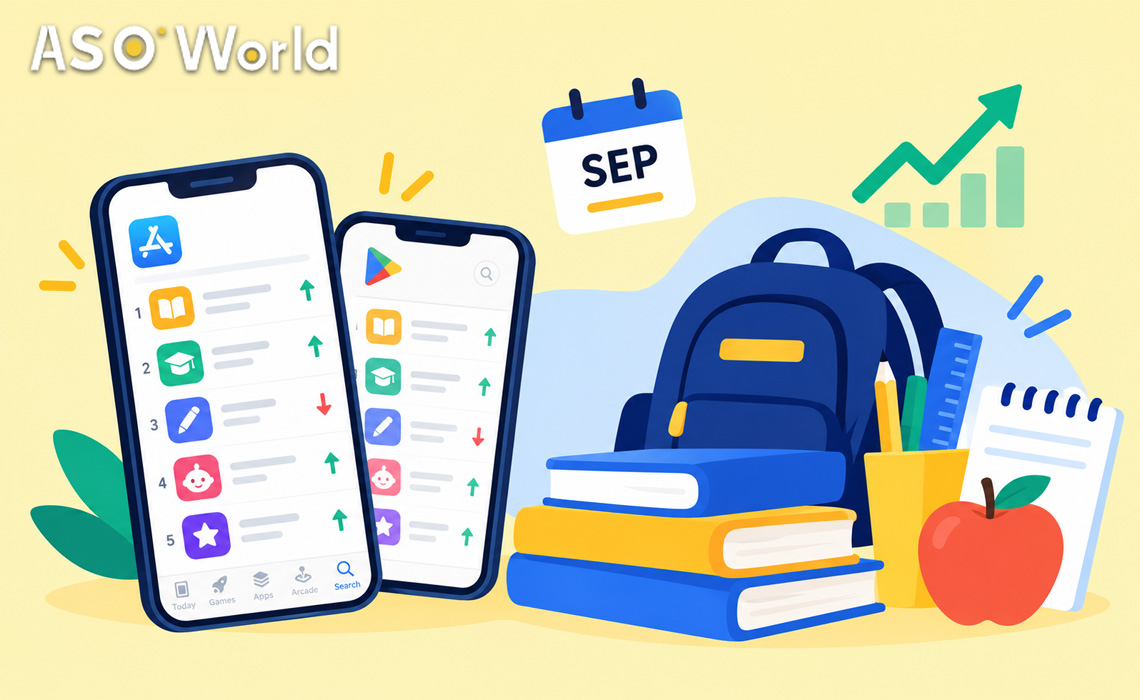
ASOWorld’s ASO specialists insight – drawn from years of optimising apps across App Store and Google Play: If your keyword rankings have jumped or dropped since late August, it is very likely tied to back-to-school seasonality — not a penalty, and not something your last update broke.
Seasonal swings tend to hit many unrelated apps in your category at the same time, settle down within two to three weeks, and do not come paired with falling ratings or a shrinking impression-to-install rate. Run the two-minute self-check below before you touch your keywords, budget or listing.
Why This Happens Every September
1. Search demand itself shifts – not just your position in it. Late August through mid-September brings a predictable spike in searches for education apps, planners, note-taking tools, parental controls and kids’ apps, while categories like travel and summer games cool off. When the volume and mix of searches change, your rank for a given keyword can move even if nothing about your listing changed at all – you are being measured against a different, temporarily larger pool of competitors chasing the same terms.
For a deeper look at how education apps can turn this seasonal demand into an ASO opportunity, see our guide on how education apps can win the September search spike.
2. User behaviour signals reset at the same time. Both stores weigh recent engagement – session length, retention, day-one behaviour – pretty heavily. Back-to-school routines change how people use their phones almost overnight, so the behaviour data feeding the algorithm shifts for your app and your competitors’ apps simultaneously. That is a timing effect, not a quality signal about your app specifically.
3. The category gets temporarily crowded. A lot of developers time updates, new listings and paid pushes to land right before school starts. That is a short-term reshuffle of the chart, not a structural change to how your app ranks long-term.
From the ASOWorld team – what our case work keeps confirming. Across the seasonal windows we have worked through with education, utility and gaming apps, the ones that come out ahead treat the swing as data rather than panic.
Re-optimising keywords mid-swing is the single most common reason teams later cannot tell whether their next change actually worked. Hold the line for the 2–3 week window, log your positions and conversion rate daily, and you will have a clean before/after baseline to measure any real optimisation against.
Seasonal Noise or a Real Problem? Quick Comparison
| Signal | Seasonal fluctuation | A genuine ranking issue |
|---|---|---|
| Duration | Settles within 2–3 weeks | Persists past mid-October |
| Scope | Multiple unrelated keywords move together | Isolated to one or two specific keywords |
| Category pattern | Competitors’ rankings shift too, same window | Your app moves while competitors stay flat |
| Ratings/reviews trend | Unchanged | Falling, or a spike in 1-star reviews |
| Impressions → installs | Roughly stable | Meaningfully declining |
Quick Self-Check Before You Change Anything
- Pull your keyword ranking history for the last 30 days – did the move start in the last 1–2 weeks of August?
- Check 3–5 direct competitors on the same keywords – did their rankings move in the same window?
- Compare your rating average today vs. 30 days ago – has it actually dropped, or just stayed flat?
- Look at your impression-to-install conversion rate – is it holding, or genuinely falling?
- Check whether the affected keywords are seasonal-adjacent (education, planning, kids, productivity) rather than your core brand terms.
- Confirm nothing changed on your side in the same window – no rejected update, no metadata edit, no paused campaign.
- If you run paid keyword installs or review campaigns, confirm they are still active and delivering as scheduled.
- If everything above points to “seasonal,” hold your current strategy for another 1–2 weeks before making changes.
If your situation does not match this pattern – the drop is isolated to your app, keeps going past mid-October, or comes with a real ratings decline – that is the point to stop guessing and run a proper audit rather than keep adjusting in the dark.
Two Misconceptions Worth Retiring
- “A drop means Apple/Google penalised me.” Algorithmic penalties are real but rare, and they are almost always tied to a specific policy violation, not a seasonal dip shared with half your category.
- “I need to change my keywords right now.” Swapping keywords mid-swing makes it harder to tell later whether the recovery was seasonal or caused by your change – you lose the ability to learn from what actually happened.
FAQ
How long does back-to-school ranking volatility usually last?
Most of what we see resolves within two to three weeks as search behaviour and usage patterns stabilise into the autumn routine.
Should I pause my ASO campaigns until this settles down? Not necessarily – pausing removes a variable you might need later to tell seasonal noise from a real problem. It is usually more useful to keep everything steady and just watch the numbers.
Does this affect the App Store and Google Play equally? Both stores factor in recent engagement and search demand, so both can show back-to-school movement, but the timing and size of the swing often differ store to store – check them separately rather than assuming one mirrors the other.
My ranking dropped but a competitor’s went up – did I do something wrong? Not necessarily. In a shared seasonal pool, one app’s temporary gain is often just reshuffling, not evidence that you lost ground permanently.
What’s the one number I should watch most closely this month?
Impression-to-install conversion rate. Ranking position moves around seasonally; conversion rate is the more reliable signal that something outside the seasonal pattern is actually going on.
If the self-check above points to something beyond normal seasonal noise, ASOWorld’s ASO service team – with optimisation experience across App Store, Google Play, Galaxy Store and RuStore – can review your keyword and listing setup to pin down what is actually driving the change and re-optimise the elements that move it. And if you want a faster gut-check first, the ranking diagnostic insight is a good place to start before you spend budget chasing a swing that would have corrected on its own.