COVID-19 UPDATE


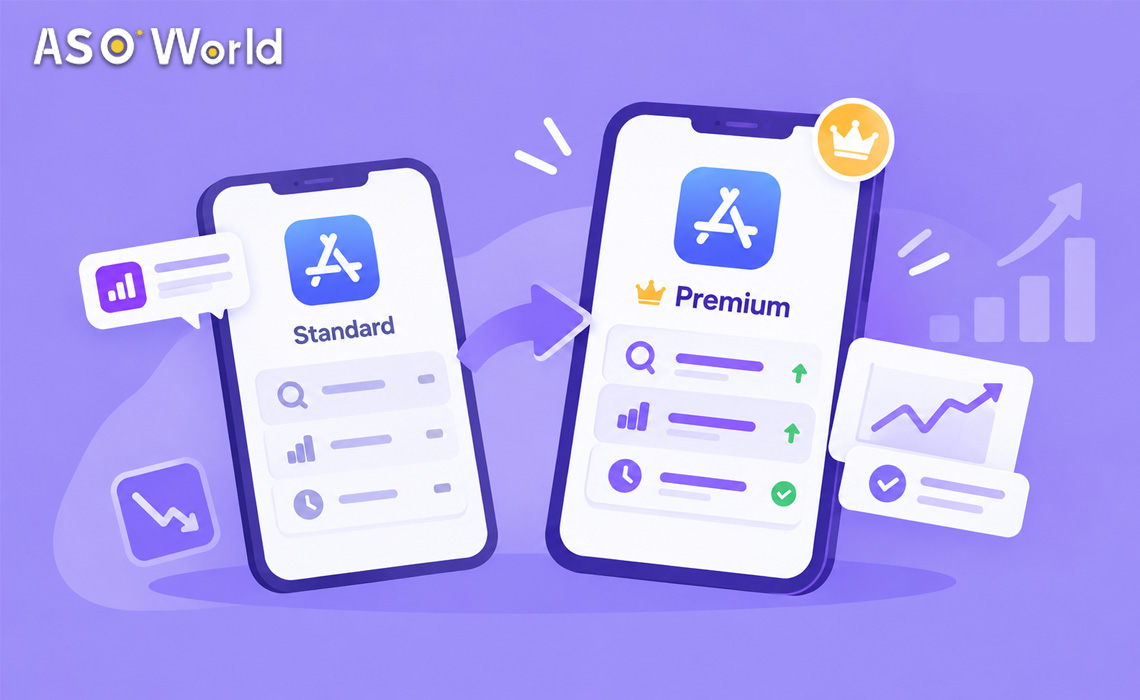
Standard-tier ASO campaigns are designed for stable, low-competition keywords and predictable budgets. They begin to underperform once a keyword becomes competitive, once you need a guaranteed outcome for a launch date, or once your account has grown beyond the volume a Standard plan was built to support. If two or more of the seven signals below apply to you, moving to Premium — without resetting your keyword history — is usually the solution, not simply waiting longer.
What actually changes between Standard and Premium?
This is not a rebrand with a higher price tag. The two tiers are configured differently at the order level:
| Dimension | Standard | Premium |
|---|---|---|
| Best suited for | Low-to-medium competition keywords, steady maintenance | Competitive keywords, launch deadlines, ranking recovery |
| Daily volume flexibility | Fixed, slower to scale | Configurable per keyword, per day |
| Outcome assurance | Best-effort | Guarantee-backed options available |
| Typical use case | Ongoing visibility upkeep | Breaking into Top 10, defending against a competitor push |
We cover the full feature-by-feature breakdown in Standard vs Premium ASO Packages: Which Fits Your App? — this article assumes you already know the basics and focuses only on the decision point: when to move.
7 signals you’ve outgrown Standard
1. You’ve run the same keyword on Standard for 3+ cycles with no rank movement
If a keyword has received consistent daily volume for multiple full cycles (iOS: 3+ days per cycle, Google Play: 7–9 days per cycle) and the position has not moved at all, the volume ceiling of Standard is usually the constraint, not the keyword itself.
2. Your target keyword has more than a handful of established competitors already ranking Top 10
Standard volume is calibrated for keywords with light-to-moderate competition. Once several competitors are actively defending Top 10 positions on the same term, matching them requires the higher, more flexible daily configuration Premium allows.
3. You have a hard external deadline
A product launch, a seasonal campaign or a featured placement you are trying to support all share the same problem: Standard’s best-effort pacing does not give you a date to plan around. If the outcome needs to land by a specific day, that is a guarantee conversation, not a volume conversation.
4. A competitor just overtook you on a keyword you used to hold
Defensive situations move faster than offensive ones. When someone else’s campaign pushes past your position, matching Standard volume against their (likely higher) volume rarely closes the gap before they extend their lead further.
5. You’re spending on Standard across many keywords instead of concentrating on a few important ones
Spreading a fixed budget across ten keywords at Standard volume often produces ten mediocre results instead of two or three strong ones. If your priority list has shrunk to a handful of genuinely important terms, concentrating Premium volume on those is usually more efficient than maintaining broad Standard coverage.
6. Your app’s install/review base has grown, but your keyword ranking hasn’t kept pace
When organic signals (downloads, ratings, retention) are already healthy but ranking still lags, the bottleneck is normally recoverable with a stronger, better-configured push — not a metadata rewrite.
7. You need to see the volume-to-ranking relationship, not just the end result
If you are being asked to justify spend internally, or you simply want to know which day’s volume actually moved the needle, Premium campaigns expose day-by-day volume alongside the ranking trend line, so you can see cause and effect instead of guessing.
How to switch without losing your current ranking progress
The most common mistake is cancelling a Standard order and starting a brand-new Premium order from zero. That resets your keyword’s order history and can trigger the same ranking dip you would see from any abrupt stop. The safer sequence:
- Let your current Standard cycle finish naturally rather than cancelling mid-cycle.
- Configure the Premium order for the same keyword(s) to start immediately after, so there is no gap in daily volume.
- Increase volume gradually over the first few days rather than jumping to the maximum immediately — a sudden spike is treated with more scrutiny than a ramp.
- Track the same keyword’s position daily for the first cycle to confirm the new volume is actually moving rank, and adjust before committing to a longer run.
You can preview and adjust day-by-day volume for each keyword directly before committing to a schedule — this is the fastest way to catch a misconfigured cycle before it runs. Want to see current coverage and ranking for your app before deciding? Run a free check with ASOWorld’s free ASO tools first.
Premium in practice: matching plan to problem
Once a keyword shows one or more of the signals above, ASOWorld’s Guaranteed Keyword Ranking Service configures daily volume against a target position rather than a flat daily number — iOS cycles run from 3 days, Google Play from 7–9 days, matched to how each store’s algorithm actually updates rankings. That is the practical difference from Standard: the plan is built backward from the outcome you need, not forward from a fixed budget.
For a closer look at what “guaranteed” actually means operationally (and why it costs more than uncapped Standard volume), see What Is the Keyword Guaranteed Ranking Service?
Is Premium worth the extra cost for a smaller app?
Not always immediately — and that is a fair question to ask before switching everything over. If your app is pre-launch with no keyword coverage yet, the more urgent gap is usually metadata and initial coverage, not tier. In that case, start with Direct Installs to establish coverage first, then layer in Premium keyword campaigns once you have a baseline to defend. Real before/after examples for both paths are in ASOWorld Case Studies.
FAQ
Can I run Standard and Premium at the same time on different keywords?
Yes. Many accounts keep Standard running on stable, low-competition maintenance keywords while running Premium on the handful of terms that are competitive or deadline-driven. There is no requirement to move every keyword to the same tier.
Will switching to Premium reset my current keyword ranking?
Not if you sequence it correctly. Ranking resets typically come from a hard stop in daily volume, not from changing tiers. Starting the new Premium cycle immediately after the current Standard cycle ends avoids the gap that causes a drop.
How long before I know if Premium is actually working?
Follow each platform’s natural update cycle: roughly 3 days minimum for iOS, 7–9 days for Google Play. Judging results before a full cycle completes is the most common reason people conclude “it’s not working” when the campaign simply has not had time to register.
What happens if I stop a Premium order early?
The same rule applies as with any ASO order: stopping abruptly, on either tier, generally causes ranking to drift back down over time as the volume that was supporting the position disappears. If you need to pause, it is worth reviewing ASOWorld’s general FAQ on campaign pacing first.