COVID-19 UPDATE


Important Notice:Beware of scams using ASOWorld's name for part-time recruitment or ASO earning app activities. ASOWorld is not hiring any part-time staff. Trust only official information posted by ASOWorld.

Competitive keywords need a different volume tier than easy ones. Learn how to size your keyword install budget — and get a tailored number from ASOWorld's ASO experts.


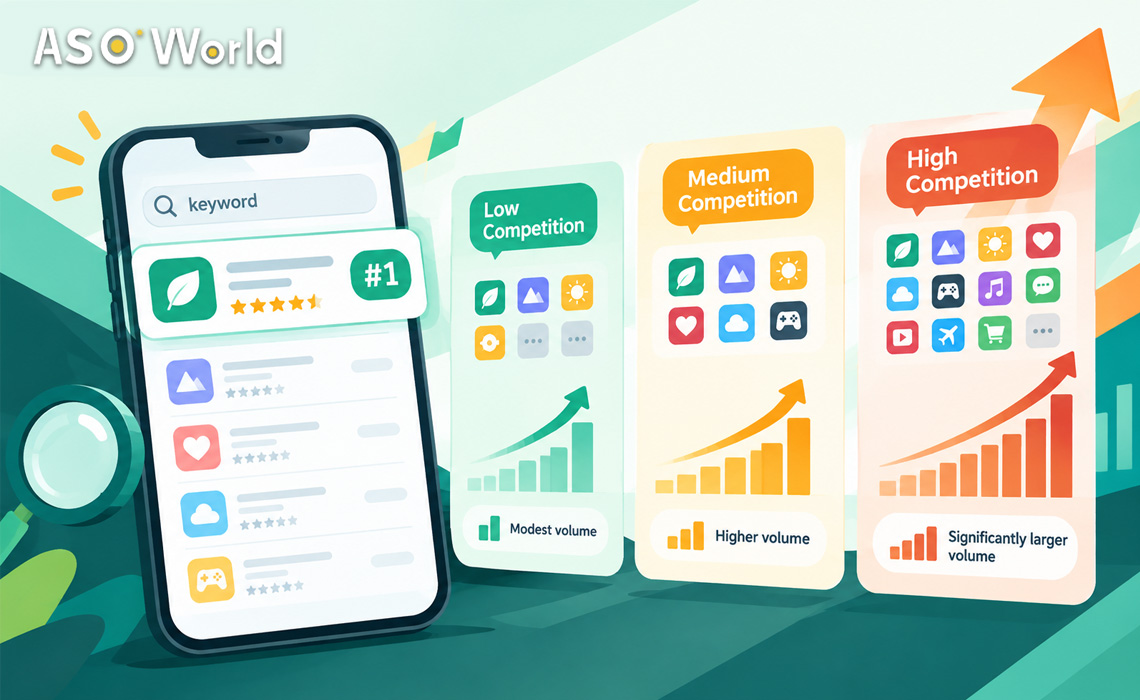
Quick answer: Competitive keywords don't need "a bit more" volume than easy ones — they need a different order of magnitude, because you're not competing against an empty search result, you're competing against apps that are already actively investing in that same term. Match your budget to the keyword's competition tier first, or you're likely spending without moving the needle.
In this article:
Ranking is relative, not absolute. Your position on any keyword is decided by how your signals compare to everyone else currently pushing that same term — not by hitting some fixed number. On a low-competition long-tail keyword, there may be almost no one actively investing, so a small, steady volume is often enough to hold a top spot. On a high-competition head term, several apps are usually already running sustained volume against it. Adding a small increment on top of your existing baseline barely changes your position relative to them — you're still below the threshold where the algorithm registers you as a serious contender for that term.
This is the mistake behind "we added a little more and nothing happened." The budget wasn't wrong in isolation — it was sized for the wrong competition tier.
Before setting a budget, it helps to place a keyword into one of three rough tiers:
You can get a rough read on this yourself by searching the term and looking at who's already ranking in the top 10 — the more recognizable, high-download apps you see there, the higher the tier. For a more structured breakdown, a full competitor keyword analysis shows exactly where the gaps are in keywords, screenshots, and reviews for any given term.
Not sure which tier your target keywords fall into? ASOWorld's free ASO tools can pull up the current top-ranking apps and search volume for any keyword, so you're sizing your budget against real data instead of a guess — and if you want the fuller toolkit picture, this 2026 ASO tools guide rounds up what else is worth using alongside it.
Think of it less as "how much do I want to spend" and more as "what tier am I trying to compete in." As a rough way to reason about it:
These are directional, not fixed numbers — the right volume for any specific keyword depends on its actual current competition, which changes over time. The point isn't to memorize a multiplier, it's to stop budgeting competitive terms like they're easy ones. Where you land on this often maps to a broader packaging decision — see how Standard vs Premium ASO packages differ if you're weighing that too.
The exact volume your keyword needs shifts with real-time competition, your app's current signal strength, and even seasonality — which is exactly why a general framework like this one can't responsibly hand you one fixed number for every case.
Register today and ASOWorld's ASO experts can review your specific keyword to give you a tailored volume recommendation — plus your first order at 50% off.
ASOWorld First Order Discount
Get 50% off on your first order to start your app growth!

The most common outcome isn't a bad result — it's no result. When volume sits below the threshold a competitive keyword actually needs, the term simply doesn't move, because you never register as a real contender against the apps already active on it. The spend doesn't get wasted dramatically; it just doesn't produce a visible change, which makes it easy to wrongly conclude that "this doesn't work" when the real issue was tier mismatch. If you're not sure whether a specific keyword is under-ranked or simply under-funded, Badly Ranked or Not Ranked? — the budget diagnostic walks through exactly that distinction.
The more efficient path is usually one of two choices: commit to the volume a high-competition term actually requires, or start with medium- and low-competition variations of the same term while you build up — pairing that with a look at why retention & engagement matter more than keywords and a proper keyword research & optimization guide tends to work better than attacking the head term directly. Trying to win a head term with a long-tail budget tends to spend the same money for a worse outcome than either of those. Competition tier is the biggest lever, but it's not the only one — this breakdown of what actually decides your keyword ranking covers the other factors worth knowing before you commit budget.
Keyword research only tells you which terms to target — ranking still needs volume behind it. If you're weighing which service actually fits your stage, Keyword Installs vs Guaranteed Ranking breaks down the difference. Keyword Installs lets you configure daily volume per keyword and adjust it as a term's competition changes, so your budget is matched to the tier you're actually trying to compete in — not set once and left to guess.
Before you get here, make sure you've actually picked the right keywords to begin with.
Generally longer than a low-competition term — high-tier keywords usually need a sustained ramp-up before a shift becomes visible, since you're overtaking apps with an established, ongoing presence rather than filling an empty spot.
If budget is limited, building up through medium- and low-competition variations first is often more efficient — you get visible movement sooner, and that visibility itself can make the head term easier to approach later.
Not linearly. Once you're competing at the right tier for a keyword, additional volume has diminishing returns unless the competition on that term also increases. The goal is matching the tier, not maximizing spend.
Yes — starting at a lower volume to see how a keyword responds before scaling up is a reasonable way to sanity-check a tier estimate, as long as you're aware a small test on a high-competition term may show little movement simply because it hasn't crossed the threshold yet.
Get FREE Optimization Consultation
Let's Grow Your App & Get Massive Traffic!
All content, layout and frame code of all ASOWorld blog sections belong to the original content and technical team, all reproduction and references need to indicate the source and link in the obvious position, otherwise legal responsibility will be pursued.