COVID-19 UPDATE


Important Notice:Beware of scams using ASOWorld's name for part-time recruitment or ASO earning app activities. ASOWorld is not hiring any part-time staff. Trust only official information posted by ASOWorld.

Rankings refreshing slowly? Set keyword goals that hold up: iOS and Google Play observation windows, a wait/adjust/stop table, and coverage KPIs.


TL;DR
It depends on three things all going right:
Goals built on a single position on a single date make a delay look like failure. That leads to the most expensive mistake in keyword campaigns: cancelling and restarting just before the results would have appeared.
| Goal type | Example | Strength | Weakness | Best for |
|---|---|---|---|---|
| Single position | "#1 for budget planner in the US by Friday" | Easy to understand | Fragile; ignores refresh lag and volatility | Contract-style needs where a fixed position really matters |
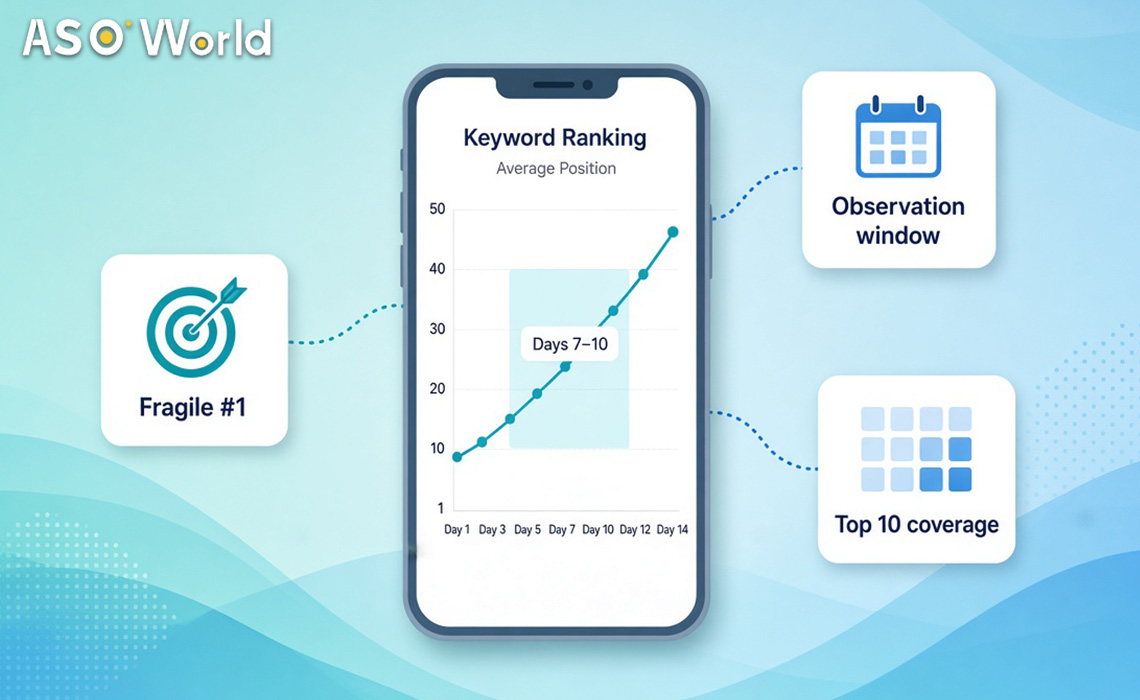
| Observation window | "budget planner inside Top 10 within 7–10 days, holding for 7 days" | Allows for lag; measures stability | Needs patience and tracking discipline | Core terms on iOS and Google Play |
| Coverage | "25 relevant keywords in Top 10 and 8 in Top 3 by end of month" | Tough to derail; reflects real search traffic | Harder to explain to stakeholders at first | Long-tail growth, new markets, new apps |
Most healthy campaigns combine the last two. Use window goals for 2–4 core terms and coverage goals for the long tail. Keep single-position goals for the rare cases that truly need them.
| App Store (iOS) | Google Play | |
|---|---|---|
| Metadata change goes live | After App Review (often within 1–2 days) | Within hours |
| Metadata indexing (keyword starts appearing) | Often 3–7 days; newer apps can take 10–14 days | Often 3–5 days; newer apps about a week |
| Install-driven ranking response | Within days, if activity is continuous | Typically 7–9 days to settle |
| Run at least … before judging | 3+ consecutive days of activity, then judge on days 5–7 | 7–9 days, then judge on days 10–14 |
| What happens when you stop | Fades quickly | Drifts down over days |
| Main risk | Pausing or cancelling mid-run | Judging too early during a volatile week |
Indexing ranges are based on industry observations (for example, SEMNexus's iOS vs. Android indexing timelines). Install-driven ranges reflect ASOWorld's campaign experience. Your app's history, category and market will shift them.
Important prerequisite: install-driven keyword work only helps when your app already appears in the top 250 results for that keyword in that country. If it doesn't, the first step is metadata and relevance, not volume.
Check what you see against the elapsed time before you touch the campaign.
| What you see | iOS: day 1–3 | iOS: day 4–7 | Google Play: day 1–6 | Google Play: day 7–14 |
|---|---|---|---|---|
| No visible movement | Wait (refresh lag) | Adjust: check relevance and competition; add related long-tail terms | Wait | Adjust: the keyword may be too competitive; shift to nearby terms |
| Rising, then dips | Wait; keep the run continuous | Hold at maintenance pace | Wait (normal volatility) | Hold; judge the 7-day average, not one day |
| Reached target window | Hold; don't add volume yet | Switch to maintenance pace | Hold | Switch to maintenance pace |
| Rising faster than expected | Slow down; lower daily volume | Maintenance pace | Slow down | Maintenance pace |
| Still outside Top 100 | Wait | Stop and re-diagnose | Wait | Stop and re-diagnose |
"Cancel and re-order the same keyword" appears nowhere in this table. If the setup was wrong, fix the setup (keyword choice, country, relevance, daily pace). A fresh copy of the same order won't help.
If you can't tell which column you're in, the badly ranked or not ranked ASO budget diagnostic sorts keywords into rank buckets and points to the next step for each.
It sounds odd, but it's common, especially in less competitive markets, where a modest push can take a keyword to the top within days.
A sudden jump that your organic installs can't support usually doesn't last. Natural growth looks gradual, so plan your pacing with that in mind:
When you lower the pace, expect a small short-term dip, and tell your team in advance. A planned dip during a pace change is normal and doesn't mean the campaign failed.
Use this template for each market:
Core terms (window goal): [keyword] inside Top [10] on [iOS / Google Play] in [country] within [7–10] days of continuous activity, holding for [7] days.
Long-tail (coverage goal): [N] relevant keywords in Top 10 and [M] in Top 3 by [date].
Outcome check: search impressions and organic installs from search up [X%] versus the 2 weeks before.
Review rhythm: check daily, decide weekly, never on a single day's data.
A worked example for a budgeting app in the UK:
| Layer | Goal | Review |
|---|---|---|
| Core (3 terms) | budget planner, expense tracker, money manager in Top 10 within 10 days, holding 7 days | Weekly, 7-day average |
| Long-tail (20 terms) | 15 in Top 10, 5 in Top 3 by month end | Every 2 weeks |
| Outcome | Search installs +25% vs. prior 2 weeks | Weekly |
This kind of goal is also easier to report upward, because one slow keyword no longer decides whether the month went well.
Track four numbers every week:
If coverage and impressions are rising, the strategy is working, even if one headline keyword is still at #4.
To have the keyword plan, pacing and weekly tracking set up for you, the keyword ranking and organic downloads solution is built around this coverage-first approach.
Sometimes you really do need a specific position, for example a launch tied to a press date, or a stakeholder who has committed to a "Top 5" result. In those cases:
The guaranteed ranking option and standard keyword campaigns are both on the keyword installs page. Keyword install pricing starts from $0.20 on Google Play and $0.30 on iOS (checked November 10, 2026).
If the real problem is upstream (wrong keywords, weak metadata, low conversion), an app store optimization service audit is usually a better first step than more ranking volume.
Why isn't my App Store keyword ranking updating?
Most often it's refresh lag. The store hasn't yet updated the ranking to reflect recent activity or a metadata change. Give iOS at least 3 consecutive days of activity before you judge, and newer apps up to 10–14 days for indexing.
How long does it take to rank for a keyword on Google Play?
For install-supported keywords, plan for about 7–9 days for the ranking to settle. Metadata changes go live within hours but can take several days to affect rankings.
Should I cancel a keyword campaign if nothing changes in two days?
Usually not. Cancelling and re-ordering resets the progress you've built. Check against the decision table first. If the setup is wrong, change the setup instead of repeating the same order.
Is Top 10 coverage better than ranking #1?
For most apps, yes. Twenty keywords in the Top 10 usually bring more stable traffic than one keyword at #1, and one slow keyword can't sink them all.
Why did my ranking drop after I reduced volume?
A small, short-term dip is normal when you move from the ramp to a maintenance pace. Judge on a 7-day average. If the dip continues past a week, adjust the maintenance level slightly.
Do iOS and Google Play need different goals?
Yes. iOS moves faster but needs continuous activity, while Google Play takes longer to settle and fluctuates more. Set separate time frames and review rhythms for each store.
 App Store Optimisation,Keyword Analysis,
Get FREE Optimization Consultation
Let's Grow Your App & Get Massive Traffic!
All content, layout and frame code of all ASOWorld blog sections belong to the original content and technical team, all reproduction and references need to indicate the source and link in the obvious position, otherwise legal responsibility will be pursued.