In short
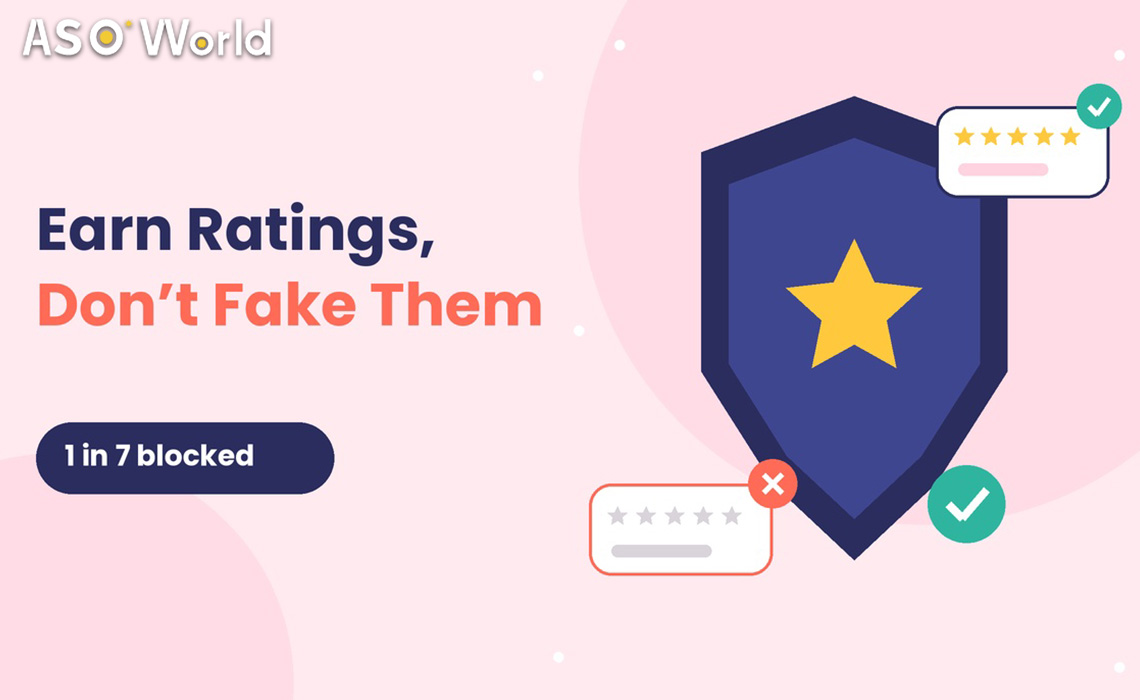
- In 2025, Apple processed over 1.3 billion ratings and reviews on the App Store and blocked close to 195 million of them as fraudulent, roughly one in seven, using human review and AI.
- Both stores prohibit the manipulation of ratings. Google Play's policy names incentivised feedback, forced pop-ups and paid fake reviews as violations.
- A healthy profile of ratings grows in proportion to installs, has a natural spread of stars and countries, and keeps receiving recent reviews. The safest engine for growth is the native in-app prompt, shown after a good moment, together with quick replies to negative reviews.
- Review services are a limited top-up, not a strategy. If you use one, insist on written terms and keep the volume small relative to your organic ratings.
Holiday traffic exposes a weak rating faster than any other time of year. More people see your product page, and they compare you with the app next to you within seconds. The question for most teams is not whether ratings matter, but where new ratings should come from, and which sources put the developer account at risk.
What Did Apple Actually Block in 2025?
Apple's annual report on fraud, published in May 2026, gives the clearest picture yet of how much activity in reviews is filtered.
| Figure for the App Store in 2025 |
Value |
| Ratings and reviews processed |
1.3 billion+ |
| Fraudulent ratings and reviews blocked |
close to 195 million |
| Developer accounts terminated over concerns about fraud |
193,000 |
| Fraudulent creations of customer accounts rejected |
1.1 billion+ |
| Customer accounts deactivated for fraud and abuse |
40.4 million |
Source: Apple Newsroom, "The App Store stopped over $2.2 billion in fraudulent transactions in 2025," 20 May 2026.
Two numbers matter for app marketers. First, about 15% of the ratings and reviews that were submitted never appeared. Second, Apple rejected more than a billion fraudulent attempts to create accounts, so a large share of fake reviews never had an account to be posted from. Apple says it uses human review together with AI to identify problem reviews and inflated ratings.
Google Play's rule is just as direct. Its User Ratings, Reviews, and Installs policy says that it prohibits any manipulation of ratings, reviews or counts of installs, including incentivising feedback, using forced pop-ups and paying for fake reviews.
Why Do Genuine Reviews Disappear Too?
Filters aren't perfect, and plenty of real reviews are delayed or removed. Common reasons include new accounts, reviews posted in a burst from one region, text that's copied or very short, and reviews written before the version of the app they describe was live. We cover the five most common causes, and what to check, in App ratings and reviews not appearing? Five reasons they're delayed, hidden or taken down.
The practical lesson is the same whether reviews are organic or not: patterns that look unnatural get filtered, even when each review is real.
What Does a Healthy Profile of Ratings Look Like?
Stores don't publish their rules for detection, and we won't guess at thresholds. What they do publish, and what we see across campaigns, points to the same picture of a profile that holds up.
| Signal |
Healthy pattern |
Pattern that tends to be filtered or flagged |
| Speed of ratings |
Rises and falls with daily installs |
Jumps while installs stay flat |
| Spread of stars |
Mostly 4-5 stars, with some 1–3 |
Almost only 5 stars, overnight |
| Text of reviews |
Varied in length, mentions real features and versions |
Short, generic, with repeated phrasing |
| Recency |
New ratings every week |
Long gaps, then a burst |
| Countries |
Matches where the app is installed |
Many reviews from one country that the app barely serves |
| Replies from the developer |
Replies to complaints within days |
No replies, or replies that ask for a higher rating |
Recency carries extra weight on Google Play, which gives more emphasis to recent ratings. On the App Store, you can choose to reset your summary rating when you release a new version, which helps after a bug has been fixed but also wipes your count of ratings.
Which Ways of Getting Ratings Are Allowed, and Which Are Not?
| Source |
The store's position |
Effect on the profile |
Use it? |
| Native in-app review prompt (SKStoreReviewController, Play In-App Review API) |
Allowed; Apple shows the prompt at most 3 times in 365 days, Google applies a quota that isn't published |
Natural speed, matches installs |
Yes, the first priority |
| Asking in email, push or replies from support, with no reward |
Allowed |
Small, steady lift |
Yes |
| Replying to reviews and fixing the issue |
Allowed; Google says not to ask for a higher rating in replies |
Raises ratings that are updated, improves conversion |
Yes |
| Offering a discount, coins or rewards for a rating |
Prohibited (incentivised) |
High rate of filtering, risk to the account |
No |
| Forced pop-ups that block the app until the user rates |
Prohibited on Google Play |
Negative ratings, risk to policy |
No |
| Paid review services |
Both stores prohibit manipulation; the risk sits with the developer account |
Depends entirely on volume and pacing |
Only as a small top-up for a limited time, if at all |
The prompt is the engine. The most common mistake is showing it at the wrong time: on first launch, after an error, or in the middle of a task. Show it after a moment of success, such as a completed workout, a finished level or a saved document, and only to users who have opened the app several times.
Where Do Review Services Fit, Honestly?
ASOWorld sells reviews, so we should be clear about where we think they help and where they don't.
- They don't fix a problem with the product. If your rating fell because of a crash or a change in pricing, new reviews will be outnumbered by new complaints. Fix the cause first.
- They don't replace the prompt. An app with a well-timed prompt rarely needs outside reviews, except in a new country or just after launch.
- They can help as a limited top-up, for example when a new market has no local reviews at all, or when a few written reviews in the local language would answer common questions. Keep the volume small relative to organic ratings, spread it over days, and stop entirely if the app receives a warning from a store.
If you use guaranteed reviews, the written term is specific: more than 80% of the reviews you order stay live for 30 days or longer, or ASOWorld refunds you. Prices start at $1.50 per review on Google Play and iOS (checked 24 November 2026). The guarantee covers retention, not the risk to policy on the platform. No provider can remove that risk, and you should be wary of one that says it can.
For a longer comparison of buying ratings against earning them on Android, read Google Play reviews that stay: buying vs earning ratings in 2026.
Which Situation Are You In? A Decision Matrix
| Your situation |
What to do first |
What to avoid |
| New app, no ratings |
Turn on the native prompt after the first moment of success; build installs from relevant keywords so that the prompt has an audience |
Ordering reviews before the app has organic installs |
| Rating dropped after an update |
Find the theme of the complaints, ship a fix, reply to every 1-3 star review, consider a reset of the rating on iOS |
Burying complaints under new 5-star reviews |
| Good rating, low count in a new country |
Localise the prompt and the store listing; a small, paced top-up of local reviews can help |
Large volumes in a market with few installs |
| Holiday traffic, rating below 4.0 |
Fix the product page first: screenshots, the message on the first screen, answers in replies |
Expecting reviews alone to recover conversion |
| Received a warning from the App Store |
Pause all paid activity and read the notice carefully |
Any new promotion until the issue is resolved |
For an app with no ratings, the order matters. Ratings come from users, and users come from visibility. Building installs first on keywords that are relevant and can be won, for example with keyword installs for terms where the app already ranks in the top 250, gives the in-app prompt real people to ask.
If your app has received a warning, our guide Received an App Store "Fraudulent Activity" warning? What it means and how to respond covers the official path for a response.
A 30-Day Plan for Healthy Growth in Reviews
- Days 1-3: audit. Export the last 90 days of ratings. Note the mix of stars, the top three themes of complaints, countries and your rate of replies.
- Days 4-7: fix the prompt. Move the native prompt to two or three moments of success. Show it only to users with at least a few sessions. Remove any wording that hints at a reward.
- Days 8-14: answer every 1-3 star review. Reply within 48 hours, name the issue, and give the fix or the route to support. Don't ask for a better rating.
- Days 15-21: ship one fix for the top complaint, and mention it in the release notes so that returning users notice.
- Days 22-30: measure. Compare ratings per 1,000 installs, the average star of new ratings, and conversion on the product page with the first week. If one country still has almost no reviews, decide whether a small, paced top-up is worth it.
Our app reputation and negative review management solution follows the same four stages (diagnosis, recovery, improvement of sentiment and long-term maintenance) for teams that want help in running it.
How Many Ratings Do You Need Before the Holiday Rush?
There's no official minimum, and the star rating alone isn't the whole story. In our analysis of public research, the count of ratings correlated more strongly with positions in the top 10 than half a star did. The full breakdown is in How many ratings do you need before the holiday rush?
What matters most for conversion is what a visitor sees in the first two seconds: the average of stars, the count, and the two or three most visible recent reviews. If those reviews describe a bug that you fixed last month, reply to them. Your reply is part of the product page. See how ratings, screenshots and the message on the first screen work together in our organic conversion and user experience solution.
Frequently Asked Questions
How many fake reviews did Apple block in 2025?
Close to 195 million ratings and reviews, out of more than 1.3 billion processed, according to Apple's report on fraud in May 2026.
Why were my app reviews removed?
Usually because they matched a pattern that the store filters: new accounts, bursts from one region, repeated text, or reviews that look incentivised. Real reviews can be caught too. Check timing, countries and wording before you assume a penalty.
Is it against the rules to ask users for a review?
No. Asking is allowed, and the native prompt is the recommended way. Offering a reward for a rating, or forcing a pop-up, is not.
How often can I show the review prompt on the App Store?
Apple shows it at most three times in a period of 365 days for each user. Google Play applies a quota but doesn't publish the number.
Are paid reviews safe?
No provider can guarantee that. Both Apple and Google prohibit the manipulation of ratings. If you use a review service, keep the volume small relative to organic ratings, get the terms on retention in writing, and stop if you receive a warning from a store.
Should I reset my rating on the App Store?
Only when a new version fixes the main reason for low ratings. A reset removes your count of ratings as well as your average, so the page looks newer but less proven.
What Else Is in the Ratings & Reviews Series?
This is the first guide in our 2026 Ratings & Reviews series. One more page is worth reading before you change your prompt:
Where Should You Go From Here?
- No ASOWorld account yet? Create a free account and run the free diagnosis of your app to see your rating, coverage of keywords and the gaps that hold back conversion.
- Account ready, rating below 4.0? Start with the 30-day plan above before you spend on visibility; traffic sent to a weak page converts poorly.
- Rating healthy, launching in a new country? Localise the prompt and store listing first, then decide whether a small, paced top-up of local reviews is needed.
 COVID-19 UPDATE