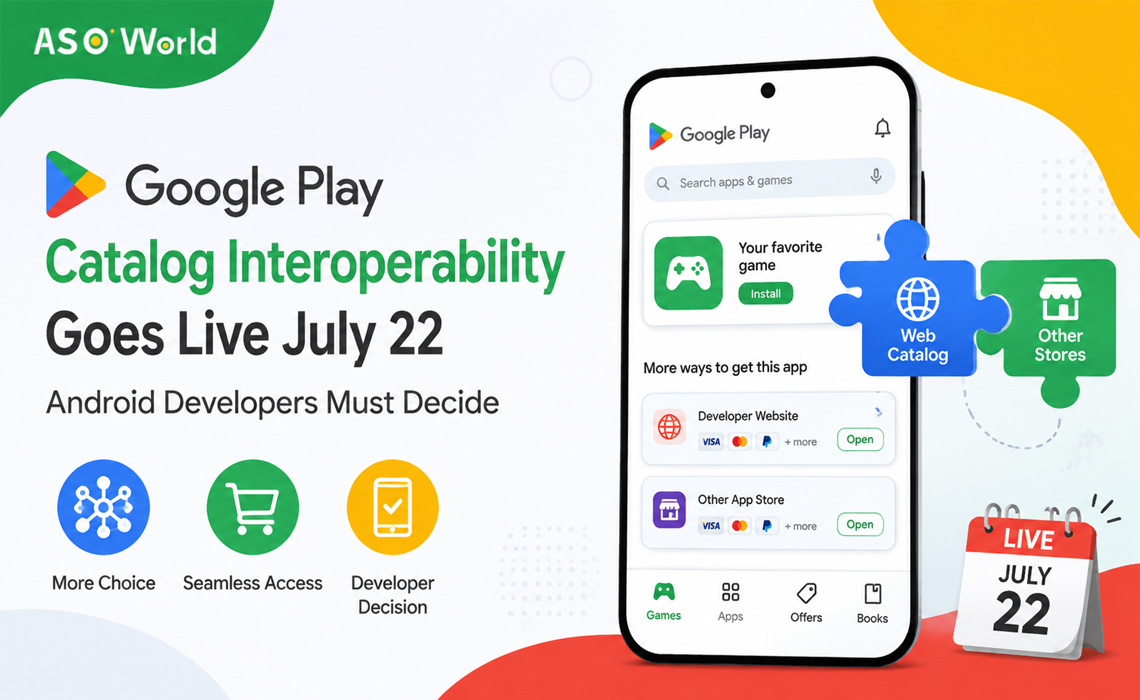
According to a recent TechTimes report, Google Play Catalogue Interoperability is expected to go live on 22 July 2026. The change would allow enrolled third-party Android app stores in the United States to display Google Play app listings, including app names, icons, descriptions, screenshots, and metadata.
For Android developers and app marketers, this is far more than a legal or platform policy update. It could fundamentally reshape Android app distribution, Google Play ASO, and the way app listings are optimised for discovery beyond the Play Store interface.
This follows a broader pattern ASOWorld has been tracking throughout 2026: Google Play is becoming more dynamic, more AI-assisted, and more discovery-driven. In our analysis of the Google Play Store v51.7 update, we noted that store listings are no longer static download pages. They are becoming active surfaces for content discovery, pricing visibility, and re-engagement.
What Is Play Store Catalogue Interoperability?
Play Store Catalogue Interoperability refers to a system whereby enrolled third-party Android stores can access and display Google Play app listing information. Based on the reported programme, users may discover an app through another Android store, but the download process still connects back to Google Play infrastructure.
In practical terms, this means an app's Google Play listing could appear in more places without the developer having to manually create a separate store page for each third-party marketplace.
The key marketing shift is straightforward: your Google Play listing may no longer reside solely within Google Play. It may become the source asset for multiple Android discovery environments.
Why This Matters for App Marketing
For years, app marketing teams have treated Google Play ASO as a channel-specific discipline: optimise the listing, improve keyword rankings, increase conversion rate, and support paid user acquisition. Catalogue interoperability could introduce a new layer: multi-store visibility from one core listing asset.
This creates both opportunity and risk.
| Marketing Area |
Potential Impact |
What App Marketers Should Do |
| Organic Discovery |
Apps may gain exposure in third-party Android stores without requiring separate listing creation. |
Optimise core metadata for broader search intent, not solely for Google Play ranking behaviour. |
| Brand Consistency |
Icons, screenshots, and descriptions may appear within unfamiliar storefront layouts. |
Ensure creative assets are clear, trust-building, and legible outside the native Play Store context. |
| Conversion Rate |
Users may discover an app in one store but complete the download through Google Play. |
Review the full user journey and eliminate any confusion between the discovery source and the install flow. |
| Attribution |
Install source tracking may become more complex if third-party discovery routes back to Play. |
Prepare source-level reporting, cohort analysis, and controlled tests wherever possible. |
| Compliance |
Apps with age ratings, regulated content, or enterprise use cases may face brand safety concerns. |
Review opt-in settings and manage third-party store access on an individual basis where necessary. |
The Biggest ASO Change: Metadata Becomes a Distribution Asset
Traditional ASO focuses on ranking and conversion within a single app store. With catalogue interoperability, metadata may also function as a distribution asset across multiple Android storefronts.
This means your app title, short description, long description, screenshots, feature graphic, promotional text, and privacy messaging all need to perform across a wider range of contexts. A screenshot that converts well within Google Play may not prove equally effective in a third-party store if the surrounding UI, trust signals, or recommendation logic differ significantly.
This connects directly with Google Play's recent discovery updates. ASOWorld's coverage of App Store and Google Play May 2026 updates highlighted how AI-powered discovery, ranking volatility, and platform-level changes are compelling developers to monitor store visibility far more frequently.
⚡ Expert Tips
- Rewrite your short description so it communicates the app's core value without relying on the surrounding Google Play page context.
- Use the first three screenshots to address user intent directly: what the app does, why it can be trusted, and what outcome users can expect.
- Audit your icon at smaller sizes, as third-party stores may display it within different recommendation modules.
- Ensure feature claims remain consistent with your data safety section, permissions, and subscription messaging.
Should Developers Opt In, Manage Stores Individually, or Opt Out?
The reported programme gives developers several strategic choices. The right approach will depend on app category, compliance risk, brand sensitivity, and growth objectives.
| Developer Scenario |
Recommended Approach |
Reason |
| Mass-market consumer app |
Consider default opt-in or broad participation |
Additional discovery surfaces may improve reach with minimal operational burden. |
| Mobile game with live events |
Opt in, but monitor visibility and event timing |
Third-party discovery may help capture seasonal demand and live-ops momentum. |
| Finance, health, dating, betting, or adult-sensitive app |
Manage stores individually |
Policy alignment, age rating presentation, and compliance controls carry greater weight in these categories. |
| Enterprise-only or internal app |
Consider opting out |
Consumer-facing third-party visibility may not align with the intended distribution model. |
| Kids or family app |
Review carefully before broad opt-in |
Store-level presentation of age ratings and safety signals must remain consistent throughout. |
Developers should also keep abreast of broader Google Play compliance trends. ASOWorld's article on April 2026 Google Play policy updates demonstrates that Google is tightening controls around permissions, privacy, account transfers, and sensitive data. Catalogue interoperability does not diminish the importance of compliance-first growth.
How This Changes User Acquisition Strategy
For app marketers, the biggest mistake would be treating catalogue interoperability as a source of “free installs.” Greater visibility does not automatically translate to high-quality users.
Instead, consider third-party Android stores as potential top-of-funnel discovery channels. They may introduce users to your app at an earlier stage, but conversion, trust, install completion, and retention still depend on the quality of the listing and the post-install experience.
Catalogue interoperability may increase impressions, but app growth still hinges on conversion rate, install quality, retention, and monetisation. Greater storefront exposure only matters if it brings in users who stick around.
For mobile games, this is particularly important. ASOWorld's recent June 2026 global mobile game rankings showed that revenue and downloads are increasingly driven by live ops, seasonal campaigns, cultural moments, and swift metadata updates. If third-party stores become new discovery surfaces, game marketers should coordinate store metadata with event calendars, rather than updating listings only after campaigns have already launched.
Practical Checklist for Android Developers Before 22 July
⚡ Expert Tips
- Open Play Console and review Catalogue Settings ahead of the deadline.
- Classify each app as low-risk, moderate-risk, or high-risk based on content, audience, and compliance exposure.
- Update your app title, short description, screenshots, and feature graphic so they function effectively across multiple storefront environments.
- Check whether your age rating, subscription terms, privacy claims, and data safety information are sufficiently clear outside the Google Play context.
- Create a monitoring sheet for third-party store visibility, covering store name, policy fit, listing appearance, install flow, and observed performance.
- Align your ASO, legal, product, and UA teams before committing to a blanket opt-in or opt-out decision.
What App Marketers Should Monitor After Launch
Once the programme goes live, marketers should look beyond rankings alone. They should monitor the full discovery-to-install journey.
- Listing consistency: Is your title, icon, description, and screenshot order displaying correctly?
- Brand safety: Is your app appearing alongside compatible categories and competitors?
- Conversion quality: Are new discovery sources generating installs, registrations, purchases, or subscriptions?
- User reviews: Are users confused about where they discovered the app versus where they installed it?
- Policy fit: Do third-party stores present age ratings, sensitive content notices, and regional restrictions appropriately?
ASO Strategy: How to Prepare Your Listing
Catalogue interoperability makes semantic clarity all the more important. Search algorithms, AI recommendations, and third-party store modules may each interpret app metadata differently. To improve machine readability and user clarity, app marketers should write listing content that directly addresses common user questions.
For instance, rather than simply writing “Track your progress and reach your goals,” a fitness app should be more specific: “Track workouts, monitor daily activity, build personalised fitness plans, and review progress over time.” This improves keyword coverage whilst making the value proposition easier for both users and recommendation systems to understand.
⚡ Expert Tips
- Use natural keyword phrases such as “Android app distribution,” “Google Play ASO,” “app listing optimisation,” and “third-party Android stores” only where they genuinely match user intent.
- Include category-specific terms within screenshots and descriptions, but avoid keyword stuffing.
- Write FAQ-style copy in your long description to mirror the way users and AI search systems phrase their queries.
- Refresh metadata ahead of major campaigns, policy deadlines, seasonal events, and product launches.
Final Takeaway
Play Store Catalogue Interoperability could prove to be one of the most significant Android distribution changes of 2026. For developers, the immediate task is operational: review Play Console settings and determine whether broad listing access makes sense. For app marketers, the strategic challenge is greater: prepare for an environment in which a single Google Play listing may influence visibility across multiple Android discovery surfaces.
The winning strategy is not simply a matter of opting in or opting out. It is about building a stronger, clearer, safer, and more conversion-ready app listing that can perform wherever Android users happen to discover it.
FAQs
What is Play Store Catalogue Interoperability?
Play Store Catalogue Interoperability is a reported system that allows enrolled third-party Android stores to display Google Play app listing information, such as app name, icon, description, screenshots, and metadata. Downloads may still be completed through Google Play infrastructure.
Why does catalogue interoperability matter for app marketing?
It may extend app discovery beyond the Google Play Store interface. This means app marketers need to optimise metadata, screenshots, trust signals, and conversion messaging for a variety of storefront contexts.
Should every Android developer opt in?
Not necessarily. Broad opt-in may be appropriate for mass-market consumer apps, but developers with enterprise-only apps, age-restricted content, regulated categories, children's apps, or sensitive brand requirements should review store access with care.
Will this replace Google Play ASO?
No. Google Play ASO remains essential. However, ASO may become even more important, given that Google Play metadata could influence visibility across additional third-party Android stores.
What should developers do before 22 July?
Developers should review Play Console Catalogue Settings, classify app risk, update listing assets, check compliance signals, and decide whether to opt in, manage stores individually, or opt out.
How can app marketers measure the impact?
Marketers should monitor listing visibility, install source signals, conversion rate, retention, user reviews, and revenue quality. Where attribution is limited, cohort analysis and controlled campaign comparisons can help estimate impact.

 COVID-19 UPDATE