COVID-19 UPDATE


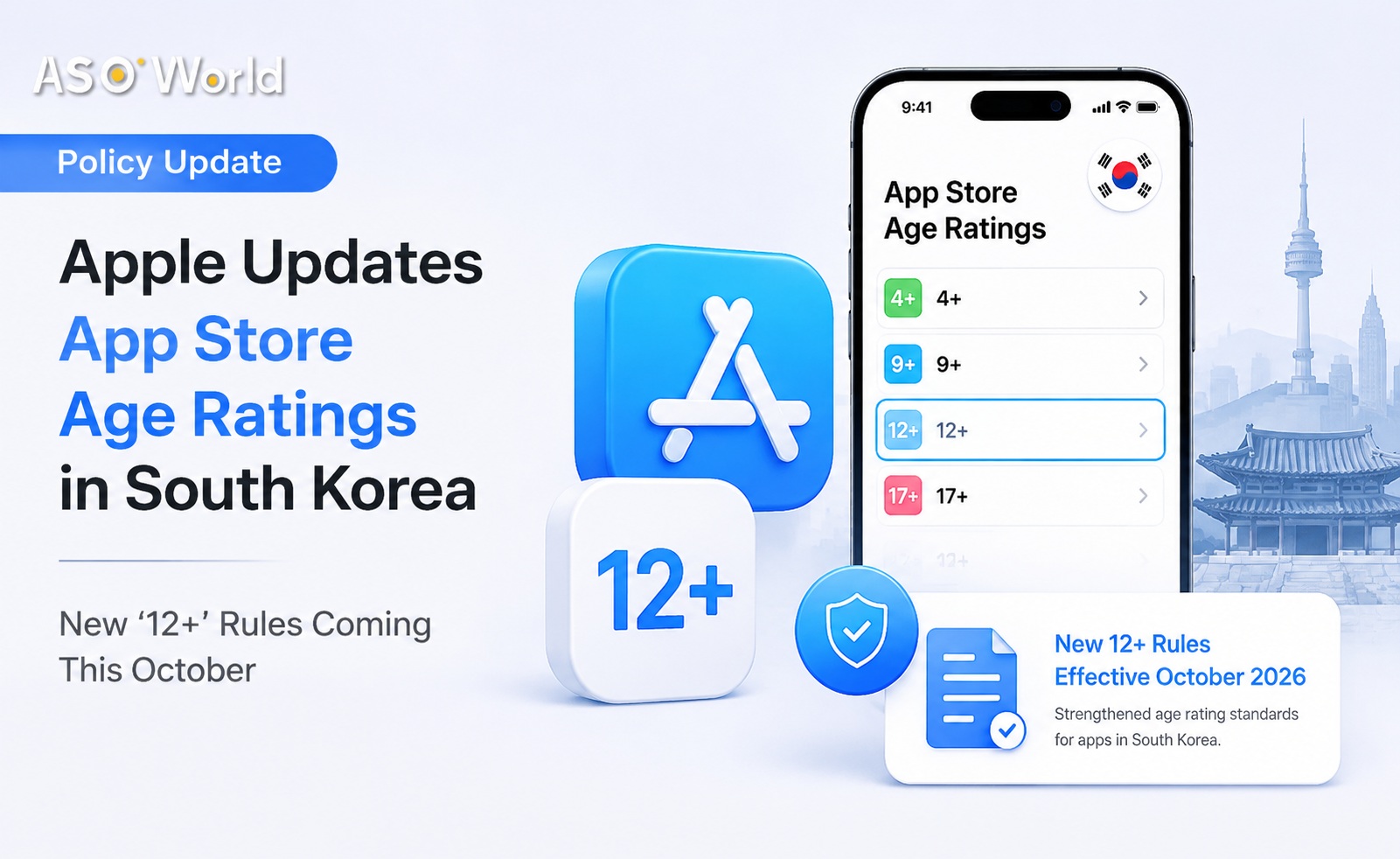
Apple has handed South Korean developers something it gives almost no one else: the right to overrule the App Store’s own age rating. Filed under compliance, the change is really a story about how regional rating logic is quietly becoming a distribution variable — and about a second, less-discussed update landing in October 2026 that will push a slice of “All ages” apps into 12+ overnight.
Key Takeaways
- Live since 12 August 2026: developers with an official GRAC rating can override their Korean App Store age rating by submitting a Rating Classification Number (RCN) with their next app version.
- Available values in Korea: All, 12+, 15+, or 19+ — a region-specific scale that is not Apple’s global one.
- From October 2026: infrequent profanity/crude humour and infrequent mature or suggestive themes shift from All to 12+ in Korea.
- Scope: Games and Entertainment categories on the Korean App Store.
- Hard gate: apps with frequent or intense simulated gambling require an RCN to be available in Korea at all.
What Apple Actually Changed
On 12 August 2026, Apple published two changes to age ratings for the Republic of Korea. They run on different timelines and in opposite directions.
Change one, live now: if your app carries an official rating from Korea’s Game Rating and Administration Committee (GRAC), you can override the rating Apple assigned and replace it with any of Korea’s region-specific values — All, 12+, 15+, or 19+. The mechanism is simple: supply your GRAC Rating Classification Number (RCN) with your app’s next version submission.
Change two, October 2026: two content descriptors move up from All to 12+ in Korea — infrequent profanity and crude humour, and infrequent mature or suggestive themes.
Both operate inside the framework Apple already runs in Korea, where Games and Entertainment apps receive a region-specific rating derived from App Store Connect questionnaire answers rather than the global scale.
The Detail Most Coverage Skips: Korea Kept the Tier Apple Deleted
In July 2025, Apple overhauled age ratings globally, moving to 4+, 9+, 13+, 16+, and 18+. The old 12+ and 17+ tiers were retired worldwide.
Korea never joined that scale. Its four values mirror GRAC’s statutory bands, not Apple’s. So when Apple says two descriptors move “from All to 12+” in October, it is populating a tier that no longer exists anywhere else on the App Store.
The consequence for anyone maintaining a cross-market rating matrix: Korea is not a variant of your global rating, it is a separate axis. The same build can legitimately show 13+ in the US, 12+ in Korea, 16+ in Australia, and 12+ in Vietnam — four numbers on four product pages, none of them a bug.
Korea’s 15+ Bucket Is Triggered by Growth Features, Not Content
Read Apple’s Korea rating table closely and an uncomfortable pattern appears. The 15+ tier in Korea is not primarily driven by violence or sexual content. It is driven by capabilities:
- Unrestricted web access
- Social media
- Social media disabled for users under 13
- Frequent medical or treatment information
Every one of those is a feature a growth team might ship deliberately. An in-app browser for a promo landing page. A social feed to lift retention. A creator wall to fuel UGC loops. In most markets these are neutral. In Korea, they can lift an otherwise family-friendly title from All straight past 12+ to 15+.
There is a second landmine in the same table. Apps with frequent or intense simulated gambling are available on the Korean App Store only if you provide an RCN. For social casino, arcade and casual titles with slot mini-games, the RCN is not an optional override — it is the price of entry.
Why the Override Cuts Both Ways
The obvious read on the override is defensive: developers who felt Apple’s questionnaire over-rated their app can now substitute the regulator’s verdict. That happens, and it is real relief for teams whose questionnaire answers produced a stricter tier than GRAC issued.
But the override is bidirectional. It lets you set your Korean rating to any of the four values your RCN supports — including a higher one. That matters for a scenario compliance teams know well: a title whose Korean rating drifts below its GRAC classification is misaligned with the local authority, and misalignment with a statutory rating is the more expensive failure mode.
Apple has also closed the loop on detection. Per App Store Connect documentation, if GRAC issues an official rating that differs from your App Store rating, App Review will notify you and point you to the override flow. Translated: the discrepancy will be found. The only variable is whether you fix it on your schedule or on App Review’s.
What the October Shift Does to Your Korean Product Page
The October change is narrow in wording and broad in effect. “Infrequent profanity and crude humour” and “infrequent mature or suggestive themes” are exactly the descriptors that casual games, comedy content, dating-adjacent apps and short-video entertainment titles tick almost by default.
If your Korean listing sits at All today on the strength of those two descriptors alone, plan for 12+ in October. Three downstream effects to model before it lands:
- Parental-control eligibility. Age ratings feed Apple’s parental controls. An app moving from All to 12+ becomes filterable on any managed device configured below that threshold — a silent contraction of your addressable install base, not a visible rejection.
- Family and kids-adjacent positioning. If your Korean store presence leans on being suitable for everyone, the creative and copy built around that claim needs revisiting alongside the rating.
- Conversion-rate baselines. A rating badge change is a product-page change. If you are tracking Korean CVR week over week, annotate the October boundary or you will misattribute the delta to your next screenshot test.
The Real Trend Line: Ratings Are Becoming Local Law, Not Store Policy
Step back from Korea and the pattern across 2026 is unmistakable. Apple is no longer applying one rating system with regional footnotes; it is operating parallel, legally-anchored systems per market.
- Australia: the 15+ rating was removed as of 18 June 2026, with affected apps — including those flagged for unrestricted web access or loot boxes — moving to 16+.
- Vietnam: a region-specific scale of 00+, 12+, 16+, and 18+ was introduced to align with Article 38 of Decree 147.
- Brazil and Korea: both maintain their own region-specific rating values in App Store Connect.
- Globally: the questionnaire itself keeps expanding — social media capability questions arrived in July 2026, and Apple has explicitly told developers that AI assistant and chatbot functionality counts toward sensitive-content frequency.
Korea’s GRAC override is the logical endpoint of that trajectory: where a national regulator already issues a binding rating, Apple defers to it rather than competing with it. Expect that deference model to spread to other markets with statutory rating bodies, not to remain a Korean exception.
Bottom Line
The GRAC override looks like paperwork and behaves like a distribution control. It gives Korea-facing developers real authority over how their app is presented — and, in the simulated-gambling case, over whether it is presented at all. The October 12+ move, meanwhile, will reclassify a meaningful band of “All ages” apps with no code change required from anyone.
Teams that treat store metadata as a living growth surface will absorb both changes in a single submission cycle. Teams that treat age ratings as a launch-day form will discover the shift in a Korean conversion chart, one quarter late.
For continued coverage of App Store policy shifts, regional compliance deadlines and their downstream impact on ASO and user acquisition, follow the Marketing Trending — App Store feed. If you are planning a Korean launch or repositioning an existing listing for the local market, ASO World’s App Store Optimisation services and gaming app marketing solutions can help align metadata, ratings and growth strategy market by market.
FAQ
What is a GRAC Rating Classification Number (RCN)?
It is the identifier attached to an official rating issued by South Korea’s Game Rating and Administration Committee. Since 12 August 2026, supplying your RCN with an app version submission lets you override your App Store age rating in Korea to All, 12+, 15+, or 19+.
Which apps can use the Korean age rating override?
The region-specific rating system applies to apps in the Games and Entertainment categories distributed on the Korean App Store, and the override requires an existing official GRAC rating.
What changes on the Korean App Store in October 2026?
Two content descriptors — infrequent profanity and crude humour, and infrequent mature or suggestive themes — move from an All rating to 12+.
Why does Korea still show a 12+ rating when Apple retired 12+ globally?
Apple’s July 2025 global overhaul moved to 4+, 9+, 13+, 16+, and 18+. Korea uses a separate region-specific scale — All, 12+, 15+, 19+ — aligned to local regulatory bands, so its tiers operate independently of the global scale.
Do I need an RCN to publish a game with simulated gambling in Korea?
Per Apple’s App Store Connect reference, apps and games with frequent or intense simulated gambling content are only available on the Korean App Store if you provide an RCN.
When does an override take effect?
Overrides are applied through your app’s next version submission, so the rating change ships with a new version rather than instantly on an existing one.