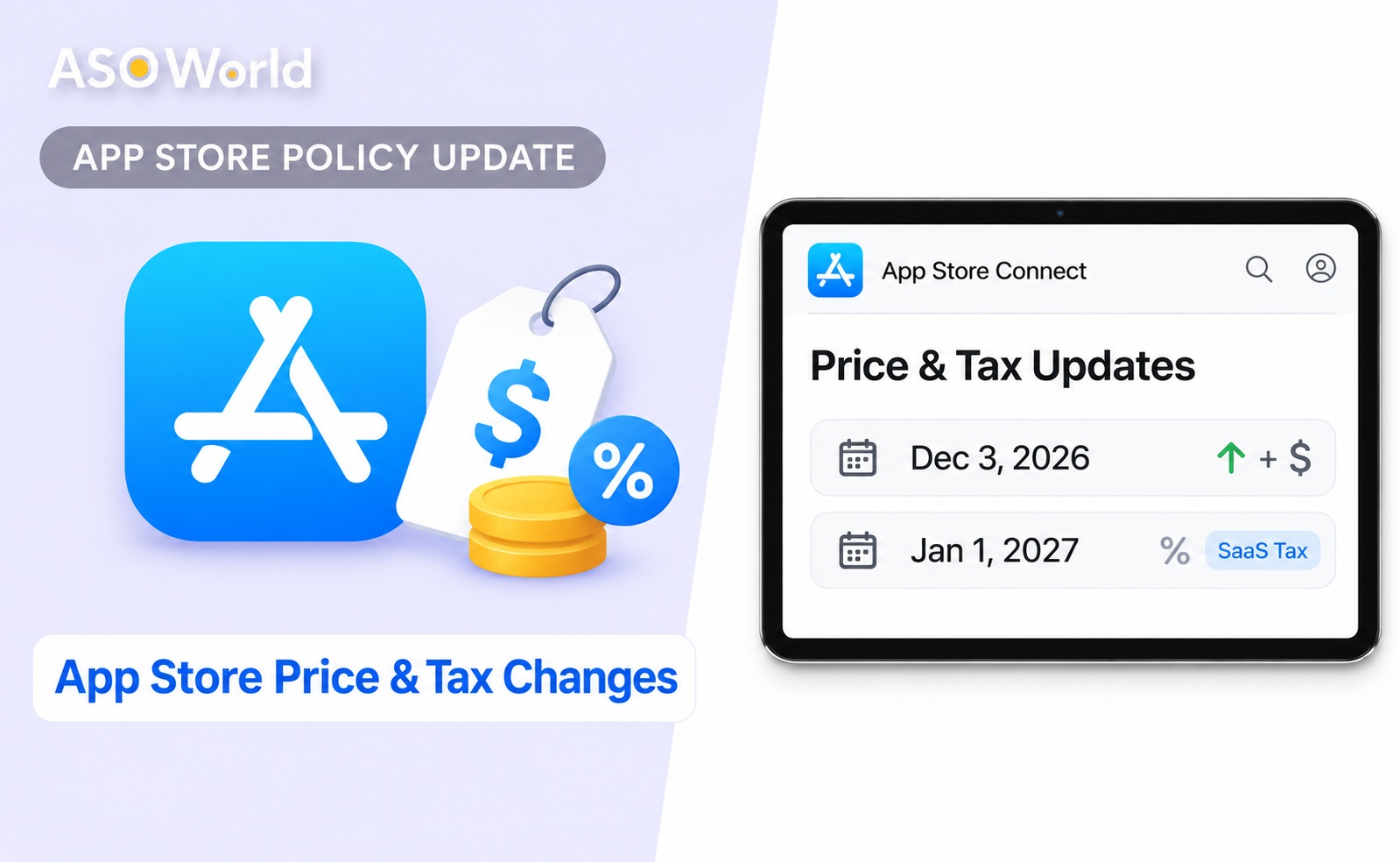
Apple has told developers that App Store prices will change in five storefronts on December 3, 2026, and that proceeds will shift in four African markets where new consumption taxes take effect. The notice, published on the Apple Developer site on November 17, also introduces a “Software as a Service (SaaS)” tax attribute — a small setting with consequences that stretch well beyond this month’s price list.
Nothing here changes commission rates or review policy. This is the routine machinery of operating 175 storefronts in 43 currencies: Apple re-equalizes prices when exchange rates drift, and adjusts developer proceeds when a government introduces a tax. What makes this round worth reading closely is the combination — a December price update, four new tax regimes, and a California change that lands on January 1, 2027.
What Apple announced
The notice separates two tracks. Price updates take effect on December 3. Tax changes apply to proceeds immediately, with the exception of California, which begins on the first day of 2027.
| Market |
What changes |
Effective |
| Botswana |
App and in-app purchase prices updated; 14% VAT introduced; Apple begins collecting and remitting the tax |
Dec 3, 2026 |
| Rwanda |
Prices updated; 18% VAT introduced; Apple begins collecting and remitting the tax |
Dec 3, 2026 |
| Cameroon |
3% Significant Economic Presence (SEP) tax applied to proceeds |
Now |
| Côte d’Ivoire |
3% SEP tax applied to proceeds |
Now |
| Colombia, Egypt, Türkiye |
Prices re-equalized against the developer’s base storefront; no new tax in this notice |
Dec 3, 2026 |
| California, United States |
Sales and use tax applies to SaaS, App Store Software, Software Training Material, Dating and Boosting |
Jan 1, 2027 |
The price update: equalization, with three exemptions
Apple frames the December 3 adjustment as equalization. If a developer has not selected Botswana, Colombia, Egypt, Rwanda or Türkiye as the base storefront for an app or in-app purchase, prices in those markets will move to keep local pricing consistent with the chosen base price. The company says it derives exchange rates from public data published by financial media and data providers such as The Wall Street Journal and Bloomberg, rather than from negotiated rates.
If one of those five markets is the base storefront, the local price stays put and Apple adjusts the developer’s other storefronts instead. Three carve-outs matter more than the headline list: auto-renewable subscriptions are excluded entirely, storefronts where a developer manually manages prices are not touched, and developers can override any automated price at any time. App Store Connect’s Pricing and Availability section now displays the upcoming changes before they take effect.
In practice, the affected cohort is narrower than “all apps in five countries.” It is developers who rely on Apple’s automated equalization and who have not localized their price ladder by hand — which, for most small and mid-sized studios, is the default.
Why these five markets punch above their weight
Türkiye and Egypt have both been through sharp currency depreciation in recent years, and each previous slide has been followed by an App Store repricing round. Colombia’s peso has been volatile against the dollar over the same period. For developers with a US or euro base storefront, these are the markets where a quiet price adjustment can swing revenue per install by double digits in local currency terms.
Botswana and Rwanda are smaller, but they are also markets where the entry price point sits at the bottom of Apple’s price ladder. A single tier shift is a much larger percentage move there than in the United States, and price sensitivity is correspondingly higher — a relevant detail for subscription apps and games testing low-cost entry tiers across sub-Saharan Africa.
Apple has not published the size of the individual moves. Developers will see them in App Store Connect, and the practical question is whether the new local price still lands on a clean, familiar number or an awkward converted figure that reads as expensive.
The tax file is the more consequential story
Botswana’s 14% VAT and Rwanda’s 18% VAT are the largest single changes in the notice, and both come with an administrative shift: Apple will collect and remit the tax itself, per an update to Exhibit B of the Paid Applications Agreement. That removes a remittance obligation from developers selling in those markets, but it also means the gross price a customer sees will rise while the developer’s net proceeds are recalculated against the new tax-inclusive structure.
Cameroon and Côte d’Ivoire introduce a 3% Significant Economic Presence tax, applied to proceeds rather than to the displayed price. For a studio with modest revenue in either market, the absolute amount is small; for anyone treating West Africa as a growth region, it is a permanent margin adjustment that belongs in the model rather than in a footnote.
The most forward-looking item is the new “Software as a Service (SaaS)” tax attribute. Apple has made it available for four existing tax categories — App Store Software, Software Training Material, Dating and Boosting — and asks developers to review and update their selections in the Pricing and Availability section. Getting this wrong is not a display problem. An app that qualifies as SaaS but is tagged as something else can accumulate under-collected tax exposure across an entire catalog of in-app purchases.
That attribute exists because California is about to need it. From January 1, 2027, those same categories become subject to sales and use tax in California under the state’s expanded treatment of prewritten software and SaaS. Apple notes two important details: US storefront prices are displayed exclusive of tax, so the listed price does not change, and developer proceeds do not change. What changes is the total a California customer is charged at checkout — which is exactly the number that influences conversion.
📱 What this means for app marketers
A repricing round is a conversion event, not just a finance event. When a price tier moves in Türkiye, Egypt or Colombia, install-to-paid rates and revenue per install move with it — and the effect shows up in store analytics weeks before it shows up in a board deck. Running app store optimization alongside the change lets you see whether a dip is price-driven or ranking-driven, and adjust keyword and creative strategy accordingly.
What to do before December 3
Most of the work is administrative, but it has a deadline. The checklist below reflects what Apple’s notice actually requires, plus the two commercial checks that follow from it.
| Task |
Why it matters |
Deadline |
| Confirm the base storefront for every app and in-app purchase |
Determines whether the December 3 price applies to you or to your other markets |
Before Dec 3 |
| Review manually managed price points |
These are excluded from automated equalization and can drift out of line |
Before Dec 3 |
| Audit tax categories and the new SaaS attribute |
Misclassification creates under-collection risk that surfaces later |
Before Jan 1, 2027 |
| Model conversion at the new local price points |
A tier move changes install-to-paid rates, especially in price-sensitive markets |
Dec 3 |
| Check paywall and promotional copy for hard-coded prices |
A mismatch between ad copy and store price reads as a bait-and-switch |
Before Dec 3 |
What comes next
Apple says translated versions of the updated Paid Applications Agreement will appear on the developer site within a month. The January 1 California change is the one to diarize: it is the first US jurisdiction where Apple has explicitly built a SaaS classification into App Store Connect, and it would be surprising if it were the last.
For now, the December 3 update is a reminder that store pricing is not a set-and-forget decision. In markets with volatile currencies and newly introduced digital taxes, the price a customer sees — and the amount a developer keeps — is revised on Apple’s schedule, not the developer’s. The teams that treat repricing as part of their growth operations, rather than as an accounting event, tend to be the ones that hold conversion steady when the next round lands.
Quick answers
Which markets have App Store price changes on December 3, 2026?
Botswana, Colombia, Egypt, Rwanda and Türkiye — but only where one of those markets is not the developer’s chosen base storefront.
Will auto-renewable subscription prices change?
No. Apple explicitly excludes auto-renewable subscriptions from this price update, and from the price-adjustment mechanism described in the notice.
Does the California tax change reduce developer proceeds?
No. US storefront prices are displayed exclusive of tax, so listed prices and proceeds stay the same. The total charged to California customers, tax included, may increase from January 1, 2027.
Where do developers see the upcoming prices?
In the Pricing and Availability section of App Store Connect, which Apple has updated to display the changes before they take effect.
 COVID-19 UPDATE