COVID-19 UPDATE


Important Notice:Beware of scams using ASOWorld's name for part-time recruitment or ASO earning app activities. ASOWorld is not hiring any part-time staff. Trust only official information posted by ASOWorld.

Learn how negative reviews impact App Store Optimisation (ASO). Discover data-driven strategies to efficiently manage user feedback and boost app conversion rates.



In today's highly competitive digital application ecosystem, maintaining a robust app store presence is fundamental to long-term commercial success. User ratings and reviews serve a dual purpose: they function as a public barometer of user sentiment and act as critical ranking signals for App Store Optimisation (ASO) algorithms. Negative feedback introduces friction into the acquisition funnel, thereby degrading organic visibility and inflating user acquisition costs.
This article examines the structural consequences of poor ratings on ASO performance and outlines strategic methodologies to mitigate their impact, ensuring your app maintains a competitive edge.
User feedback forms the foundation of consumer trust and algorithmic valuation. Ratings (quantified from 1 to 5 stars) provide an immediate visual summary, whilst reviews offer qualitative context that prospective users parse before making an install decision.
&
Upon landing on a product page, the aggregate star rating operates as the primary trust heuristic. High quantitative ratings are non-negotiable in sectors requiring high user trust, such as FinTech, health, and e-commerce.
To sustain optimal user acquisition efficiency and low abandonment rates, developers should systematically target maintaining a rating benchmark between 4.3 and 4.9.
Recognising the direct correlation between user feedback and install conversion rates is vital for managing overall App Store Optimisation (ASO) strategies.
The following core ASO mechanisms are heavily influenced:
An application's trajectory in standard category charts is predominantly dictated by its download velocity (the aggregate volume of installs within recent 24-72 hour windows). Friction caused by ratings below the 4.0-star threshold severely hampers daily install volumes, making top-tier category positioning mathematically improbable.
⚡ Related analytical reading: Understanding iOS and Google Play Ranking Algorithms
Both Apple and Google algorithms continuously evaluate an app's Tap-Through Rate (TTR) and subsequent conversion rate for specific search queries. Apps exhibiting sub-optimal conversion rates due to negative reviews are progressively de-indexed or pushed down the rankings for high-volume, competitive keywords.
⚡ Related analytical reading: Advanced Search Visibility and Conversion Strategies
In paid acquisition via Apple Search Ads, keyword auction pricing is algorithmically tied to an app's "Relevance Score", heavily influenced by organic conversion metrics.
Diminished organic conversions stemming from poor ratings result in lowered relevance. Consequently, the developer must pay a significantly higher Cost Per Tap (CPT) to win the ad auction, destroying Return on Ad Spend (ROAS).
Platform editorial teams enforce strict quality thresholds. Applications holding average ratings below 4.0 are routinely disqualified from feature consideration. For context, entries within Google Play's "Editors’ Choice" consistently operate above a 4.3-star baseline.
⚡ Related analytical reading: Strategies for Securing App Store Featuring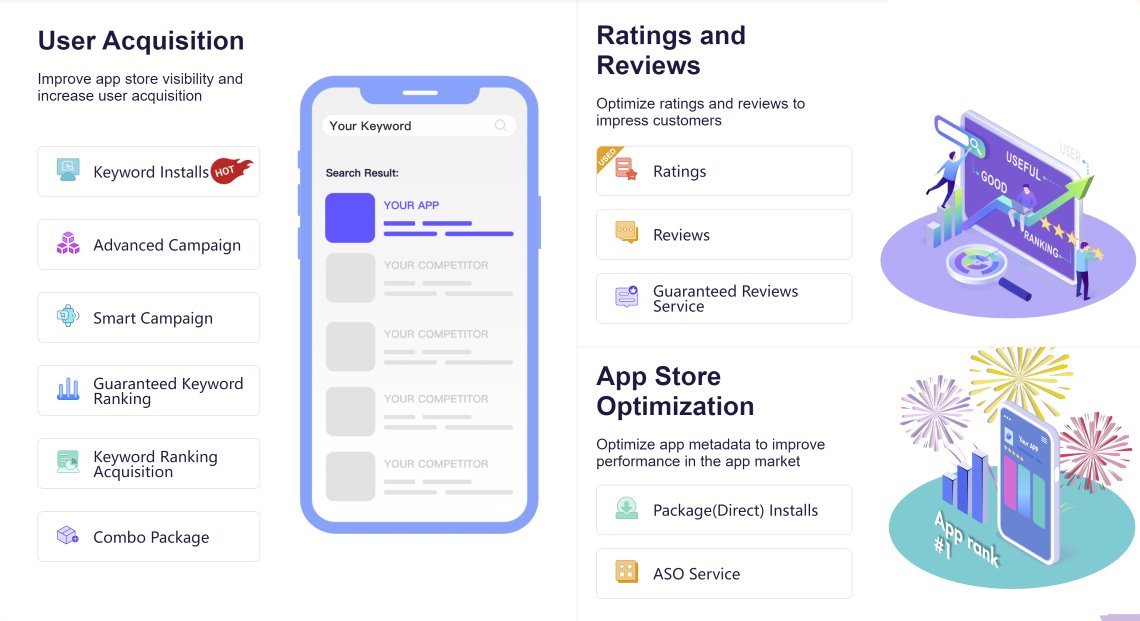
* Scale your user base with structured growth engineering - select our& Guaranteed Keyword Ranking Acquisition& to secure& TOP 5& chart positioning, ensuring maximised organic traffic flow.
* Click the banner& above (explore& Keyword-Driven Installation Services& to augment algorithm visibility, or& Review and Rating Optimisation Packages& to systematically repair conversion rates).
Negative reviews mathematically dilute the aggregate score. Due to the saturation of the application market, users rarely download apps falling into the 2-to-3-star bracket. Rebuilding median scores requires a disproportionately high volume of 5-star reviews to neutralise the mathematical drag of 1-star feedback.
Once conversion drops drop beneath vertical benchmarks, marketplace algorithms actively suppress the application’s exposure. A heavily criticised app will systematically lose impressions in automated recommendations (e.g., "Similar Apps" or "Suggested for You" widgets), severely bottlenecking the top of the user acquisition funnel.
The qualitative text of a review often highlights specific operational failures. Consistent mentions of server downtime, subscription cancellation issues, or poor customer support construct a public log of technical debt. Prospective users scrutinise these specific failure points, elevating user hesitation and directly blocking the install action.
The logical endpoint of reduced visibility and degraded trust is an immediate drop in Gross Installs. A mobile game suffering from frame-rate drops or constant crashing will quickly surrender its market share to more technically stable competitors, leading to a measurable decline in Lifetime Value (LTV) and monthly recurring revenue.
⭐ Case Study: Driving an 85% Rating Uplift and Reducing Negative Feedback
As app store algorithms primarily utilise real-time behavioral data (search -> click -> download -> retain), apps accumulating negative sentiment face systemic keyword demotion. This establishes a negative feedback loop: lower rankings trigger lower downloads, which further signals poor relevance to the algorithm.
⚡ Related analytical reading: Root Causes of Negative App Reviews and Professional Mitigation

While operationally punitive in the short term, negative consumer feedback acts as a high-fidelity diagnostic tool. It bypasses internal biases to spotlight exact failure points in user experience, onboarding friction, and technical stability.
By systematically isolating, resolving, and communicating these corrections, product teams can neutralise algorithmic penalties, reconstruct user trust, and ultimately re-accelerate the wider ASO and user acquisition strategy.
 Mobile App Growth,App Store Optimisation,
Get FREE Optimization Consultation
Let's Grow Your App & Get Massive Traffic!
All content, layout and frame code of all ASOWorld blog sections belong to the original content and technical team, all reproduction and references need to indicate the source and link in the obvious position, otherwise legal responsibility will be pursued.