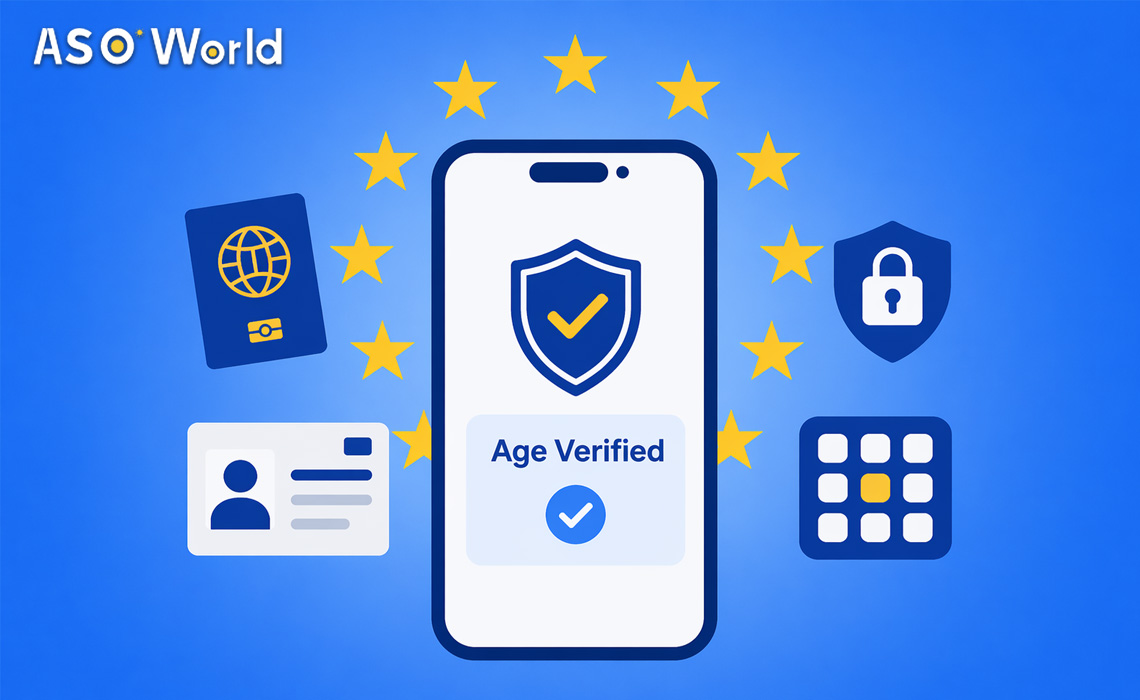
The European Union's forthcoming age verification app will change the way apps manage user access across the bloc. Here's what every app developer and marketer needs to know, along with the practical steps for turning regulatory change into an opportunity for growth.
Key Takeaways
-
Is the EU bringing in a single, unified age verification app that lets users prove their age without handing over personal identity data?
-
Will the new system have a significant effect on high-risk app categories such as social media, dating, gaming and gambling?
-
Does the Digital Services Act (DSA) rely on age verification as a technical mechanism for enforcing its child safety and risk mitigation requirements?
-
Can developers gain a competitive edge by updating their privacy practices, onboarding flows and app store metadata ahead of time?
-
Is EU age verification more than just a compliance requirement, and also a chance to improve ASO performance and user acquisition?
What's Happening: The EU Age Verification App Explained
European Commission President Ursula von der Leyen has confirmed that the EU's age verification app is technically ready and will be introduced over the coming months. The app is designed to let users verify their age across digital platforms without revealing their personal identity, a privacy-first approach built on anonymisation and an open-source architecture.
This is how it works:
- One-time setup: Users prove their age with official documents (passport, national ID) when they first set the app up.
- Cross-platform verification: Once verified, users can confirm that they're eligible to use age-restricted services, such as social media, gambling and alcohol-related content, without sharing any further personal data each time.
- Multi-device support: The app is built to work across smartphones, tablets and desktop environments.
Several EU member states, including France, Denmark and Italy, are already looking at integrating the verification system into their national digital identity frameworks. No binding EU-wide minimum age has yet been enacted, but the European Parliament has previously backed proposals calling for a minimum age of 16 for access to social media.
The initiative is closely linked to the Digital Services Act (DSA), which places greater responsibility on platforms to mitigate risks relating to harmful content and user safety. For app developers and marketers, this means that the compliance landscape is widening, and the enforcement infrastructure is becoming more concrete.
Why This Matters for App Developers and Marketers
If your app is available in the EU, or you plan to expand into it, this regulatory shift has direct implications for your product, your store listing and your growth strategy.
1. Wider Compliance Requirements Beyond Content Ratings
The age verification app adds a new layer of compliance on top of existing content rating systems such as IARC. It's no longer enough just to set a "Mature 17+" or "Teen" rating and move on. Platforms operating in the EU will need to support, or integrate with, a standardised verification mechanism backed by government.
This is particularly relevant given that Google Play has already tightened its child safety policies. As we covered in our analysis of October 2025 Google Play Policy Updates: Key Changes for Child Safety, Finance & Health Compliance, Google is raising the bar by itself on how apps deal with minors. The EU's verification app adds a regulatory mandate on top of enforcement at platform level.
2. Privacy Declarations Under Greater Scrutiny
The EU app's privacy-first design, with anonymisation and no sharing of personal data beyond confirmation of age, sets a new standard against which regulators will judge the data practices of other apps. If your app collects more data during age verification or onboarding than is necessary, expect closer scrutiny.
This fits a wider enforcement trend. Apps that have already run into the EU's trader status requirements (as covered in Apps Without Trader Status Face Removal from EU App Store) know that the EU is prepared to enforce removal on a large scale. Data safety declarations that don't match what the app actually does are a leading trigger for removal.
3. Implications for Store Listings and Metadata
Age-gated content categories will face new requirements for their store listings. Your app description, screenshots and content ratings must accurately reflect how your app handles age-restricted content and user verification. Misleading metadata, even if unintentional, could lead to your listing being suppressed or removed.
Which App Categories Will Be Hit Hardest?
Not every app faces the same exposure. Here's a breakdown of risk levels by category:
| Category |
Impact Level |
Key Concern |
| Social Media |
Very High |
The prime target of EU proposals for a minimum age (a threshold of 13–16) |
| Dating Apps |
Very High |
Age verification is already a legal requirement in some EU markets |
| Gambling & Betting |
Very High |
Existing age restrictions will be enforced through the new app |
| Gaming (with chat/UGC) |
High |
User-generated content and social features bring child safety requirements into play |
| Streaming & Content |
High |
Content involving alcohol, violence and other mature themes is affected |
| Health & Fitness |
Medium |
The handling of health data overlaps with the rules protecting minors |
| E-commerce |
Medium |
Product categories with age restrictions (alcohol, tobacco) |
| Utilities & Productivity |
Low |
Very little age-sensitive content, though the rules on data collection still apply |
Expert Tip: Carry Out an EU Compliance Audit Now
Don't wait for the app to launch officially. Map every feature of your app that could be considered age-sensitive (social features, UGC, in-app purchases, content feeds, messaging) and record how each one handles, or ought to handle, minors. This audit will form the basis of your compliance response and will greatly speed up your reaction once specific requirements are published.
5 Practical Strategies to Prepare Your App for EU Age Verification
Strategy 1: Update Your Content Ratings and Age Classification
Resubmit your IARC content rating questionnaire with the EU's emerging requirements in mind. If your app has any features that minors could access, even if it wasn't designed for them, err on the side of a higher rating.
Common Mistake
Assuming that a correct content rating exempts you from age verification requirements. The EU's verification app works as a separate layer: your content rating tells the store who your app is for, while the verification app will control who can actually get into it. The two must be aligned.
Strategy 2: Redesign Your Onboarding Flow to Work With Verification
Start thinking about how your app's onboarding flow will fit in with external age verification. The EU app is designed to be cross-platform and independent of any particular service, which means your app will probably need to accept a verification token or signal from the EU system rather than running its own age check.
Expert Tip: Build a Modular Verification Layer
Design your age-gating logic as a modular component that can take verification signals from several sources: the EU app, native platform controls (such as Apple's Screen Time or Google's Family Link) and your own in-app system. This gives you the greatest flexibility as regulations develop in different markets.
Strategy 3: Strengthen Your Privacy Declarations and Data Safety Section
Audit every SDK in your app for how it collects data. Third-party analytics, ad networks and crash reporters often collect data that you haven't declared. With the EU's emphasis on privacy-first age verification, any mismatch between your data safety section and what your app actually does becomes a higher-risk compliance gap.
Your privacy policy must comply with the GDPR, be accessible from both the store listing and within the app, and say specifically how your app handles data from users who may be minors.
Strategy 4: Optimise Your Store Listing to Signal Compliance and Trust
This is where compliance meets ASO. Apps that clearly signal their commitment to user safety and regulatory compliance in their store listings will gain from both user trust and the favour of the algorithm.
Practical steps:
- Add safety-related keywords to your metadata where relevant. Terms such as "age verification", "child safety", "GDPR compliant" and "parental controls" are gaining search volume in EU markets.
- Update your screenshots and feature graphics to highlight safety features, parental controls or privacy protections, if your app includes them.
- Write your app description so that it explicitly addresses how your app handles age-appropriate content and the protection of user data.
For a comprehensive approach to keyword optimisation, see How To Enlarge Your App Store Searching Traffic With Keyword Research & Keyword Optimisation.
Expert Tip: Localise Your Compliance Messaging
The EU has 24 official languages, and compliance messaging that works in English may not translate well. With Apple's recent expansion to 50 supported localisations (covered in App Store Now Supports 11 New Languages: Your Complete Localisation Action Plan for 2026), you now have the infrastructure to deliver localised compliance messaging across all the major EU markets. This is both good compliance practice and an ASO opportunity, as localised listings consistently outperform English-only listings in non-English markets.
Strategy 5: Spread Your Distribution and Build Resilience Across Platforms
The EU's regulatory framework applies to every platform operating in the region, but enforcement timelines and interpretations may differ between Apple's App Store, Google Play and alternative stores. Apps with a presence on several platforms are better placed to absorb regulatory disruption on any one of them.
The Bigger Picture: Regulatory Compliance as a Competitive Advantage
EU regulators accept that the age verification system won't completely prevent circumvention. VPN use, for example, has already been observed in markets such as Australia that have introduced similar restrictions. The app is intended as a "protective barrier" rather than a comprehensive enforcement mechanism.
But here's what matters for app marketers: the direction of regulation is clear, and it's accelerating. Several EU member states are independently pursuing minimum age thresholds of between 13 and 16, and a coordinated approach at EU level is under discussion. The Digital Services Act is being actively enforced, with platforms such as Meta and X already facing investigations and penalties.
Developers who regard these regulatory changes as a competitive opportunity, by building compliance into their product, signalling it in their store listings and using it as a lever for differentiation, will outperform those who respond only when enforcement arrives.
This echoes a pattern we've seen time and again in compliance with app store rules. As we documented in How to Avoid Getting Your App Removed from Google Play, the developers who come through waves of enforcement are those who build proactive compliance into their operational workflow, with quarterly audits, monitoring tools and documented processes.
Expert Tip: Keep Track of Policy Changes Across Both Stores and the Regulators
Set up a monitoring pipeline that follows not only App Store and Google Play policy updates, but also developments in EU regulation. Announcements from the European Commission, DSA enforcement actions and legislation at member state level all give early signals of the platform-level requirements that will follow. Our coverage of App Store News shows how changes on the platforms often follow regulatory pressure, and tracking both gives you the earliest possible warning.
What Comes Next: Timeline and Preparation Checklist
| Timeline |
Expected Development |
Your Action |
| Q2 2026 |
Official launch of the EU age verification app |
Finish your compliance audit; update your content ratings |
| Q2–Q3 2026 |
Integration begins in member states (France, Denmark and Italy first) |
Localise your compliance messaging for priority EU markets |
| Q3–Q4 2026 |
Recommendations from the policy panel on an EU-wide minimum age |
Get changes to your onboarding flow ready for age-gating |
| 2027 |
Possible binding EU-wide age legislation |
Complete integration with the EU verification infrastructure |
FAQs
Will the EU age verification app affect apps outside the EU?
Not directly, as the app is designed for the EU market. However, if your app is available on the App Store or Google Play in any EU member state, you'll need to comply with the rules that it enforces. What's more, regulatory trends in the EU often influence policy elsewhere (Australia, the UK and parts of Asia have pursued similar measures), so preparing now has relevance worldwide.
Does my app need to integrate directly with the EU verification app?
The specific requirements for integration haven't been fully published yet. The app is designed to provide a verification signal that works across platforms, which suggests that the platforms (Apple, Google) may handle the integration layer, with apps receiving a verified or unverified status for each user. Even so, apps in high-risk categories (gambling, dating, social media) should prepare for the possibility of requirements for direct integration.
What if my app already has its own age verification system?
Your existing system may still be useful as an additional measure, but it's unlikely to replace the EU's standardised verification. The EU app is specifically intended to provide a uniform, privacy-preserving alternative to the fragmented methods of age-gating that individual apps use at the moment. Plan for both systems to coexist during the transition period.
How does this relate to the Digital Services Act (DSA)?
The age verification app is a technical tool for enforcing the DSA's requirements on child safety and the responsibility of platforms. The DSA already requires platforms to mitigate risks relating to harmful content and user safety, and the verification app provides the infrastructure to enforce restrictions on access by age in particular.
Will this affect my app's ASO performance?
Yes, in two ways. First, apps that fail to comply may see their listings suppressed or removed in EU markets, which directly hits visibility. Second, apps that signal compliance in advance, through updated metadata, safety-related keywords and elements of the store listing that build trust, can capture more search traffic as users and regulators alike give priority to safe, compliant apps.
What is the penalty for non-compliance?
Under the DSA, platforms can face fines of up to 6% of global annual turnover for systemic non-compliance. For individual app developers, the more immediate risk is removal of the listing or geo-restriction in EU markets. Since the EU has already enforced its trader status requirements with app removals, developers should take compliance deadlines seriously.
Looking for expert help to prepare your app for the EU's changing regulatory landscape? ASOWorld provides end-to-end App Store Optimisation services, from compliance-aligned metadata optimisation and localisation to keyword strategy and creative optimisation, across both iOS and Google Play.
 COVID-19 UPDATE