COVID-19 UPDATE


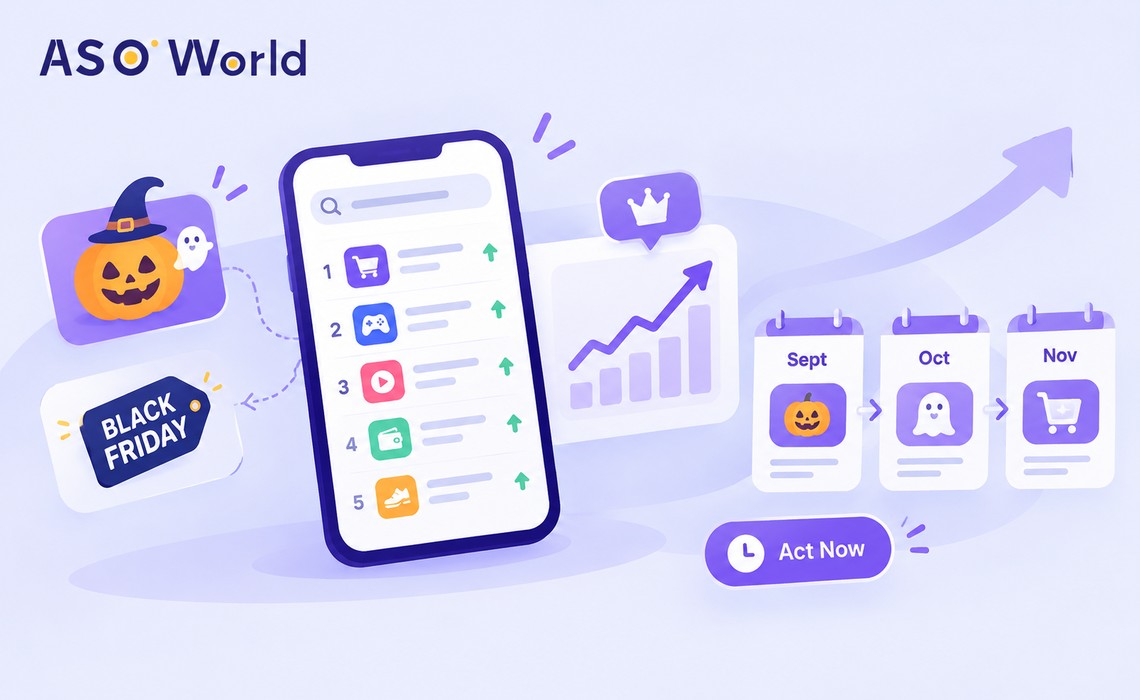
Seasonal search demand for terms like "Black Friday" and "Halloween" starts climbing weeks before the actual date — often by late September for Black Friday specifically. Apps that wait until the week of the event to update metadata and push keyword rankings are optimizing into demand that's already peaked.
The window to act is now: build your seasonal keyword list this week, get core terms ranking over the next 2-3 weeks, and have your metadata, creative, and ranking push fully in place before the last week of October.
Why Timing Beats Everything Else This Quarter
Search behavior on the App Store and Google Play doesn't wait for the calendar date. Interest in Black Friday-adjacent terms typically begins climbing in the second half of September, builds steadily through October, and peaks in the days immediately around Thanksgiving weekend. Halloween follows the same pattern on a shorter runway — search interest for costume, game, and entertainment-adjacent Halloween terms typically starts building in early October, three to four weeks before October 31.
This creates a specific, actionable planning problem: your keywords need to be ranking, not just added to your metadata, before demand peaks. Ranking takes time — new keywords added to your listing this week won't be sitting at position 3 by tomorrow. That lag is exactly why the standard advice across the ASO industry is to start seasonal prep 2-3 months out, not 2-3 weeks out.
For the exact week-by-week schedule — including Christmas, and the platform-specific lead times (iOS vs. Google Play) behind every date — see ASOWorld's 2026 Q4 App Store Marketing Calendar. This article picks up where that calendar leaves off, and focuses on the two things it doesn't cover in depth: which seasonal keywords are actually worth targeting for your app category, and how to build that keyword list from scratch.
Which Keywords Actually Move During Q4 — By App Category
Seasonal keyword opportunity isn't uniform across every app type. The category determines which seasonal terms carry real search volume for you specifically:
- Shopping & e-commerce apps: direct event terms ("black friday deals," "cyber monday sale") plus gift-intent terms ("gift ideas app," "holiday shopping list") — this category sees the largest and most direct seasonal lift.
- Games: Halloween-themed in-app content terms and "new" or "update" modifiers tied to seasonal content drops tend to outperform generic event terms.
- Streaming & entertainment apps: seasonal content-driven terms ("halloween movies," "christmas movies [year]") rather than the event names themselves — the modifier is the content, not the holiday.
- Finance & budgeting apps: "holiday budget," "black friday budget tracker" — a genuinely underused long-tail angle most competitors in this category aren't targeting yet.
- Fitness & lifestyle apps: less Black Friday-driven, more relevant to the January surge — worth noting so you don't over-invest budget on a Q4 window that isn't your app's actual seasonal moment.
If your category isn't obviously seasonal, don't force a seasonal keyword campaign — a mismatched seasonal push can look unnatural in your metadata and dilute the core keywords that drive your baseline traffic year-round.
How to Build Your Seasonal Keyword List
- Start with last year's data, if you have it. Which seasonal terms actually converted for you last Q4? That's your highest-confidence starting list — reuse and refresh it before inventing new terms from scratch.
- Mine autocomplete with seasonal modifiers. Type your core category term followed by "black friday," "halloween," or "holiday" directly into store search and capture what autocompletes — this surfaces real, current seasonal phrasing rather than guessed terms.
- Check which seasonal terms are genuinely winnable. The same Volume/Difficulty/Chance framework that applies to your core keywords applies here — a seasonal head term like "black friday" is often dominated by major retail apps, while a more specific seasonal long-tail phrase can be genuinely reachable in a few weeks.
- Keep your brand and category core terms in the mix. Seasonal terms should supplement your keyword portfolio during Q4, not replace your always-on core terms — you still need baseline visibility once the seasonal window closes.
Metadata and Creative: The Other Half of Seasonal Prep
Keyword ranking is only half of a seasonal push — what a user sees once your listing appears matters just as much, and it moves on a different (faster) timeline than ranking does.
- Title and subtitle: work a seasonal modifier in only where it fits naturally and where you have real character budget — forcing "black friday" into an already-tight title can crowd out a core keyword that drives traffic the other 11 months of the year.
- Screenshots and icon: a seasonal badge or a refreshed first screenshot signals relevance instantly, and unlike ranking, this change is visible the moment it goes live post-review — it's the highest-leverage, fastest-acting lever you have during a seasonal window.
- Short description (Google Play) / promotional text (App Store): this is the safest place to front-load seasonal messaging, since it can often be updated without a full app review cycle on iOS, and it's prime real estate on Android's crawled-text ranking model.
- Review timing: both platforms review metadata and screenshot changes before they go live — budget a few extra days beyond your target launch date for that review cycle, especially if you're submitting close to a platform-wide high-traffic period when review queues can run longer than usual.
None of these changes need to wait for your keyword rankings to climb — they can go live independently and start working on conversion the moment your existing traffic sees them, which is why they belong earlier in your timeline than developers often assume.