In short
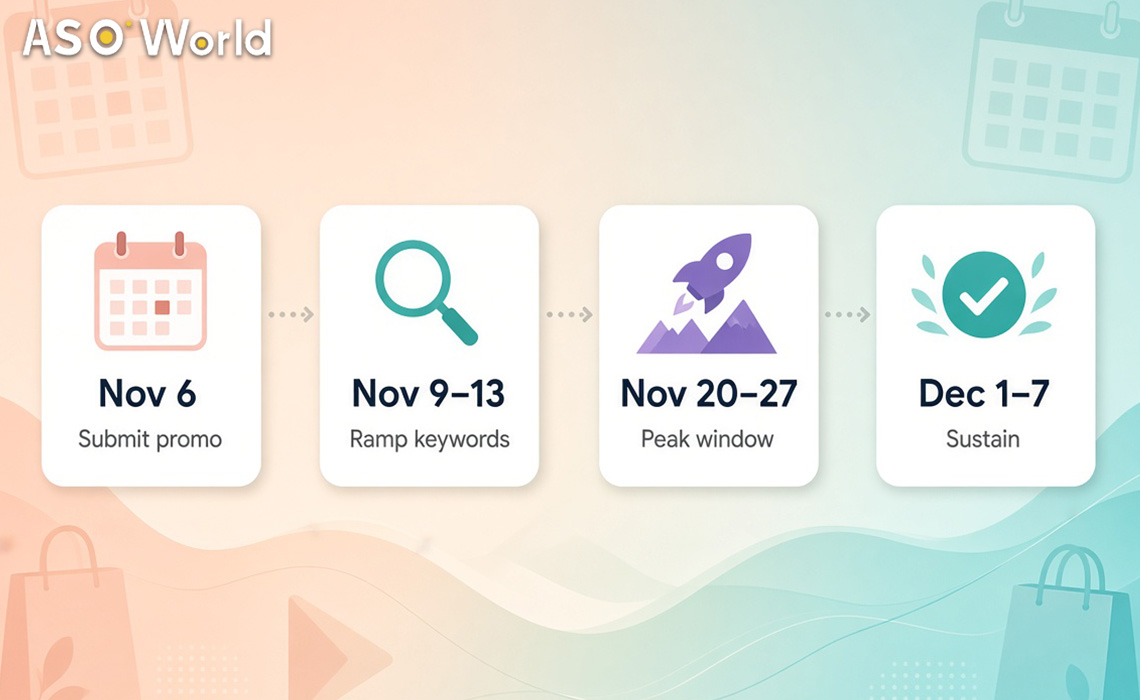
- Black Friday 2026 falls on Friday 27 November. On Google Play, the deadlines come earlier than most teams expect: a promotional content event that requests featuring must be submitted at least 14 days before it starts, so an event beginning on 20 November has to be in by 6 November.
- Google Play rankings typically take about a week to settle, so keyword campaigns aimed at the European peak before Black Friday (around 20–24 Nov) should begin by 9–13 November.
- The most dependable mix on Google Play combines keyword installs (to move search rank), CPI or direct installs (to add real users and momentum in the charts), promotional content (for visibility in Explore) and in-app review prompts (for ratings that last).
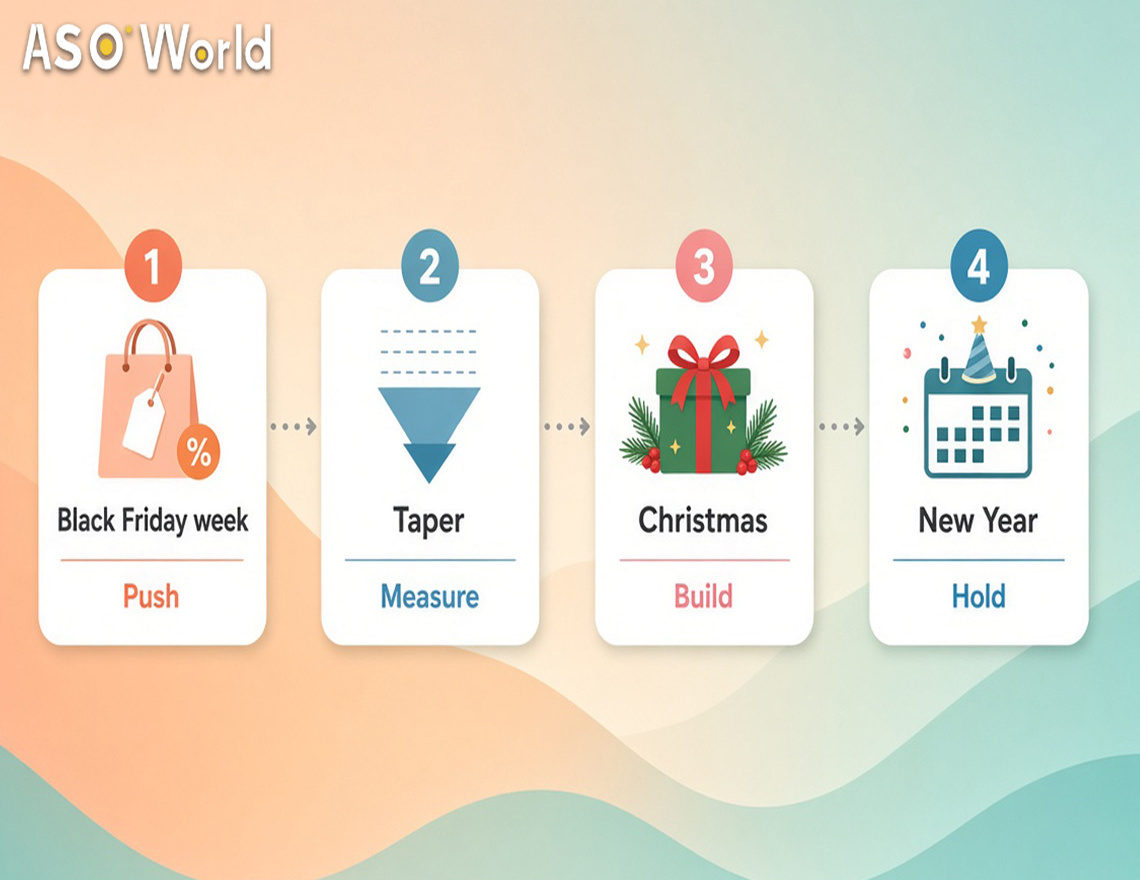
- Gains on Google Play tend to persist: in 2025, seven of the ten apps in the US Shopping top 10 on Black Friday were still there a week later (FoxData estimates). Plan to sustain your position, not just to spike.
This is a plan for execution on Google Play specifically. If you need the overview across both stores, begin with our Black Friday ASO timeline; if you want the data behind the differences between the stores, see iOS vs Google Play ranking stability.
What Are the Google Play Black Friday Deadlines?
| Asset |
Google Play rule |
Deadline for a 20 Nov start |
Deadline for a 27 Nov start |
| Promotional content with a request for featuring |
Submit at least 14 days before the start |
6 Nov |
13 Nov |
| Promotional content without featuring |
Approval can take up to 4 days; submit at least 4 days beforehand |
16 Nov |
23 Nov |
| Changes to the store listing (title, descriptions, graphics) |
Review can take up to 7 days for some apps; use managed publishing to control when changes go live |
Submit by 12 Nov |
Submit by 19 Nov |
| Keyword campaigns |
Rankings typically need about a week to settle |
Start by 9–13 Nov |
Start by 16–18 Nov |
Source: Play Console Help (Promotional content; publishing and review); ASOWorld observations from users' cases | checked 3 November 2026
A single promotional content event can run for up to four weeks, and you can choose to have it previewed on Google Play up to 14 days before it starts. A Black Friday event running from 20 November to 17 December covers the European peak, Black Friday, Cyber Monday and the start of the holiday period in one submission.
What this means for your app: if you want Google to consider your Black Friday event for featuring, this week is your deadline. Everything else can follow over the next ten days.
What Does Each Tool Do in a Google Play Black Friday Plan?
| Tool |
Main job |
When it matters most |
Watch out for |
| Promotional content |
Visibility in Explore on Google Play; Google reports that featured events can more than double acquisitions from Explore |
The event window (20 Nov–17 Dec) |
Must be new and aimed at users; no evergreen content |
| Keyword installs |
Move rank for specific search terms |
Ramp up from 9–13 Nov; hold through 1 Dec |
The app must already rank in the top 250 for each keyword |
| CPI (paid user acquisition) |
Add real, engaged users who can open the app, register and rate it |
16–30 Nov |
Rules for reviewing ads; apps in the style of gambling may be rejected |
| Direct (package) installs |
Short-term momentum in the charts |
1–3 days before the peak |
Keep volumes in proportion to your baseline |
| In-app review prompts |
Ratings from real users that stay visible |
Throughout the window |
Follow Google's rules on prompts |
Source: Play Console Help; ASOWorld service pages | checked 3 November 2026
The pairing that holds up best on Google Play is keyword installs plus CPI: keyword installs tell Google Play which searches your app should rank for, while CPI adds users whose engagement supports the ranking. For apps where retention of reviews has been a problem, this mix also grows ratings from real users rather than relying on bought reviews.
The Six-Phase Google Play Black Friday Schedule
| Phase |
Dates (2026) |
Actions |
| 1. Submit |
3–6 Nov |
Submit a promotional content event (20 Nov–17 Dec) with a request for featuring; draft the copy for the offer and the visuals |
| 2. Prepare the listing |
6–12 Nov |
Update the short description and screenshots for the season; submit them with managed publishing; localise for Germany, the UK and France |
| 3. Ramp up keywords |
9–19 Nov |
Start keyword installs on 8–15 terms at a moderate pace; launch CPI with a test budget |
| 4. European peak |
20–24 Nov |
Raise keyword and CPI volumes in European markets; promotional content goes live |
| 5. US node |
25–30 Nov |
Shift the weight to the US; consider 1–3 days of direct installs for position in the charts if your app already has a strong rating |
| 6. Sustain |
1–7 Dec |
Ease down to a maintenance pace rather than stopping; keep promotional content running |
Source: ASOWorld planning framework; timing of demand in 2025 from FoxData estimates (the UK, Germany and France peaked on 23–24 November 2025)
Developers have recently reported that Google Play keyword campaigns are responding well in several European markets, Germany among them, while some markets such as Brazil have been slower. Weight your budget towards the markets that are responding in your own data, and check again after the first week of phase 3.
What this means for your app: the biggest mistake on Google Play is a gap. Rankings slip when campaigns stop between orders, so plan continuous coverage from 9 November to 7 December and fund it in advance, rather than ordering week by week.
How Much Should You Budget?
| Tier |
Budget |
What it covers on Google Play |
| Tier 1 |
Under $1,000 |
A promotional content event, a refresh of the listing, in-app review prompts, keyword installs on 3–5 terms in one country |
| Tier 2 |
$1,000–$10,000 |
Keyword installs on 8–15 terms across 2–3 countries, CPI on a test scale, paced support for reviews |
| Tier 3 |
$10,000+ |
A keyword and CPI programme in several countries, direct installs for pushes in the charts, a sustain phase through December; often scoped as a customised solution |
Source: ASOWorld planning framework; prices verified 3 November 2026
Keyword installs on Google Play start from $0.20 per install, and package (direct) installs from $0.15. CPI campaigns are scoped and quoted for each app, as costs depend on the category, the country and the event you optimise for.
A Worked Example: A Mid-Size Android App (Hypothetical)
Take a hypothetical utility app on Google Play with about 3,000 organic downloads a day across the US, UK and Germany, a rating of 4.4, and eight target keywords for which it ranks between #15 and #80.
| Item |
Plan |
Volume |
Estimated cost |
| Keyword installs |
8 keywords, 3 countries, 9 Nov–1 Dec |
~900 a day in total (30% of organic), 23 days ≈ 20,700 |
~$4,140 at $0.20 |
| Direct installs |
Push in the US charts, 26–28 Nov |
~1,000 a day for 3 days ≈ 3,000 |
~$450 at $0.15 |
| Paced reviews |
Gaps in the local language in Germany |
~5 a day for 20 days ≈ 100 |
~$150 at $1.50 |
| CPI |
Test, then scale up in the UK and Germany |
Quoted separately |
— |
| Promotional content |
One event, 20 Nov–17 Dec |
— |
No fee |
Source: hypothetical illustration; ASOWorld prices verified 3 November 2026
That comes to roughly $4,700 before CPI, with every daily volume kept well below the app's organic baseline. Because positions on Google Play tend to decay slowly, the sustain phase in early December often brings a better return for each dollar than the same spend on Black Friday itself.
What this means for your app: in a Tier 2 plan for Google Play, the money goes first into continuous coverage of keywords, second into the acquisition of real users, and last into short pushes in the charts.
How Do You Measure Results During the Window?
Check once a week during phases 3–6, and daily only during the US node:
| Metric |
Where to find it |
What good looks like |
| Keyword positions by country |
Your ASO tool |
A steady climb in phase 3, holding through phase 6 |
| Acquisitions from Search + Explore |
Acquisition reports in Play Console |
Rising together; judge them combined |
| Performance of promotional content |
The promotional content page in Play Console |
Impressions of the event and acquisitions during the window |
| Visible new reviews and rating |
Ratings and reviews in Play Console |
Rating steady or rising as traffic grows |
Bear in mind that searches for generic keywords are often reported as Explore rather than Search in Play Console, so a rising Explore line during a keyword campaign is usually a good sign.
What Should You Avoid on Google Play This Black Friday?
- Missing the deadline for featuring. Events that request featuring need 14 days; after 6 Nov, an event starting on 20 Nov can't request it.
- Submitting evergreen promotional content. Google requires content to be new, noteworthy and aimed at users.
- Stopping campaigns between orders. Gaps cause slips that take a week to recover from on Google Play.
- Buying volume far above your baseline. Unnatural spikes put your account at risk, and recent warnings to accounts across the industry make this the wrong season to test the limits.
- Relying on bought reviews for your ratings. Many are filtered out; reviews from real users, gained through campaigns and prompts, last longer.
- Judging results after two days. Google Play often needs about a week to reflect changes.
For a plan that lines up promotional content, keyword campaigns and the sustain phase in December in a single calendar, see ASOWorld's seasonal and event marketing programme. For longer-term positioning in your category beyond the season, the boost app rankings and user acquisition approach covers the ongoing mix.
Pre-Launch Checklist
- Promotional content event submitted with a request for featuring (by 6 Nov for a 20 Nov start).
- Listing updates submitted with managed publishing, with dates for going live set.
- A keyword list of 8–15 terms for each country, each one already in the top 250.
- Continuous coverage by campaigns funded from 9 Nov to 7 Dec.
- Caps on daily volume set for each country as a share of organic installs.
- In-app review prompt triggered after a positive moment.
- Weekly reconciliation scheduled, combining Search and Explore in Play Console.
FAQ
When should I submit Google Play promotional content for Black Friday?
If you want featuring, at least 14 days before the event starts: by 6 November for a start on 20 November, or by 13 November for a start on 27 November. Without featuring, submit at least four days ahead, as approval can take up to four days.
How long can a promotional content event on Google Play run?
Up to four weeks. A Black Friday event from 20 November to 17 December covers the European peak, Black Friday, Cyber Monday and early December.
When should keyword campaigns on Google Play start for Black Friday?
About a week before the demand you want to catch. For the European peak around 20–24 November, start by 9–13 November.
Should I combine keyword installs and CPI on Google Play?
Yes, for most apps. Keyword installs move rank for specific searches, while CPI adds engaged, real users who support the ranking and can leave reviews.
How much does a Black Friday campaign on Google Play cost?
It depends on the countries and keywords. In our hypothetical example, a keyword programme across three countries, with a short push in the charts and paced reviews, cost about $4,700 before CPI, using ASOWorld prices verified on 3 November 2026.
Should I stop campaigns after Cyber Monday?
No. Ease down to a maintenance pace through early December. Rankings on Google Play decay slowly, so sustaining your positions is usually cheaper than rebuilding them.
 COVID-19 UPDATE