In Short
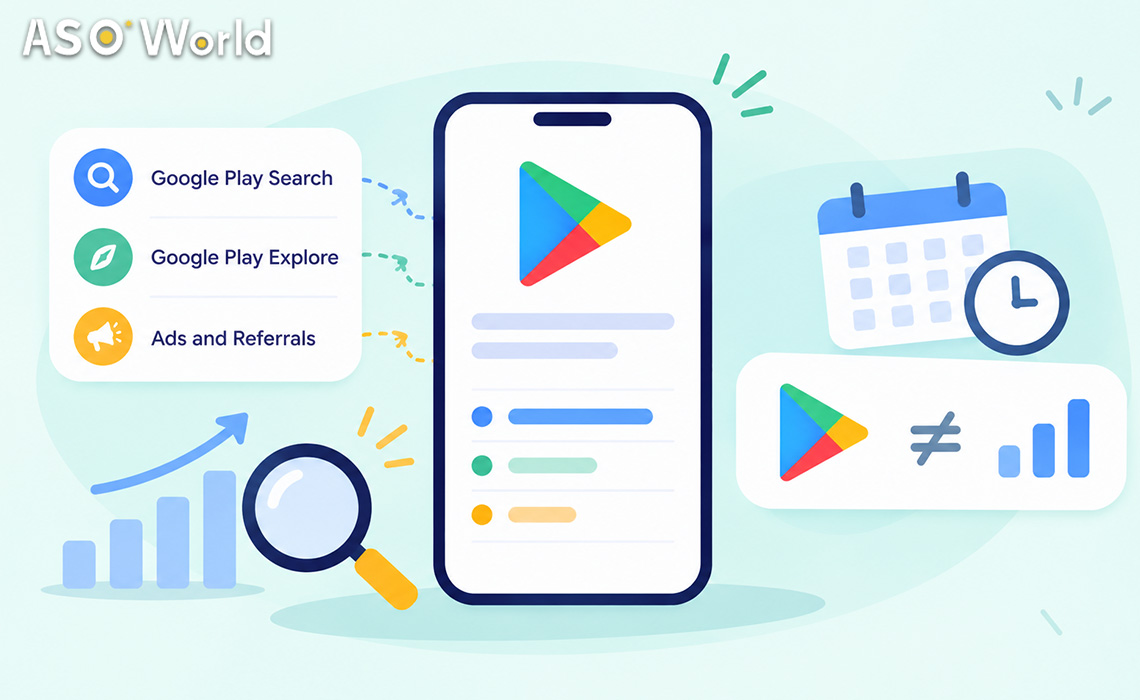
- Google Play Console divides acquisitions from the store listing into Google Play search, Google Play explore and ads and referrals (third-party referrals). Each has a narrower definition than most teams assume.
- Since 20 February 2023, "categorical" searches (generic, category-style queries) have counted as Explore, not Search. Installs that began with typing a generic keyword can legitimately appear as Explore.
- Since November 2022, paid traffic is no longer counted in Search or Explore. Traffic from Google Ads and other campaigns sits under ads and referrals.
- Play Console reports use Pacific Time and count acquisitions from the store listing (new users who install from your listing). Your MMP or campaign dashboard counts in a different way, so totals rarely match one to one.
- Before you declare a campaign "missing", work through the five-step reconciliation below.
If you've ever run a keyword or CPI campaign and then opened Play Console to find that "Google Play search" has barely moved while "Google Play explore" has leapt, or that a chunk of installs sits somewhere you didn't expect, you're not alone. It's one of the questions we hear most often from developers this quarter. In most cases nothing is broken: the report is simply answering a different question from the one you're asking.
What Do Google Play's Traffic Sources Actually Mean?
The acquisition reports in Play Console group visitors to your store listing, and the acquisitions that follow, by the way in which users reached the listing. The labels look self-explanatory, but each comes with its own specific rules:
| Traffic source |
What Google counts here |
What surprises people |
| Google Play search |
Users who found your app through search results on Google Play, including searches for a brand and auto-complete in search |
Generic searches in the style of a category no longer count here (since Feb 2023) |
| Google Play explore |
Users who found your app on Google Play but not from search results: browsing tabs, charts, categories, clusters of similar apps, and categorical searches |
Can rise when a campaign on a generic keyword is working |
| Ads and referrals (third-party referrals) |
Users arriving from outside the store or via ads: Google Ads, untagged deep links, websites, social posts, other apps |
All paid traffic sits here since Nov 2022 |
| Tagged UTM sources |
Third-party referrals arriving through links that carry UTM parameters |
Works only if the link is tagged correctly |
Source: Play Console Help (Acquisition reports), Google announcements on changes to the attribution of traffic, November 2022 and February 2023 | checked 3 November 2026
Two changes explain most of today's confusion. In November 2022, Google moved paid traffic out of Search and Explore and into ads and referrals, so historical comparisons across that date aren't like for like. In February 2023, Google began attributing categorical searches to Explore. A user who types "budget tracker" is behaving like someone browsing for a type of app, so Google now treats that visit as discovery rather than search.
What this means for your app: "Search" in Play Console is closer to search with a specific intent (brand names and precise queries) than to "anything typed into the search box". If your campaign targets generic terms, look at Explore and at the view of search terms, not just the Search line.
Why Do Keyword Campaigns Show Up as Explore?
This is the question behind most of the tickets that say "the campaign didn't work" on Google Play. This is the chain of events:
- You target a generic, high-volume keyword such as "photo editor" or "habit tracker".
- Google classifies many of those queries as categorical searches.
- Since February 2023, acquisitions from the store listing that come from categorical searches have been reported under Google Play explore.
- Your Search line looks flat while Explore rises, even though the user typed a keyword.
Queries that resemble a brand or are highly specific ("[your app name]", "habit tracker with streaks widget") are more likely to stay under Search. Google doesn't publish its exact rules for classification, so treat the split as a guide to direction rather than a precise ledger for each keyword.
There's a second effect as well. When an app climbs for a generic keyword, it often climbs in category charts and clusters of similar apps too, and that browsing traffic is also Explore. A keyword campaign that's working tends to lift Explore from two directions.
What this means for your app: judge a campaign on a generic keyword by search and explore together, plus keyword rank, rather than by the Search line alone. If you're choosing which terms to target, ASOWorld's guide on how to pick the right keywords explains how to balance generic terms against specific long-tail ones.
Why Don't Keyword Installs Show Up as a Big Jump in Total Installs?
Keyword installs exist to move keyword ranking, not to inflate your count of installs. A campaign may deliver a modest daily volume spread over a few terms. In Play Console, that volume is divided between sources, filtered by Google's own rules for counting and set against your normal organic baseline, so it rarely looks like a spike.
The result to look for comes later: a higher position for the target keyword, followed by more organic acquisitions from search and explore as users now see your app. That's why ASOWorld's keyword installs are measured by movement in rank, and why your app must already appear in the top 250 results for each keyword.
What this means for your app: report keyword campaigns first on rank and second on organic acquisitions. Total installs are a lagging and noisy proxy.
Why Do CPI Installs Land in "Ads and Referrals" or Look Unattributed?
Traffic from cost-per-install (CPI) campaigns usually reaches your listing from outside the store, through an ad, an offer wall or a partner app. Play Console therefore files it under ads and referrals. Within that bucket, you'll see a meaningful name for the source only if the link that brought the user carried UTM parameters that Play Console can read.
Common reasons why CPI installs look "unattributed" or land somewhere unexpected:
- Untagged links. Google describes third-party referrers as users who arrived through deep links that weren't tagged. No tag means no name for the source.
- Different rules for counting. Play Console counts acquisitions from the store listing: users who visited your listing and installed. Ad platforms and MMPs count clicks, installs and opens using their own windows and deduplication.
- Time zones. Acquisition data in Play Console is reported in Pacific Time. A dashboard for a campaign in UTC or your local time will move installs from one day to another.
- Reinstalls and multiple devices. Users who already had the app on another device may not count as new acquisitions in the same way.
- Delivery that reaches the listing through browsing the store. Some campaign flows send users into the store, where they then search or browse. Those users can be counted under Search or Explore instead of referrals.
What this means for your app: don't expect Play Console and your campaign dashboard to agree exactly. Settle on a single source of truth for each question: Play Console for behaviour on the store listing, your MMP or campaign dashboard for the performance of paid activity. If you run CPI through ASOWorld's app promotion services, compare the delivery reports with trends in Play Console over a week, not on single days.
How Does This Compare With the App Store?
App Analytics in App Store Connect uses its own types of source, including App Store Search, App Store Browse, App Referrer and Web Referrer, and reports only on users who have agreed to share analytics data with developers. The logic is similar (search against browse against external), but the definitions and the rules on opting in differ, so comparisons between the stores need the same caution.
| Question |
Google Play Console |
App Store Connect |
| Typed a generic query |
Often Explore (categorical search) |
App Store Search |
| Browsed charts / Today / tabs |
Explore |
App Store Browse |
| Came from an ad |
Ads and referrals |
Depends on the type of ad (Apple Ads in search results vs external ads) |
| Came from a website or other app |
Ads and referrals (UTM if tagged) |
Web Referrer / App Referrer |
| Who is counted |
Acquisitions from the store listing |
Users who have opted in to share analytics |
Source: Play Console Help; Apple App Store Connect help (App Analytics source types) | checked 3 November 2026
What this means for your app: if your keyword campaign on iOS shows up cleanly under App Store Search but the same strategy on Google Play shows up under Explore, that's a difference in reporting, not a difference in performance.
Five-Step Reconciliation: Before You Call a Campaign "Missing"
- Align the time zone. Re-cut your campaign data to Pacific Time, or compare weekly totals rather than daily ones.
- Combine search and explore. For campaigns on generic keywords, track Search + Explore together, plus the rank of the target keyword.
- Check the view of search terms. In Play Console, the search-term dimension is available only when the traffic source is filtered to Google Play search. Use it to see which specific queries still land under Search.
- Tag every external link. Make sure that every link to your listing from a campaign, social post or website carries UTM parameters, so that referrals show a source rather than "untagged".
- Compare against your baseline. Look at the change against your previous four weeks, by country. A campaign in Brazil won't move a chart filtered to the US.
If the numbers still don't make sense after these five steps, the problem is usually not attribution but performance: a keyword that's too competitive, a listing that doesn't convert, or the wrong country. A structured badly ranked or not ranked diagnostic helps to separate those causes before you spend again.
Common Misconceptions
- "Explore means organic browsing only." Since February 2023 it has also included categorical searches.
- "Search includes ads in search results." Not since November 2022; paid traffic sits under ads and referrals.
- "Play Console should match my ad dashboard." Different rules for counting, time zones and deduplication make exact matches rare.
- "If total installs didn't jump, keyword installs failed." Keyword campaigns are judged on rank and on the organic acquisitions that follow.
- "Unattributed means fake." Usually it means untagged, or counted under a different rule.
FAQ
What is Google Play Explore traffic?
Google defines it as users who found your app on Google Play but not from search results, such as by browsing tabs, charts, categories or lists of similar apps. Since 20 February 2023, it has also included categorical (generic) searches.
Why did my Google Play search traffic fall while explore went up?
Most often because your traffic comes from generic, category-style queries, which Google has counted as Explore since February 2023. Check whether total acquisitions from search and explore changed before you assume a decline.
Where do installs from Google Ads appear in Play Console?
Since November 2022, paid traffic has been reported under ads and referrals (third-party referrals), not under Google Play search or explore.
Why don't installs in Play Console match my CPI dashboard?
Play Console counts acquisitions from the store listing in Pacific Time, while ad platforms and MMPs use their own windows, time zones and deduplication. Compare trends over a week, not single days.
How can I see which keywords drive installs on Google Play?
Open the acquisition reports, filter the traffic source to Google Play search and use the search-term dimension. Categorical searches won't appear there, because they're counted as Explore.
Do keyword installs count towards my total of installs?
Google counts them under its normal rules, but their purpose is to move rank, so the effect usually shows up as higher keyword positions and more organic acquisitions rather than as a visible spike in total installs.
The definitions reflect the documentation for Google Play Console and App Store Connect as of 3 November 2026. Labels in the console can change, so check Google's help centre for the latest wording.
 COVID-19 UPDATE