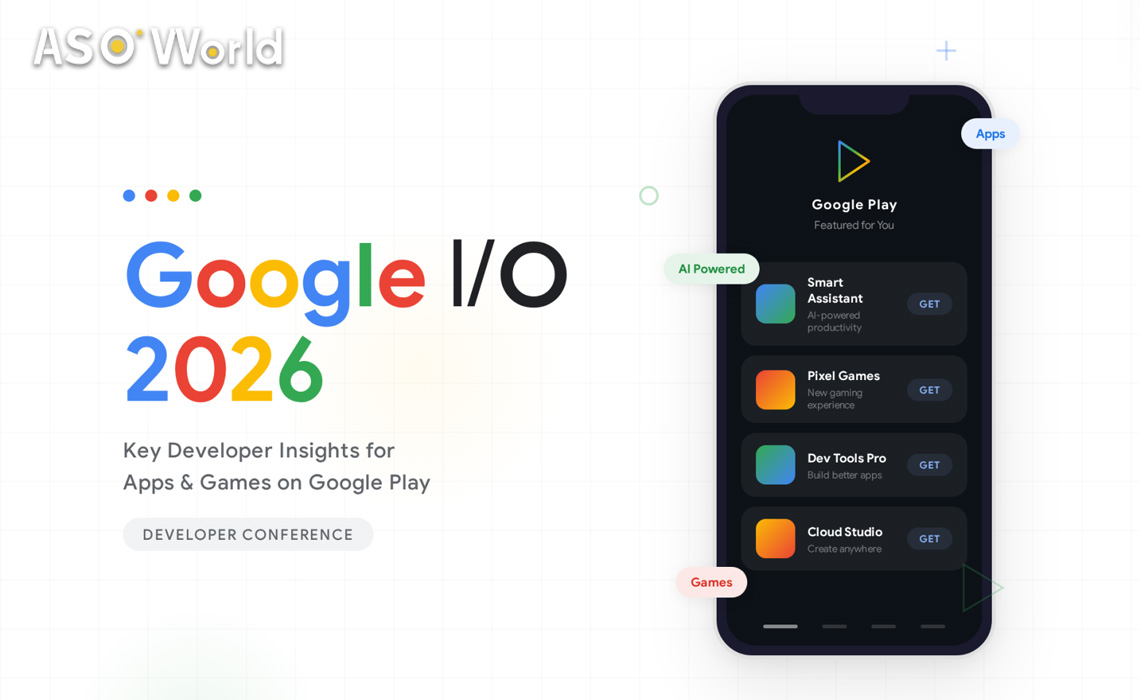
Google I/O 2026 delivered one of the most consequential updates for the mobile app ecosystem in years. Whilst much of the headline coverage focused on new Gemini models and consumer-facing AI features, the implications for App Store Optimisation (ASO) and app marketing strategy are profound — and largely underreported.
From AI-driven app discovery that renders keyword-stuffing ineffective, to post-install behaviour becoming a more explicit ranking factor, to an entirely new shopping infrastructure that could bypass your app altogether — every change announced at I/O 2026 carries direct consequences for how apps get found, installed, and retained on Google Play.
In this article, we break down the seven most impactful announcements from Google I/O 2026 for app developers and marketers, with actionable strategies you can implement straight away to stay ahead of the curve.
1. AI-Driven App Discovery: Gemini Discovery and Ask Play Are Rewriting ASO Rules
The single biggest shift for ASO at Google I/O 2026 is the deep integration of Gemini into Google Play's discovery layer. Users can now describe what they need in natural, conversational language — and Gemini recommends matching apps based on semantic understanding, not merely keyword overlap.
This is not a minor UI change. It fundamentally alters how apps get surfaced. The new "Ask Play" feature, similar to Ask YouTube, allows users to query the Play Store directly with questions such as "What's the best app for tracking my running without a subscription?" — and receive AI-curated recommendations in response.
What This Means for ASO
Traditional ASO relied heavily on identifying high-volume keywords and embedding them into titles, subtitles, and descriptions. With Gemini Discovery, the algorithm no longer simply pattern-matches keywords — it understands user intent and evaluates whether your app description genuinely addresses that intent.
This means an app description that reads "fitness tracker running GPS calories steps workout health" will be far less effective than one that clearly articulates: "Track your daily runs with GPS mapping, pace analysis, and calorie tracking — no subscription required."
| Old ASO Approach |
New ASO Approach (Post-Gemini) |
| Keyword stuffing in descriptions |
Natural language that mirrors user queries |
| Optimising for exact-match search terms |
Optimising for user intent and problem statements |
| Short-tail, high-volume keywords |
Conversational, long-tail phrases |
| Feature list format |
"What problem does this solve?" format |
| Metadata-first optimisation |
Holistic content + metadata + post-install signals |
⚡ Expert Tips
- Rewrite your app descriptions as answers to user questions. Rather than listing features, frame your description around the problems your app solves. Ask yourself: "How would a user describe their need to Gemini?"
- Audit your keyword strategy for intent alignment. Move beyond volume-based keyword selection. Prioritise keywords and phrases that reflect genuine user intent (e.g., "best budget app for couples" rather than simply "budget app").
- Use structured, scannable content in your long description. Gemini processes the full text of your store listing. Use clear headings, bullet points, and benefit-driven language that an AI model can parse accurately.
2. Post-Install Behaviour Is Now a More Visible Ranking Signal
Google Play's May 2026 updates made post-install behaviour a more explicitly visible factor in store rankings. This includes metrics such as:
- Day 1 / Day 7 / Day 30 retention rates
- Session depth and frequency
- Ratings and review quality (not just volume)
- Uninstall rates
Whilst post-install signals have always influenced rankings to some degree, Google is now making these metrics more transparent and more heavily weighted in the Play Store's algorithm. This aligns with Google's broader push towards quality-based discovery across all its platforms.
For a closer look at recent Google Play algorithm changes, see our coverage of Google Play System Updates May 2026.
ASO is no longer simply an "upload and optimise" exercise. Your ranking depends on what users do after they install. ASO teams must work closely with product and growth teams to improve onboarding, feature adoption, and retention metrics.
⚡ Expert Tips
- Set up retention tracking by acquisition source. Understand which channels and keywords deliver users who stay — not merely users who install.
- Optimise your onboarding flow. A confusing first experience kills Day 1 retention. Test different onboarding sequences and measure their impact on 7-day retention.
- Proactively manage ratings and reviews. Review quality matters more than ever. Respond to negative reviews promptly and use in-app prompts to encourage satisfied users to leave detailed feedback.
- Monitor uninstall rates after metadata changes. If a store listing attracts the wrong audience, you'll see higher uninstall rates — which now directly harms your ranking.
3. Universal Cart: E-Commerce Apps Face a New Reality
One of the most commercially significant announcements at I/O 2026 was Universal Cart — an intelligent, cross-platform shopping basket that lets users add products whilst browsing Search, chatting with Gemini, watching YouTube, or reading Gmail.
Universal Cart runs on Gemini models and proactively:
- Finds deals and price drops automatically
- Alerts users when out-of-stock items become available again
- Flags product incompatibilities and suggests alternatives
- Uses Google Wallet data to optimise payment method selection
With the Universal Commerce Protocol (UCP), users can check out directly on Google in a few taps — or transfer items to the retailer's own site.
The Double-Edged Sword for E-Commerce Apps
This creates both opportunity and threat for shopping apps. On one hand, your products gain exposure across Google's entire ecosystem. On the other hand, users may complete purchases without ever opening your app, reducing your control over the customer journey and your ability to build in-app loyalty.
⚡ Expert Tips
- Ensure your product feeds are fully synced with Google Merchant Centre. If your products aren't listed in Merchant Centre, they cannot appear in Universal Cart — and you'll lose visibility to competitors who are.
- Invest in in-app value that cannot be replicated through Universal Cart. Loyalty programmes, personalised recommendations, wishlist features, and exclusive app-only deals give users a compelling reason to keep engaging with your app.
- Track attribution carefully. As purchases take place across more surfaces, you need clear attribution to understand which touchpoints are driving revenue.
4. Generative UI in Search: A Substitution Threat for Utility Apps
Google announced that Search can now use Generative UI — powered by Google Antigravity and Gemini 3.5 Flash — to build custom interactive interfaces on the fly, directly within search results. Users can access custom layouts, interactive visuals, tables, graphs, simulations, and even mini apps for ongoing tasks such as wedding planning or home move management.
This represents a direct competitive threat to utility and tool apps. A user who previously would have searched "best budgeting app" and downloaded one from the Play Store may now be presented with a fully functional budgeting tool built for them inside Search — with no download required.
👉 Learn About Utility App Marketing Solutions
If your app's core value can be replicated in a simple interactive UI with no data persistence or personalisation, Search's Generative UI could cannibalise your organic install traffic. Utility apps must double down on what AI mini-apps cannot offer: data synchronisation, deep personalisation, offline functionality, and long-term data history.
⚡ Expert Tips
- Audit your app's "moat." Ask yourself: "Could Search replicate my core feature in a one-off interaction?" If the answer is yes, your app needs deeper value propositions — historical data, cross-device sync, integrations with other services.
- Emphasise irreplaceable features in your store listing. Highlight data export, offline mode, privacy controls, and long-term tracking that no ephemeral mini-app can match.
- Consider building for the new surface. Google is opening Antigravity-powered experiences in Search to developers. If your app's functionality maps well to this format, building a companion mini-app experience could capture users at the top of the funnel.
5. AI Mode at 1 Billion MAU: The Search-to-Download Funnel Is Compressing
Google revealed that AI Mode has surpassed 1 billion monthly active users, with AI Mode queries more than doubling every quarter. AI Overviews and AI Mode have now been merged into a single, seamless AI Search experience. The traditional path of search query → landing page → app store listing → download is being compressed into a far shorter journey: AI query → AI-curated recommendation → direct download.
For app marketers, this means the external traffic sources that drive app installs are fundamentally changing. AI Search now synthesises answers from multiple sources, and your app may be recommended — or overlooked — based on how well AI models can understand and cite your store listing content.
What This Means for Store Listings
Your Google Play store listing page is no longer just for human visitors — it is also being read, parsed, and evaluated by AI models. Content that is structured, factual, and clearly articulates your app's unique value proposition will perform better in AI-driven discovery.
⚡ Expert Tips
- Add structured, fact-based content to your store listing. Include specific data points (e.g., "Used by 2M+ runners in 150 countries") that AI models can cite when recommending apps.
- Use question-and-answer formatting in your long description. AI Search favours content that directly answers user questions. Structure parts of your description as implicit Q&A: "Looking for a meditation app that works offline? [App Name] offers 500+ guided sessions with full offline support."
- Monitor your app's appearance in AI Overviews. Search for your category's key queries in AI Mode and see whether — and how — your app is being recommended. Adjust your listing content based on what the AI is, or isn't, surfacing.
- Align your Google Play keyword optimisation with AI-readable language. The same metadata that supports traditional search also feeds into AI discovery — but it needs to read naturally, not as a keyword list.
6. Ask YouTube: A New Channel for App Discovery Through Video
Google introduced Ask YouTube, a conversational search experience that compiles relevant videos — both long-form and Shorts — into structured, interactive responses. Users can now pose complex queries such as "What's the best project management app for small teams?" and receive video-based answers with full context.
For app teams with a YouTube marketing presence, this represents a significant new discovery channel. Tutorial videos, app reviews, comparison videos, and how-to content can now be directly surfaced and cited in Ask YouTube's structured responses.
How to Optimise for Ask YouTube
The key shift is that Ask YouTube uses semantic understanding to match video content to user queries. This means the quality and relevance of your video's title, description, and spoken content all matter — not just view counts or subscriber numbers.
⚡ Expert Tips
- Create "problem + solution" videos, not brand advertisements. Videos titled "How to Track Expenses as a Freelancer" will outperform "Why Our App Is Amazing" in Ask YouTube's recommendation engine.
- Optimise video descriptions with natural-language queries. Include the types of questions users are likely to ask, and provide clear answers within your description text.
- Use clear, keyword-rich spoken language in your videos. Ask YouTube indexes audio content. If your video discusses app features, articulate them clearly and in context.
- Produce both long-form tutorials and Shorts. Ask YouTube draws from both formats, so a varied mix ensures maximum coverage across different query types.
7. SynthID Content Verification: App Screenshot Authenticity Now Matters
Google expanded SynthID — its AI-generated content detection technology — to Search and Chrome. Users can now verify whether images, videos, and audio were AI-generated by using Search features such as Lens, AI Mode, and Circle to Search, or by asking Gemini directly.
Google also added verification for C2PA Content Credentials, which can confirm whether content is an unaltered camera original or has been modified using specific tools.
Why This Matters for App Store Creatives
App store screenshots and promotional videos are increasingly being produced with AI tools. Whilst AI-generated visuals can be of high quality, the expansion of SynthID to Search and Chrome means users may soon be able to identify AI-generated app screenshots — potentially undermining trust in your listing if the screenshots do not accurately represent the real in-app experience.
As content authenticity verification becomes mainstream, app store creatives that are genuine — real screenshots, real in-app footage — will carry far greater trust than AI-generated mockups. This is especially critical in categories where trust is paramount: finance, health, and education apps.
⚡ Expert Tips
- Prioritise real in-app screenshots over AI-generated mockups. Capture actual screens from your app, featuring real data and real UI, to build credibility with prospective users.
- If you use AI-generated promotional materials, consider adding C2PA Content Credentials. Labelling your content proactively signals transparency and aligns with Google's content authenticity direction.
- Audit your existing creatives. Review all screenshots and preview videos currently in your store listing. Replace any AI-generated images that misrepresent your app's actual experience.
Bringing It All Together: The New ASO Playbook After Google I/O 2026
Google I/O 2026 makes one thing clear: ASO is evolving from a metadata optimisation practice into a full-stack growth discipline. The store listing remains important, but it is now just one signal among many — and AI is the new gatekeeper for app discovery.
Here is a summary of the strategic shifts every app marketer needs to internalise:
<td style
| I/O 2026 Announcement |
ASO Impact |
Priority Action |
| Gemini Discovery + Ask Play |
Keyword matching → Intent matching |
Rewrite descriptions as user-need answers |
| Post-install behaviour signals |
Ranking depends on retention |
Collaborate with product team on onboarding |
| Universal Cart |
Bypass risk for e-commerce apps |
Sync with Google Merchant Centre |
| Generative UI in Search |
Substitution risk for utility apps |
Strengthen data persistence and offline value |
| AI Mode (1B MAU) |
Compressed download funnel |
Make store listings AI-parseable |
| Ask YouTube |
Video becomes a discovery channel |
Create problem-solution video content |
| SynthID verification |
AI screenshots may reduce trust |

 COVID-19 UPDATE