App Store Optimisation (ASO) is a continuous, dynamic procedure. App store rankings and trending keywords fluctuate daily, requiring an ASO strategy that is both flexible and agile. Routine software iterations are required to match the rapid evolution of the mobile sector. Current and regionally adapted metadata is primary to improving an application's visibility and user metrics.
Consequently, determining the optimal frequency for updating app store metadata is vital. This document provides market data and empirical strategies to assist in managing this component of application administration.
This analysis covers the following areas:
- Optimal Frequency for App Store Metadata Updates
- Comparative Metadata Iteration Rates: Applications vs. Games
- Localisation Trends in Application and Game Metadata
What is the Baseline Frequency for Application Metadata Refreshes?
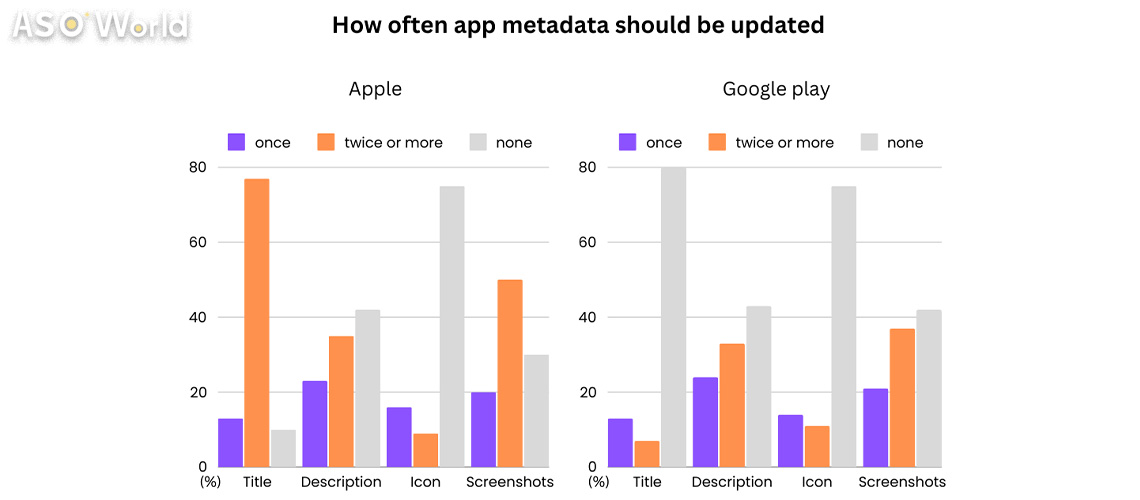
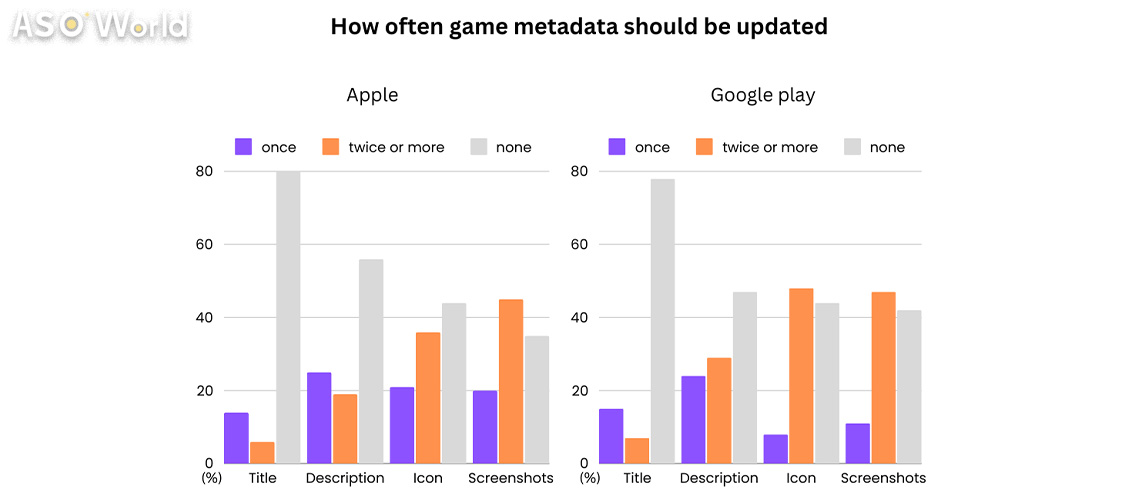
Quantitative analysis indicates that 50% of top-tier iOS applications updated their screenshots more than twice in the preceding year. Conversely, nearly 75% did not alter their icons over the same period. Although title keywords significantly impact search rankings, approximately 80% of applications maintained identical titles throughout the past year.
Do Mobile Games Exhibit Higher Metadata Update Activity?
Mobile games demonstrate a higher frequency of icon updates compared to standard applications. Over 50% of top-ranking games on Google Play revised their icons within the last year. Similarly, nearly half of these games updated their screenshots more than twice annually across both major app stores. However, mirroring standard applications, 80% of games retained their original titles.
💡 Industry Analysis:
Regular visual updates serve to highlight new features, time-limited events, or seasonal elements, generating increased aesthetic relevance. In contrast, prominent games rarely modify their titles; these titles function as established brand identities within the market.
Nevertheless, periodic evaluations of game titles are structurally necessary to integrate emerging search terms or indicate significant version shifts, thereby sustaining algorithmic discoverability.
>>> Gaming Application Marketing Strategies
Metadata Variation Rates Between Major Platforms
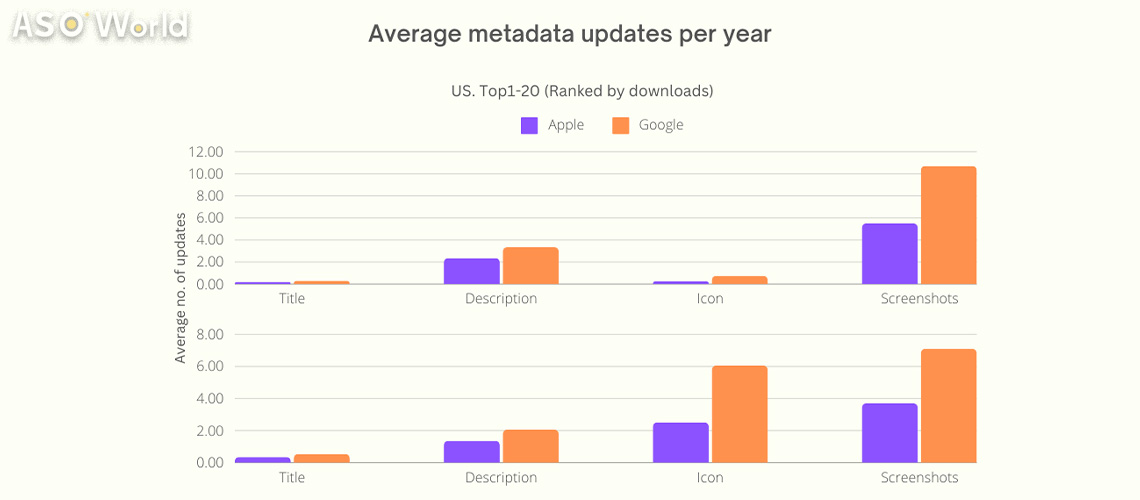
A measurable disparity exists in metadata update frequencies between the Apple App Store and Google Play. In the US market, leading applications and games execute metadata revisions more frequently on Google Play. High-ranking entities routinely modify screenshots but alter icons with less frequency than lower-ranking applications.
💡 Industry Analysis:
The Google Play algorithm and user interface facilitate more frequent iterations. The platform processes changes efficiently, and user behaviour metrics indicate a positive response to graphical modifications, specifically screenshot variations.
Which Application Categories Exhibit the Highest Screenshot Iteration?
The Graphics & Design (iOS App Store) and Photography (Google Play) classifications record the highest frequency of screenshot updates. Conversely, Travel and Food & Drink applications register the lowest modification rates.
Notably, the Dating category on Google Play yields an average of 9 screenshot deviations annually.
👉 Sector Documentation >>> ASO Strategies for Established Dating Applications on Google Play
Which Gaming Categories Command the Highest Screenshot Update Rates?
Casino and Strategy genres display the highest frequency of screenshot revisions. Trivia and Puzzle variants update more than twice as often on Google Play relative to iOS. Racing, Music, Word, and Family categories exhibit lower update frequencies on both stores, indicating a structural opportunity for developers to gain market traction through accelerated visual iteration schedules.
👉 ASOWorld Empirical Data >>> Case Study: Enhancing Visibility and Acquisition for a Mid-Tier Casino Game

Application and Game A/B Testing Disparities on Google Play
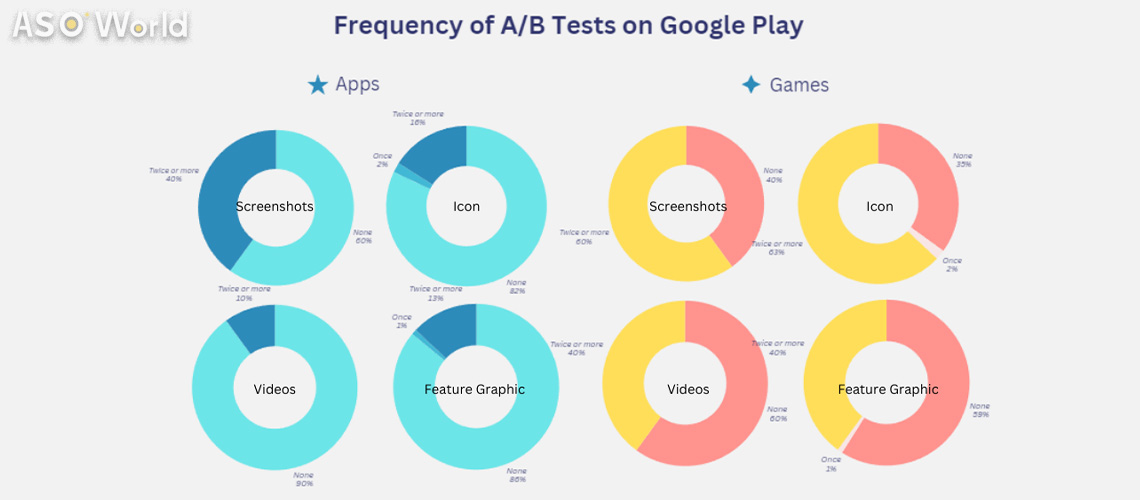
Historical data from the preceding year highlights a higher volume of A/B testing functions executed on Google Play compared to the App Store. Games implement A/B tests more frequently than utility applications, with over 60% of top-ranking games evaluating screenshot and icon assets. The statistical proportion of games initiating tests surpasses the proportion implementing final updates, suggesting that several tests yield statistically null results or are abandoned prior to deployment.
💡 Industry Analysis: Systematic A/B testing provides empirical substantiation for resource optimisation. Deploying statistically validated test outcomes is necessary to secure sustained user engagement.
Localisation Trends in Application Metadata
>>> Defining Application Localisation Matrices
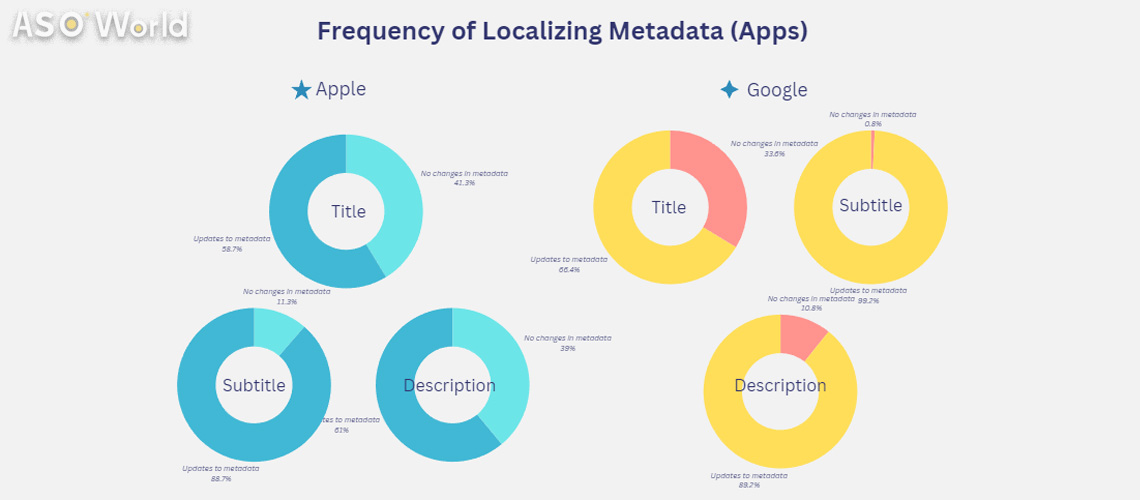
Among the top 1000 applications, 77% on the US App Store established cross-border availability in the previous year, whereas 99% achieved this metric on Google Play.
Within this parameter, 59% of iOS applications localised their titles, and 89% adapted their comprehensive descriptions. This data confirms a prevailing tendency among developers to retain primary brand titles while rigorously adapting supplementary text for specific regional cohorts.
Primary Geographic Targets for Application Localisation
The highest concentration of iOS application title localisation is recorded in Germany, followed by Japan, Spain, Mexico, and France.
App Store descriptive asset localisation is also densely concentrated in regions such as Spain, Mexico, Argentina, and France.
Localisation Trends in Game Metadata
Of the highest-ranking 1000 games isolated on the US App Store, 98% register multiregional availability. Title localisation occurs in 60% of iOS games and 72% of Google Play games respectively. Notably, short description localisation approaches totality (nearly 100%) on Google Play, contrasting against a 67% compliance rate on the App Store.
Extensive description localisation remains high across both infrastructures (87% on Apple, 96% on Google).
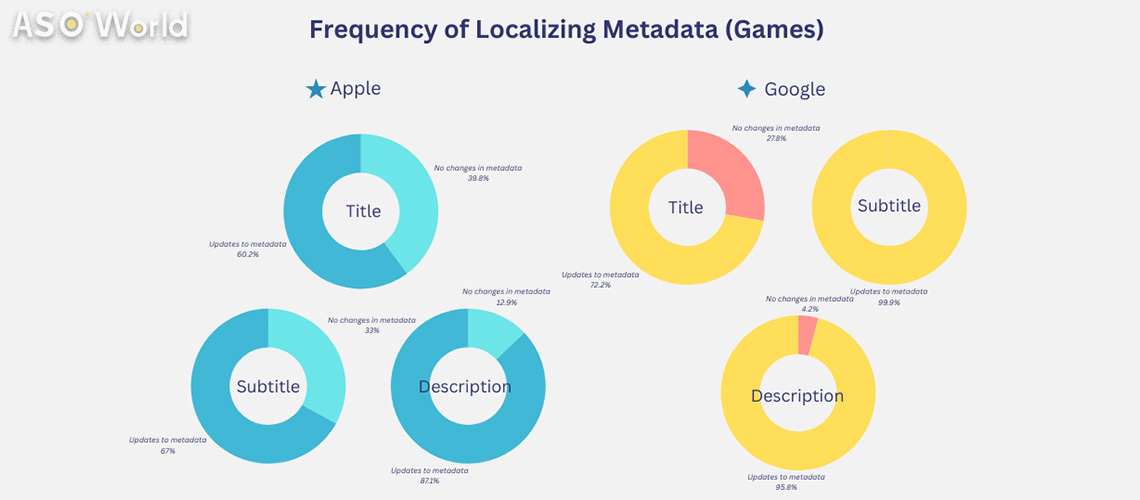
Primary Geographic Targets for Game Localisation
iOS game title localisation is predominantly aimed towards Japan, followed by Germany, Korea, and France. Description localisation on Apple's platform targets Spain, Mexico, and Argentina. On Google Play, the short description variable demonstrates mass localisation across nearly all monitored geographic jurisdictions.
💡 Industry Analysis:
Organisations observing hesitancy toward localisation implementation, stemming from linguistic barriers and foreign user behaviour variables, commonly look to external infrastructural support. ASOWorld supplies an ASO service encompassing over 100 distinct geographical territories.
Applying systematic regional tuning guarantees that targeted applications intersect with accurate demographic benchmarks, standardising scale across designated foreign markets.

Select "Learn More" to integrate your applications and games business infrastructure with ASO World's software promotional operations.
Empirical ASO Strategies: Metadata Revision Frequencies
App Store Optimisation (ASO) demands methodical iterations to sustain market viability. Quantitative observations suggest the following base parameters:
- Within the iOS App Store, standardising metadata updates every 4 weeks proves efficient in stabilising indexation trajectories.
- On Google Play, structural alterations are optimal every 6 to 8 weeks, correlating proportionately with extended algorithm indexing cycles.
- Operational consistency prevents data contamination. Isolated alterations (testing a single variable per update iteration) are strictly advised to objectively monitor variable performance differentials.
- Specific operational events, such as primary software updates or defined commercial quarters, structurally require accelerated iteration schedules.
>>> Complete methodology outlines can be accessed functionally here.

 COVID-19 UPDATE