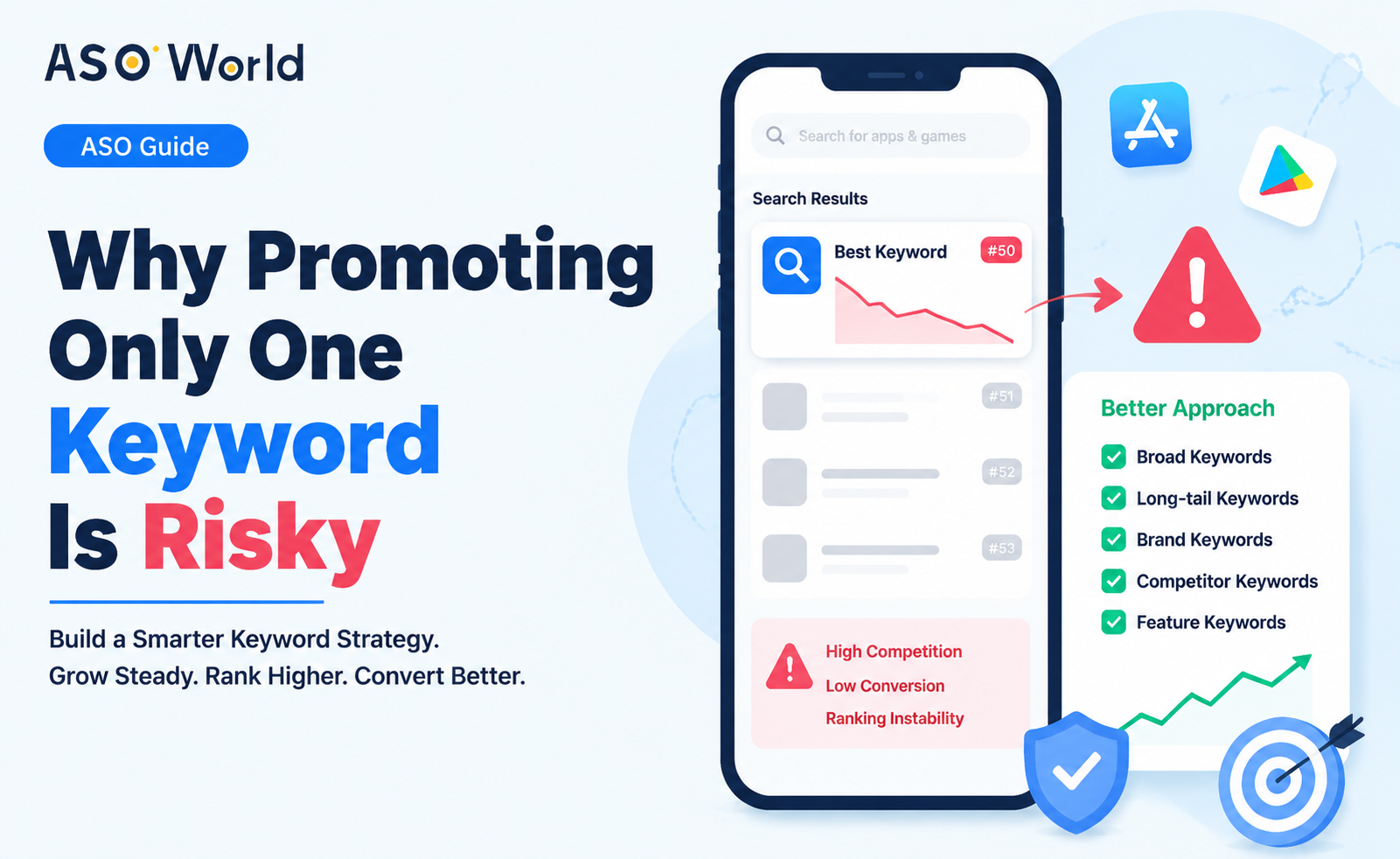
Many app developers and junior marketers begin ASO with a simple question: "Which keyword should I promote?" Budgets are tight and competition is fierce, so choosing the single term with the biggest impact seems the obvious thing to do. Yet this way of thinking often leads to a risky decision: staking everything on one keyword that simply looks best on paper.
In reality, one keyword rarely captures the full search behaviour of your target users. People on the App Store and Google Play search with different levels of awareness, urgency, language, feature needs and familiarity with a brand. A single keyword may have high search volume but weak relevance, little conversion intent, or competition too strong for a new app to break through efficiently. If you're new to keyword research, this guide on how to conduct keyword research and increase app visibility covers the basics of discovery.
Why the "One Best Keyword" Mindset Falls Short
The assumption behind targeting a single keyword is straightforward: higher search volume means more downloads. Search volume is easy to compare (a keyword with a popularity of 80 looks far more appealing than one with 25), and broad category terms feel more valuable than specific long-tail phrases.
But performance isn't decided by volume alone. Apple Ads guidance stresses relevance alongside popularity, and broader ASO practice treats optimisation as a continuing cycle rather than a one-off choice. The stores reward the fit between user intent, app relevance, ranking signals and conversion behaviour, not ambition alone.
Take a meditation app that goes after "health", for instance. People typing that could be looking for fitness tracking, diet tools, symptom checkers or hospital apps, so the intent is far too broad. A term like "sleep meditation" has lower volume but a clearer intent and stronger potential to convert. The "best" keyword isn't the one with the biggest number. It's the one your app can realistically rank for, convert from and build on.
Relying on a single keyword also concentrates your budget, expectations and learning into one path. If that keyword turns out to be too competitive, too broad or too narrow, the whole campaign suffers. Worse still, store search is dynamic: competitors update their metadata, run campaigns and respond to trends. When your entire strategy hangs on one term, any change in difficulty or pressure brings your results crashing down.
There's a measurement problem as well. Promoting one keyword teaches you almost nothing about the market. You may find out that it doesn't work, but you won't know whether the cause is a mismatch in intent, a failure of creative, ranking difficulty, localisation or product-market fit. A broader set allows comparative learning: you can see which intent groups respond, which types climb faster, and where the budget should go next.
⚡ Expert Tips
- Before investing in installs, group your candidate keywords by user intent: problem, feature, category, competitor and brand terms.
- Don't let search volume dominate the decision. Compare each keyword on relevance, current rank, difficulty and expected conversion intent.
- Use a single campaign cycle to test several opportunities, rather than forcing one keyword to carry the entire growth plan.
Thinking in Portfolios, Not Single Bets
A keyword portfolio is a structured set of terms that work together. Some reach broad category demand, others capture high-intent long-tail searches, some protect brand space or target comparison queries, and others are used for early wins because they face less competition. Together they make up a realistic ASO strategy.
This reflects how users really search. Someone typing "photo editor" isn't the same user who searches for "remove background app", "AI portrait editor" or "Canva alternative". All of them may be potential users, but they're at different stages in defining what they need. If you only promote "photo editor", you miss the specific routes where conversion is often stronger.
ASO Keywords Ranking Tools support this portfolio thinking by tracking rankings, reviewing volume, analysing competitors and surfacing suggestions. What matters isn't the tool itself but the change in mindset: data should help you design a balanced set of opportunities, not crown a single winner.
| Keyword Type |
Main Value |
Main Risk |
Best Use in ASO |
| Broad Category |
High potential for visibility |
Heavy competition, mixed intent |
Use once your app has stronger ranking and conversion signals |
| Long-Tail |
Clearer intent, lower difficulty |
Lower volume per term |
Use for early ranking gains and to test conversion |
| Feature |
Strong relevance to what the product offers |
Needs precise alignment with metadata |
Use to link demand to the app's core functions |
| Competitor |
Access to users who are comparing options |
Competitive and sensitive to conversion |
Use with care, and only when your value proposition is clearly distinct |
Building a Safer Selection Process
A safer process begins with relevance. Does the keyword describe what the app actually does, what problem it solves, or what users expect once they tap the listing? If the traffic doesn't match your screenshots, title, subtitle, description, ratings or first-time experience, ranking on its own achieves nothing.
Next, assess feasibility. New apps shouldn't rely entirely on the most competitive category head terms. Include terms where the gap between your current ranking and the top is a realistic one to close. This article on enlarging app store search traffic with keyword research and optimisation explains why research should concentrate on how users express demand, not just how marketers describe products.
Then link keywords to conversion intent. Moderate volume with strong intent often beats high volume with a poor fit. Store algorithms respond over time to conversion rate, engagement, ratings and satisfaction, not just install counts. Poorly matched promoted traffic may deliver installs in the short term without producing lasting organic growth.
Finally, spread your keywords across the stages of the campaign. Early cycles should concentrate on achievable long-tail and feature-driven terms. As ranking, conversion rate and review quality improve, gradually test broader terms. This staged approach builds momentum, rather than having you fight the hardest battle first.
Where Keyword Installs Fit In
Keyword installs strengthen the link between a specific query and an install path. Users search a term, find the app and install through that route. This supports ranking signals when used as part of a broader plan, but it's no substitute for strategy. Installs work best when the keywords have already passed checks for relevance, feasibility and intent.
Directing all your installs at one over-competitive term is wasteful. The campaign needs more volume to show any movement and may still fail to deliver an efficient organic lift. A better approach is to promote a selected set, watch how rankings shift, and reallocate according to performance. This keyword installs campaign performance guide explains how the volume you need varies with popularity, competition and your starting point.
The Keyword Installs service lets marketers bundle selected terms for unified promotion. That helps teams manage structured sets rather than treating each keyword as an isolated experiment.
Keyword installs should amplify a well-chosen portfolio. They shouldn't be used to force growth out of a single, unvalidated term.
Judging Whether Your Portfolio Is Working
Assess it against three criteria:
- Movement: Are rankings improving for the terms you selected?
- Coverage: Are more relevant keywords bringing the app into visible results?
- Conversion quality: Are the users arriving installing, engaging and leaving positive signals?
Don't judge too narrowly. One keyword may climb slowly but steadily, another may rank quickly yet bring limited traffic, and a third may generate installs but poor retention. These differences inform the next cycle. Selection becomes more effective when you treat it as a learning loop.
For new apps, the first goal is to reach visible ranking ranges for relevant terms. This article on keyword ranking acquisition and app store search traffic explains why searchable positions matter before you can expect large organic gains. Once your coverage has widened, turn your attention to improving conversion and scaling the stronger terms.
The Right Mindset
Treat the selection you make before a campaign as a matter of risk management. Instead of asking "Which keyword brings traffic?", ask "Which group gives my app the best chance to learn, rank, convert and scale?" This balances ambition with the realities of execution.
A strong strategy blends high-intent long-tail terms, relevant feature keywords, achievable category entries and a few carefully chosen competitive opportunities. Tie those choices to your metadata, screenshots, ratings and campaign goals. When all of these line up, promotion becomes part of a sustainable growth system.
Promoting only one keyword turns ASO into a lottery ticket, whereas building a portfolio turns it into a repeatable process. Once that distinction sinks in, frameworks, tools and install campaigns all become far more useful.
⚡ Expert Tips
- Draw up a shortlist of 10–30 relevant keywords before choosing what to promote.
- Sort the shortlist into priority groups rather than ranking every term from best to worst.
- Promote a balanced package, then let ranking and conversion data tell you which terms deserve more budget.
FAQs
Is it ever acceptable to promote only one keyword?
Only for very narrow tests, branded campaigns or highly specific terms with proven intent. For most growth campaigns, relying on one keyword limits what you learn and raises the risk.
How many keywords should a beginner start with?
There's no universal number, but begin with a small portfolio rather than a single term. Include relevant long-tail and feature keywords, plus a few realistic category terms based on your current ranking potential.
Search volume or relevance: which comes first?
Relevance. Volume only matters when the keyword attracts users who genuinely want your app. High volume with weak intent wastes budget and hurts efficiency.
How do keyword installs support ranking?
They strengthen ranking signals when users install via a specific search path. They work best when carefully matched to the app's value proposition and the campaign's goals.
What is the biggest mistake in selecting keywords before a campaign?
Treating it as a hunt for the one perfect keyword. Build, promote and optimise a portfolio that spreads the risk and shows your real potential for organic growth.
 COVID-19 UPDATE