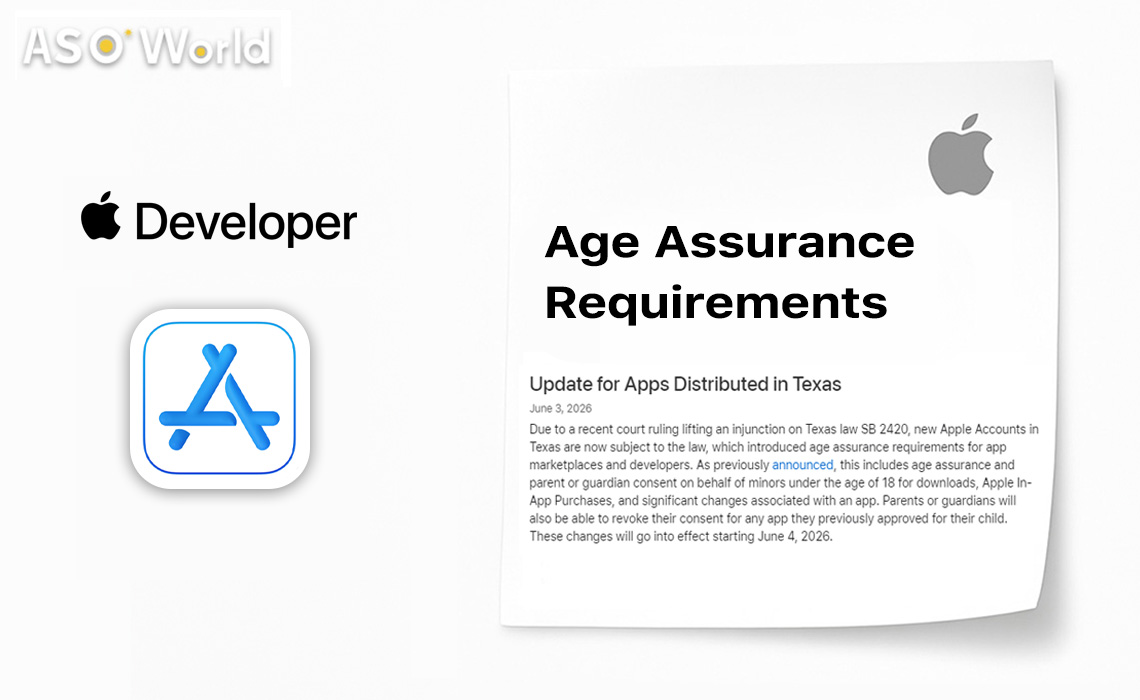
Apple has officially activated App Store age assurance for Texas Apple Accounts in response to Texas Senate Bill 2420 (SB 2420), which takes effect on June 4, 2026. The rollout follows the Fifth Circuit's decision to stay a federal injunction that had previously blocked the law, forcing Apple to switch on age-range signals, parental consent flows, and a new set of compliance APIs for every developer distributing apps to Texas users.
For app developers and growth teams, this is more than a regional regulatory headline — it's the first U.S. state-level enforcement of age assurance that materially changes how minors discover, download, and re-engage with apps. Below is a practical breakdown of what changed, what Apple now requires of you, and how to keep your conversion funnel, ASO strategy, and retention loops healthy under the new rules.
What SB 2420 Actually Requires
Texas SB 2420 (the "App Store Accountability Act") requires app marketplaces operating in the state to verify the age of account holders and obtain verifiable parental consent before a minor can download apps or make in-app purchases. Apple confirmed the changes in its official developer announcement after a federal judge's injunction was stayed by the Fifth Circuit Court of Appeals, paving the way for enforcement to begin on June 4, 2026.
In practical terms, Texas residents creating a new Apple Account must now confirm they're 18 or older. Users under 18 must be enrolled in a Family Sharing group, where a parent or guardian approves every app download, every Apple In-App Purchase, and any "significant change" to a previously approved app. Apple publicly opposed the bill on privacy grounds, warning that "SB 2420 forces users to share personally identifiable data to download any apps, even a simple app for checking weather or sports scores." That opposition aside, the company has now shipped the technical scaffolding developers need to integrate.
If you're building a global compliance roadmap, this Texas activation should be read alongside Apple's global expansion of age verification and 18+ app restrictions earlier in 2026 and the prior Texas age assurance preview — together they signal a clear trajectory: age signals are becoming a permanent fixture of the App Store stack.
The Four APIs Every Developer Needs to Know
Apple's developer note centers on four technical building blocks. Each one maps to a distinct compliance obligation and a distinct point of failure in your funnel.
| API / Framework |
Purpose |
What Developers Must Do |
| Declared Age Range API |
Retrieves the age category (child, teen, adult) for Texas Apple Accounts. |
Gate age-sensitive content, ads, and features based on the returned range — without collecting birthdays directly. |
| Significant Change API (PermissionKit) |
Notifies users when an app update introduces a "significant change" that requires re-consent. |
Define what counts as significant in your app (new data collection, new content tiers, new monetization), and trigger the prompt accordingly. |
StoreKit ageRatingCode |
Exposes a structured age-rating property for your app. |
Make sure your declared rating matches actual content and stays consistent across App Store Connect, marketing assets, and creatives. |
| App Store Server Notifications |
Server-to-server notifications when a parent or guardian revokes consent. |
Listen for revocation events, disable entitlements gracefully, and handle subscription state without breaking the user experience. |
⚡ Expert Tips
- Treat the Declared Age Range as a first-class signal. Wire it into your onboarding logic before launch day — not as a post-install patch. Apps that branch their UX based on age range will see fewer rejections and lower churn from mismatched experiences.
- Define "significant change" before your next release. Document internally which release notes trigger re-consent (e.g., a new SDK that collects location data, a new chat feature, a new monetization tier). Ambiguity here is the fastest path to a $10,000 penalty.
- Build a consent-revocation playbook. When App Store Server Notifications fire a revocation, don't silently delete user data — show a clear "parental consent withdrawn" screen, preserve recoverable state, and offer a re-consent path. This protects LTV when consent is restored down the line.
- Audit your StoreKit
ageRatingCode against your creatives. If your screenshots, preview video, or app icon imply older content than your declared rating, expect manual review delays — especially in Texas-targeted metadata.
- Sandbox-test the full minor flow. Use Apple's sandbox environment to simulate a 13-year-old in a Family Sharing group: request an app, get consent, push a "significant change" update, and finally revoke consent. The bugs you catch here are the ones your Texas users won't have to.
What This Means for ASO and User Acquisition
Compliance is table stakes; the strategic question is what happens to your install funnel. Three shifts are worth modeling right now.
1. Expect a Texas-specific conversion drag on age-restricted titles
Any title rated 12+ or higher will face additional friction: minors need parental approval before a download completes. Industry benchmarks from earlier age-assurance rollouts — notably Utah, Louisiana, and the EU — suggest conversion-rate-to-install can drop 8–20% on minor-heavy titles in the first 60 days. If Texas is a meaningful share of your U.S. installs, segment your dashboards before June 4 so you can isolate the regulatory effect from organic volatility. The May 2026 App Store & Google Play recap covers several adjacent algorithm shifts worth controlling for.
2. Age-rating accuracy is now an ASO ranking input
Misaligned age ratings have always risked rejection, but with ageRatingCode exposed via StoreKit and tied directly to download eligibility, an inflated or deflated rating now suppresses your addressable audience in a measurable way. Re-review your rating questionnaire and align it with both Apple's latest guidance and our App Store age rating developer guide.
3. Family Sharing becomes a growth surface
Because minors must be inside a Family Sharing group to install anything, products that make parental approval easy — clear "ask to buy" messaging, parent-facing previews, transparent permissions — will out-convert competitors that ignore the flow entirely. Consider building a dedicated "For Parents" section in your store listing's promotional text and screenshots, mirroring the strategy we explored in the Australia and France regional age ratings update.
SB 2420 turns age signals into a performance variable. The developers who win in Texas will be the ones who treat parental consent as a UX surface to optimize — not as a legal checkbox to clear at the last minute.
How Texas Fits Into the Global Age-Assurance Wave
Texas isn't an outlier. It's the latest beat in a 12-month sequence that includes Utah and Louisiana's developer obligations, Brazil's age-category and loot-box rules, Australia and France's regional age ratings, and the upcoming EU age verification app. The architecture is converging: a platform-issued age signal, a parental-consent layer, and a server-side revocation channel.
For multi-market apps, the most efficient strategy is to build once and configure per jurisdiction. The Declared Age Range API, PermissionKit, and App Store Server Notifications are the same primitives Apple is using to satisfy multiple regulators — so a clean implementation now pays dividends every time a new state or country flips its rules.
Compliance Timeline at a Glance
| Date |
Milestone |
Developer Action |
| Now – June 3, 2026 |
Implementation window |
Integrate the Declared Age Range API, Significant Change API, ageRatingCode, and revocation notifications. |
| June 4, 2026 |
SB 2420 enforcement begins |
All new Texas Apple Accounts subject to age assurance; minors must use Family Sharing. |
| First 30 days post-launch |
Conversion monitoring |
Segment Texas traffic; benchmark install rate, IAP rate, and revocation events. |
| Ongoing |
Significant change reviews |
Every release: determine whether the update triggers re-consent under your internal policy. |
Editor's Take
For app marketers, the temptation will be to treat SB 2420 as a legal team problem. That's the wrong frame. Age signals now sit inside the same telemetry layer as attribution, retention, and monetization — and they'll quietly reshape benchmarks for any product with a meaningful under-18 audience. The teams that come out ahead over the next 12 months will be the ones who treat compliance as a growth discipline: instrumented, A/B-tested, and continuously optimized. If you also operate on Google Play, pair this work with the Google Play v51.7 discovery and pricing update to keep your cross-platform strategy aligned.
FAQs
When does Apple's Texas age verification take effect?
Texas SB 2420 takes effect on June 4, 2026. From that date, every new Apple Account created in Texas must complete age assurance, and minors under 18 must be enrolled in a Family Sharing group with verified parental consent.
Do I need to update my app if I don't specifically target Texas users?
Yes. The App Store doesn't let you opt out of a state. If your app is available in the U.S. and a Texas user tries to download it, your app is expected to honor the Declared Age Range, parental consent, and revocation signals — regardless of your marketing focus.
What counts as a "significant change" that requires re-consent?
Apple intentionally leaves this to the developer, but common examples include adding new data collection, introducing new monetization (subscriptions, loot mechanics, ads shown to minors), enabling user-to-user communication, or unlocking content tiers above the original age rating. Document your internal definition and apply it consistently.
What happens if a parent revokes consent after a purchase?
You'll receive an App Store Server Notification indicating the revocation. Your server should disable entitlements gracefully, pause or cancel auto-renewing subscriptions per Apple's guidance, and preserve recoverable user state in case consent is restored later.
How will SB 2420 affect my conversion rate in Texas?
Expect added friction, especially for titles rated 12+ and above. Based on earlier age-assurance rollouts in Utah, Louisiana, and the EU, a measurable dip in install conversion is likely in the first 30–60 days. Segment Texas traffic in your analytics and benchmark it separately so you can tell the difference between regulatory friction and organic ASO performance.
Are the same APIs used in other jurisdictions?
Largely, yes. The Declared Age Range API, PermissionKit's Significant Change API, StoreKit ageRatingCode, and App Store Server Notifications make up Apple's reusable age-assurance stack. Implementing them well for Texas sets you up for Utah, Louisiana, the EU, Australia, France, and Brazil with minimal additional work.
What are the penalties for non-compliance?
SB 2420 authorizes civil penalties of up to $10,000 per violation, plus potential enforcement action from the Texas Attorney General. Factor in the reputational risk of being flagged as a non-compliant marketplace participant, and the cost of inaction far outweighs the engineering cost of integration.

 COVID-19 UPDATE