COVID-19 UPDATE


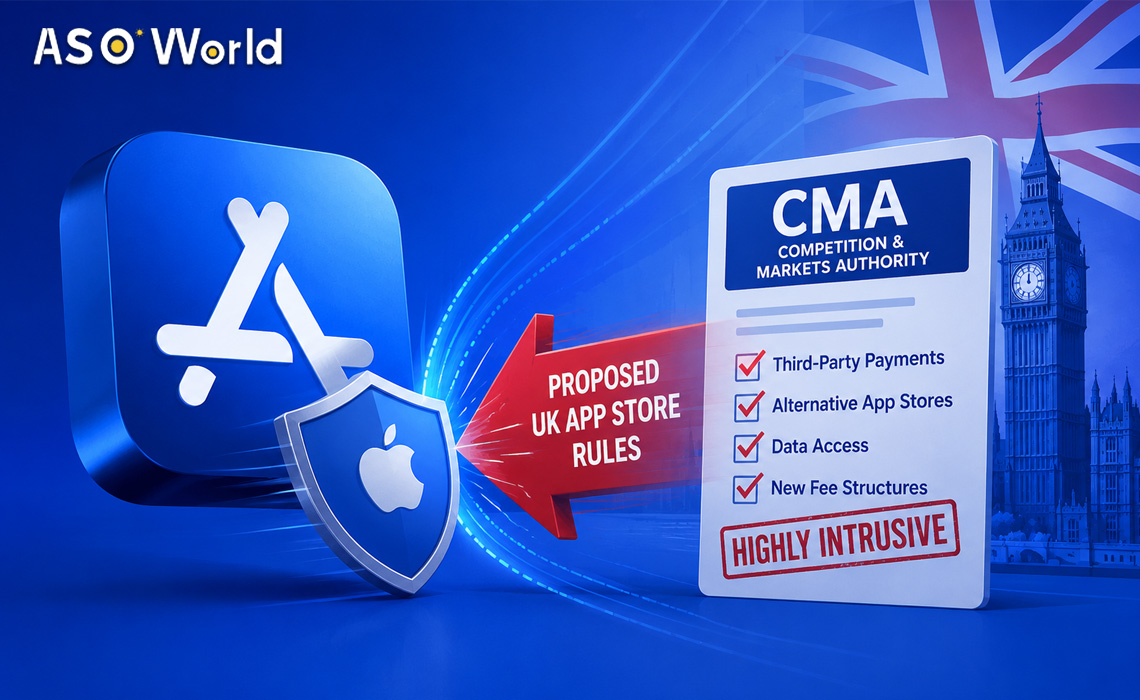
Apple has delivered its sharpest response yet to the UK’s Competition and Markets Authority (CMA), describing the regulator’s proposed App Store conduct requirements as “highly intrusive” and functionally equivalent to price regulation. For app developers, ASO teams and mobile marketers, the standoff is more than a policy story — it is a preview of the distribution, pricing and discoverability rules that may shape the next 12–24 months of the App Store.
What Just Happened
On 30 July 2026, Apple formally objected to the CMA’s package of proposed conduct measures targeting its mobile ecosystem in the United Kingdom. The company argued that the draft rules would hand regulators unprecedented authority over commercial terms, product design and platform economics.
- Regulator: UK Competition and Markets Authority (CMA)
- Target: Apple’s App Store policies, in-app payment rules and developer terms in the UK
- Apple’s framing: “Highly intrusive” — equivalent to state-level price regulation of a private platform
- Status: Consultation ongoing; final designation and conduct requirements expected later in 2026
Why This Is Different From the EU DMA Fight
App marketers have already lived through one wave of platform reform under the EU Digital Markets Act. The UK case looks similar on the surface — sideloading, alternative payment rails, steering — but the mechanics are meaningfully different:
- The CMA can tailor rules per company. Unlike the DMA’s blanket obligations, UK conduct requirements can be drafted specifically for Apple’s business model, which allows finer-grained interventions on commission rates, review policies and default settings.
- Faster feedback loop. The CMA’s Digital Markets Unit can iterate on rules without waiting for new primary legislation, meaning developer-facing terms could shift more than once a year.
- Enforcement teeth. Penalties can reach up to 10% of global turnover, giving the regulator real leverage to demand behavioural change quickly.
The practical takeaway: whatever policy pattern emerges in the UK is unlikely to stay in the UK. Historically, App Store changes forced in one major market bleed into global developer terms within a release cycle or two.
What App Developers Should Actually Prepare For
Set aside the political theatre. Based on the CMA’s published direction of travel and Apple’s counter-arguments, four operational shifts are worth planning for now:
1. Alternative Payment and External Linking Will Get Cheaper — and Messier
If the CMA forces lower “Core Technology” style fees or removes friction on external checkout links, expect a short-term revenue tailwind for subscription and high-ARPU apps — and a longer-term fragmentation of your payment stack. Finance and analytics teams should be mapping which SKUs actually benefit once Stripe, Adyen or a regional PSP is added to the mix. In many cases, the break-even point for leaving IAP is higher than founders expect.
2. Search Ads and Default Settings Are the Real Battleground
The most consequential CMA proposals are not about payments — they are about defaults, choice screens and ranking transparency. If Apple is required to expose more of how App Store search and Today tab curation works, ASO strategy shifts from guessing signals to auditing them. Keyword relevance, conversion rate and metadata hygiene remain the levers, but the diagnostic surface will widen.
3. Sideloading and Alternative Marketplaces May Land in the UK
Apple’s pushback tacitly acknowledges that some form of third-party distribution is on the table. For most consumer apps, alternative stores will not move the needle. For gaming, adult, crypto and emulation categories — historically constrained by App Store review — a UK-permitted marketplace could open a new acquisition channel with different creative rules and lower take rates.
4. Review Timelines and Policy Enforcement Could Tighten
Under regulatory scrutiny, platforms tend to enforce existing rules more consistently rather than loosen them. Expect stricter reviews around subscription disclosures, data collection notices, AI-generated content labelling and price-scam patterns. Rebuild your submission checklist accordingly.
The ASO Angle: What Changes on the Store
For App Store Optimisation teams specifically, three things are worth tracking:
- Metadata visibility: If the CMA mandates more transparency on ranking, expect richer developer-facing analytics and, eventually, more contested keyword real estate.
- Custom Product Pages and CPI economics: Any change to Apple Search Ads auction rules or to external-link creative could reshape blended CPI. Test CPPs against off-store landing pages before the rules are finalised, so you have a baseline.
- Regional divergence: Your UK store listing may soon behave differently from your US or JP listing. A/B testing frameworks that assume global uniformity will need per-market variants.
Apple’s Argument, In Plain English
Apple’s core message to the CMA is not “leave us alone.” It is “you are regulating price, and price regulation on a private platform sets a precedent that spreads.” That framing is deliberate — it invites pushback from other governments who dislike the CMA setting the template, and it plants the argument Apple will use in future US and EU proceedings.
For developers, the subtext matters: Apple is signalling it will fight hardest on commission economics and concede more readily on surface-level UX changes like choice screens. Plan your monetisation roadmap with that priority in mind.
Key Dates to Watch
- Q3 2026: CMA consultation responses closing; expect published summaries from Apple, major developers and trade bodies.
- Q4 2026: Final conduct requirements likely designated for iOS and the App Store in the UK.
- H1 2027: First compliance deadlines; the earliest window for observable changes to UK App Store behaviour.
The Bottom Line for App Marketers
The Apple–CMA fight is not just a regulatory headline. It is a leading indicator for where App Store distribution, pricing and discoverability are heading globally. Teams that treat it as background noise will be reacting to store changes in 2027. Teams that model the scenarios now — alternative payments, choice screens, region-specific ASO, tighter reviews — will be ready to move on day one.
Whatever the CMA finalises, the direction is clear: the App Store of 2027 will be less uniform, more transparent and more contested than the one you optimise for today.
Frequently Asked Questions
What did Apple say about the UK CMA App Store rules?
Apple called the CMA’s proposed conduct requirements “highly intrusive” and argued they amount to price regulation of a private platform, on 30 July 2026.
How is this different from the EU Digital Markets Act?
The UK CMA can tailor rules specifically to Apple, iterate faster without new legislation, and impose fines of up to 10% of global turnover. That makes UK rules more targeted and potentially faster-moving than the DMA.
What should app developers do right now?
Model the revenue impact of alternative payment providers, audit your UK store listing separately from other markets, tighten submission compliance for subscriptions and AI content, and prepare A/B testing frameworks that support per-market variants.
Will these rules affect App Store Optimisation?
Yes. Any mandated transparency on App Store search ranking, Search Ads auctions or default settings will change how ASO teams diagnose keyword and conversion performance in the UK — and likely globally afterwards.