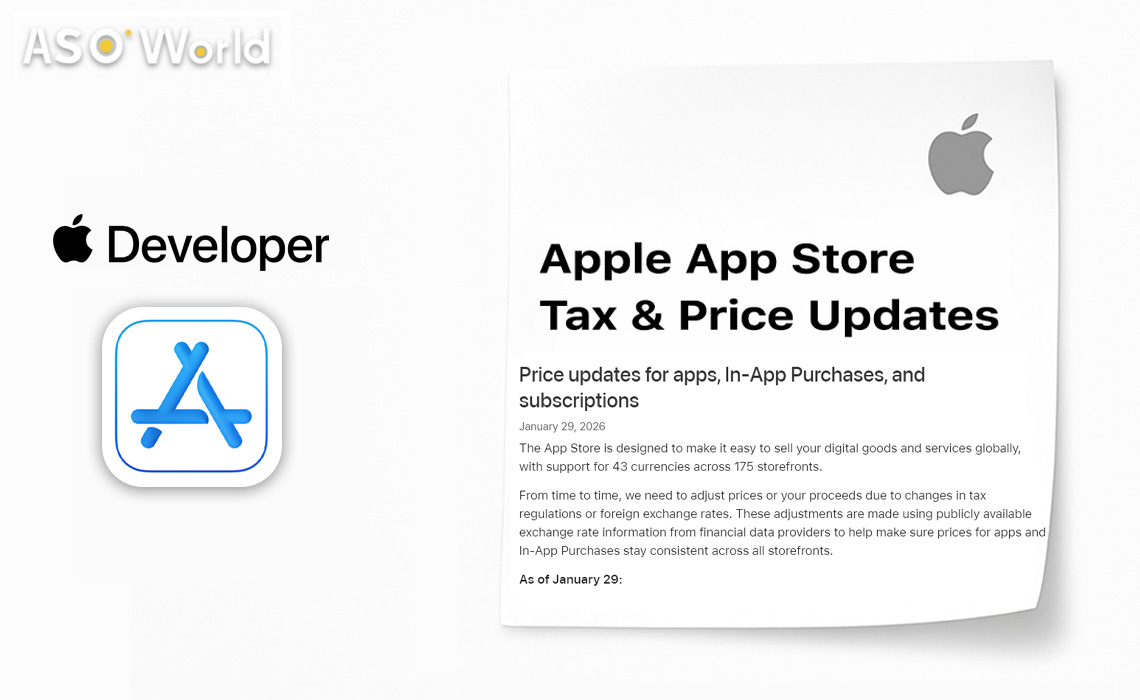
Apple has confirmed forthcoming amendments to the App Store's automated price equalisation mechanism, prompted by shifting tax and currency conditions across markets worldwide. The revision, affecting both applications and in-app purchases, is intended to preserve price consistency while meeting local tax obligations in numerous territories.
Summary of the App Store Pricing Revision
Apple's worldwide storefront presently covers 175 markets and 43 currencies, drawing on publicly accessible exchange rate and tax information to keep user pricing uniform. The newest adjustment relates directly to fresh and revised tax rates in nine countries, necessitating matching changes to developers' proceeds and app prices.
Principal Countries and Modifications
Fresh taxes introduced:
- Bhutan: 5% goods and services tax (GST)
- Mauritius: 15% value-added tax (VAT)
Increased existing rates:
- Kazakhstan: VAT up from 12% to 16%
- Russia: VAT up from 20% to 22%
- Zimbabwe: VAT adjusted from 15% to 15.5%
Reduced or removed taxes:
- Finland & Lithuania: Lower VAT on news, books, magazines, and audiobooks
- Ghana: Removal of the COVID-19 Health Recovery Levy
- Türkiye: Digital services tax reduced from 7.5% to 5%
These changes will affect developer proceeds from qualifying app and in-app sales from this cycle onward.
Policy and Agreement Revisions
Apple will amend its Paid Applications Agreement to incorporate new tax collection and remittance duties for Bhutan and Mauritius. This brings developer contracts into line with local government requirements and ensures full adherence to the new regimes.
In Mauritius, further changes are scheduled for mid-to-late February:
- If Mauritius is not set as the developer's base storefront, Apple will adjust local prices to reflect the new VAT, maintaining balance across other regions.
- If Mauritius is the base storefront, prices there remain stable, with corresponding adjustments elsewhere.
Significantly, auto-renewable subscriptions will not be affected, retaining their existing price levels. Developers who set their pricing manually outside Apple's automated equalisation will also see no changes.
What Developers Should Do Next
Adapting Pricing and Marketing Strategies
With these tax-related changes, developers should review their regional pricing tiers and analyse how the new VAT adjustments could influence local purchasing power and conversion rates. Countries experiencing price increases, such as Russia and Kazakhstan, may see temporary dips in purchase frequency, while regions with lower taxes (e.g., Türkiye and Ghana) may present new opportunities for pricing optimisation or promotional campaigns.
From an ASO (App Store Optimisation) perspective, developers should:
- Update app descriptions and promotional messages to align with potential pricing shifts, especially for seasonal or freemium apps.
- Reassess keyword strategies in emerging markets like Mauritius and Bhutan, which are gaining greater App Store infrastructure integration.
- Monitor user feedback and conversion data in App Store Connect to evaluate whether new price points are affecting engagement or retention.
Additionally, marketing teams can leverage this transition period to test localised offers, bundle promotions, and subscription models that better reflect new market conditions.
Implementation and Developer Access
Apple has already updated App Store Connect to display the new and upcoming price modifications in the Pricing and Availability section.
Additionally, translated versions of the revised agreements will be published on the Apple Developer Website over the next few weeks, ensuring all impacted regions have clear compliance guidance.
Editor's Comments
Apple's pricing adjustments illustrate the increasing complexity of managing digital distribution across rapidly changing fiscal landscapes. By leveraging automated equalisation and timely tax data, Apple continues to uphold consistent global pricing—minimising regional disparities while protecting developer earnings.
For developers and marketers, this serves as both a challenge and opportunity. The key to sustaining growth lies in adaptive ASO, localised pricing sensitivity, and real-time response to tax-driven price movements. As global regulations evolve, aligning pricing strategies with market data will be an essential competitive advantage for visibility and revenue stability.
 COVID-19 UPDATE